


Nothing stalls a research project faster than scrolling endlessly through database portals trying to pin down an original thesis angle. When figuring out how to find research gaps quickly, the major hurdle is realizing that academic breakthroughs rarely come from waiting for a random flash of inspiration. Original ideas are hiding in plain sight within existing literature, meaning specific reading strategies are required to uncover the questions previous scholars left unanswered.
This guide explains how to skip the time-consuming background reading and head straight for the analytical blind spots in your field. Developing these targeted filtering habits will make it easy to accelerate dissertation topic discovery and isolate missing variables in seconds. These frameworks are designed to pinpoint specific data shortages so you can confidently establish authentic research justifications and build a highly defensible foundation for your assignments.
How to Find Research Gaps Quickly
The journey toward an original dissertation topic often begins with an overwhelming amount of background reading. However, uncovering how to find research gaps quickly does not mean memorizing every textbook in the library. True efficiency relies on treating existing literature as a roadmap that points directly to its own missing pieces. Authors explicitly state what they could not resolve, what data sets they could not access, and what populations they failed to test. Navigating straight to these hidden disclosure points turns a massive wall of text into a fast, highly targeted source of unmapped research opportunities.
1. Extracting Disclosed Flaws From Recent Review Papers
The fastest way to scan an entire field is to ignore individual case studies initially and focus exclusively on systematic literature reviews or meta-analyses published within the last twenty-four months.
- The synthesis advantage: Review papers look at dozens of independent projects at once. Instead of revealing a single blind spot, they outline the collective shortcomings, data shortages, and ongoing arguments defining the entire field.
- The location strategy: Skipping the historical background and heading straight for sections titled “Future Directions,” “Open Challenges,” or “Avenues for Further Study” bypasses hours of unnecessary reading.
- The thematic harvest: These concluding paragraphs serve as a list of pre-verified, faculty-approved research openings that are ready to be used to anchor a new project.
How to harvest pre-verified thesis topics in minutes
- Search an institutional database using your main topic keywords combined with the phrase “systematic literature review.”
- Filter the publication date settings to display only documents produced within the last two years.
- Scroll past the introductory chapters and jump straight to the “Future Work” or “Discussion” sections at the end.
- Note the core conceptual problems that the authors state remain unresolved across the wider industry.
2. Auditing Methodological and Geographic Boundaries
A research gap does not always mean a completely untouched topic. Often, a gap exists because an established theory has only been tested under highly specific conditions or using limited tools.
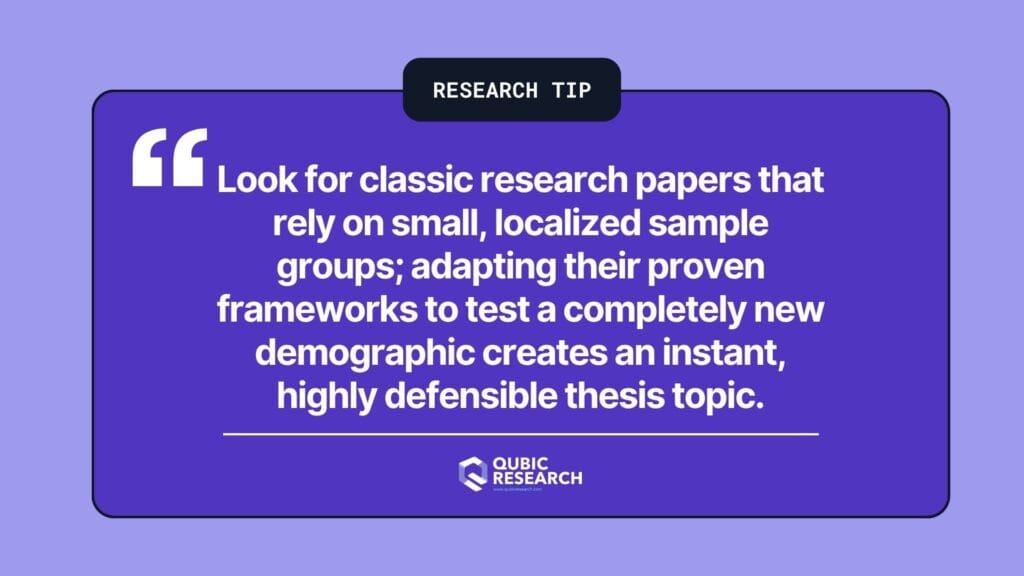
- Population and regional limits: Many highly cited studies rely on narrow demographics, such as data gathered exclusively from urban areas or specific corporate environments. Testing these same frameworks in a new setting creates an instant research contribution.
- Technological obsolescence: Older foundational studies frequently rely on outdated data collection metrics or manual tracking tools. Re-evaluating those classic frameworks using modern automated systems provides an excellent academic justification.
- Sample size expansions: Identifying where dominant conclusions are based on tiny, localized focus groups opens the door for a larger, quantitative verification project.
How to locate data boundaries across existing studies
- Select three influential papers addressing your target research question and locate their methodology chapters.
- Identify the exact parameters of their sample groups, noting geographic regions, age brackets, or industry types.
- Check the specific software tools or data metrics the researchers used to capture their primary numbers.
- Look for narrow sample traits that can be expanded or updated to fit a fresh, unmapped demographic.
3. Spotting Conflicts in a Master Tracking Matrix
Arranging independent reference files into a side-by-side tracking spreadsheet often reveals major disagreements that are invisible when reading papers one by one.
- Mapping the contradictions: Sorting a synthesis matrix by methodology or outcome makes it easy to see where different research teams clash over the same basic question.
- Investigating the friction: These contradictions usually point to hidden variables that neither side has accounted for, such as timing differences or contrasting definitions.
- Stepping into the debate: Designing a project specifically to resolve a clear contradiction between two leading scholars provides an incredibly strong academic angle.
- Open your master research spreadsheet and log the primary outcomes of ten independent studies.
- Sort the results column to group papers showing positive outcomes separately from those showing negative trends.
- Compare the differing research environments, data timelines, and sampling frameworks of those two groups.
- Formulate a fresh research question that investigates the exact reason behind those conflicting data points.
4. Identifying Theory-Practice Gaps in Real-World Data
Some of the most compelling research opportunities appear when established textbook theories fail to match actual, day-to-day conditions in a live industry.
- The execution barrier: Academic frameworks are often built using idealized, controlled scenarios. When businesses or practitioners try to apply those models in the real world, unexpected issues frequently emerge.
- Tracking industry complaints: Reviewing current trade journals, industry whitepapers, and professional forum debates highlights where practitioners are struggling with traditional academic methods.
- Formulating the resolution: Investigating why a popular academic model fails when applied under real-world constraints creates a highly practical piece of scholarship.
How to locate practical industry contradictions
- Read the dominant theoretical model described in your course textbooks or syllabus materials.
- Search industry news portals, trade blogs, or professional forums to see how practitioners apply that model.
- Identify the common complications or systemic complaints raised by professionals working in the field.
- Design a research project that analyzes why the academic model breaks down when exposed to real-world variables.
Final Thoughts on How to Find Research Gaps Quickly
Uncovering an original dissertation topic does not require reading through every text file in the library archive. When figuring out how to find research gaps quickly, the structural evidence proves that high-value opportunities are hidden inside the limitations, boundary conditions, and future work sections of current systematic reviews. Relying on passive, line-by-line reading only leads to mental exhaustion and repetitive topic choices.
Protecting your academic timeline means targeting the explicit blind spots disclosed by previous scholars, mapping methodological boundaries across a tracking matrix, and looking for where textbook theories clash with actual industry data. Taking complete control over this critical filtering phase turns existing studies into a clear roadmap that points straight to a unique, highly defensible thesis angle.
Best AI Prompts for Literature Review
If you want to know how to use structured role-priming and explicit command layout boundaries to isolate data variables automatically, read my comprehensive guide on best AI prompts for literature review preparation to optimize your study workflow.
Frequently Asked Questions
Why is skipping directly to recent systematic review papers the fastest way to map a field?
Systematic review papers are highly efficient because they analyze dozens of separate projects simultaneously. Instead of highlighting a single limitation, they outline the collective data shortages, ongoing debates, and unresolved challenges across the entire industry, providing a ready-made list of pre-verified research gaps.
What is a geographic or demographic research gap, and how can it anchor a new thesis?
A demographic gap appears when an established theoretical model has only been tested within a narrow population segment, such as a single urban area or specific corporate group. Re-evaluating that proven framework within an unmapped region or age bracket creates an immediate, highly defensible academic contribution.
A tracking matrix helps uncover gaps by sorting independent studies by methodology or outcome. Arranging data this way makes it easy to see where different research teams disagree on the same basic question, pointing to hidden variables or timing differences that need to be resolved.
What does a theory-practice gap mean, and where can researchers look to locate one?
A theory-practice gap occurs when an idealized textbook framework fails to match real-world operational conditions. Researchers can find these gaps by checking industry trade journals, whitepapers, and professional forums, which highlight where practitioners face issues with traditional academic methods.
Can classic foundational studies from a decade ago still yield valid research gaps today?
Yes, classic foundational studies can still yield valid research gaps if their frameworks rely on outdated data collection metrics or manual tracking tools. Re-evaluating those classic conclusions using modern automated systems or contemporary data standards provides an excellent justification for a new project.