

If you are looking for the best Google Scholar alternatives in 2026, you are likely running into the same limitations: incomplete results, weak filtering, and difficulty accessing full-text papers. While Google Scholar is useful for quick searches, it is not designed for deep academic research, systematic reviews, or citation analysis. This is where specialised academic search engines and research databases outperform it.
From AI-powered discovery tools like Semantic Scholar to large-scale indexing platforms such as Dimensions and Scopus, modern research tools offer far more precision, better filtering, and stronger access to full-text content. In this guide, we will explore the top Google Scholar alternatives to help you find better sources, save time, and improve your research workflow.
Google Scholar vs Alternatives (Quick Comparison)
Before choosing a research tool, it is important to understand how Google Scholar compares to specialised academic databases. While it offers broad coverage, alternative platforms provide better accuracy, filtering, and access to structured research data.
| Feature | Google Scholar | Alternatives (e.g. Scopus, Dimensions) |
|---|---|---|
| Accuracy | Mixed (includes non-peer-reviewed content) | High (curated and peer-reviewed sources) |
| Coverage | Very broad but inconsistent indexing | Structured and discipline-specific databases |
| Open Access | Limited direct access | Higher availability via CORE, BASE, OpenAIRE |
| Best Use Case | Quick searches and general discovery | Systematic reviews, citation analysis, advanced research |
Why Use Google Scholar Alternatives?
While Google Scholar is incredibly accessible, it often lacks the precision required for systematic reviews and professional academic evaluation. Advanced researchers often find that what is available on the interface is not sufficient for tracking complex citation networks or filtering by specific funding bodies. Using alternative databases allows you to access curated datasets that prioritise quality and peer-reviewed status over pure search volume.
Quick Summary: Top Google Scholar Alternatives at a Glance
If you are trying to choose the best Google Scholar alternative for your needs, the key is to match the platform to your specific research goal. Some tools are better for systematic reviews, while others excel at open-access discovery or AI-powered summaries. The table below helps you quickly identify which platform to use based on your use case.
| Alternative | Primary Discipline | Best Use Case |
|---|---|---|
| Dimensions | Multidisciplinary | Analysing citation networks, funding data, and research trends |
| Scinapse | Multidisciplinary | Quickly finding highly relevant papers using AI search |
| Semantic Scholar | Multidisciplinary | Understanding papers fast with AI summaries and key insights |
| Europe PMC | Life Sciences | Biomedical research with linked datasets and grant information |
| IEEE Xplore | Engineering / CS | Engineering and computer science papers, especially standards |
| JSTOR | Humanities / Arts | Historical and humanities research with deep archives |
| BASE | Multidisciplinary | Finding free open-access papers across global repositories |
| CORE | Multidisciplinary | Accessing full-text open-access research without paywalls |
| Scopus | Multidisciplinary | Systematic reviews and citation analysis with high-quality data |
| PubMed | Medical / Health | Medical and life sciences research using structured indexing |
| ERIC | Education | Education research, teaching methods, and policy studies |
| SSRN | Social Sciences / Law | Early-stage research and working papers in social sciences |
| arXiv | Physics / Maths / CS | Cutting-edge preprints in physics, maths, and computer science |
| ResearchGate | Multidisciplinary | Requesting full-text papers and connecting with authors |
| OpenAIRE | EU Research focus | Exploring EU-funded research with linked datasets and outputs |
How We Selected These Google Scholar Alternatives
To identify the best Google Scholar alternatives in 2026, we evaluated each platform based on the factors that matter most for academic research quality and efficiency.
- Database Size: The total number of indexed papers, datasets, and research outputs available on the platform.
- Indexing Quality: Whether the database prioritises peer-reviewed content and maintains clean, structured metadata.
- Open Access Availability: The ability to access full-text papers without paywalls or institutional subscriptions.
- Citation Tracking: Tools for analysing references, citation counts, and research impact.
- AI Capabilities: Features such as automated summaries, relevance ranking, and concept extraction.
This methodology ensures that each platform listed in this guide offers practical value for researchers, students, and professionals looking for more than basic keyword search.
Best Google Scholar Alternatives for All Disciplines
1. Dimensions
Dimensions is a strong Google Scholar alternative because it offers far more than standard publication searches. It connects over 130 million research papers with datasets, patents, clinical trials, and grant information. This makes it especially valuable for researchers who need a broader view of the research landscape or who are exploring funding opportunities. 
- Discipline: Multidisciplinary
- Provider: Digital Science
- Coverage: 130+ million publications
- Key Features: Abstracts, Related articles, References, Cited by, and Links to full text.
- Export formats: BibTeX, RIS, EndNote
- Best used when: You need to analyse the full research landscape, including grants, patents, and citation networks across multiple disciplines.
- Limitation: Some advanced analytics features may require institutional access or subscription.
2. Scinapse
Scinapse is a helpful alternative because it uses AI to deliver highly relevant search results while giving access to more than 250 million papers across a wide range of disciplines. Its combination of intelligent search and broad coverage makes it a convenient tool for quickly finding reliable academic literature. 
- Discipline: Multidisciplinary
- Provider: Pluto Network
- Coverage: 250+ million papers
- Key Features: AI-driven relevance, Related articles, and Full-text links.
- Export formats: APA, MLA, BibTeX
- Best used when: You want fast, highly relevant results powered by AI without manually filtering large datasets.
- Limitation: Less detailed citation analytics compared to platforms like Scopus or Dimensions.
3. Semantic Scholar
Semantic Scholar stands out as a powerful alternative thanks to its AI-driven search features, which highlight influential papers and key concepts. Its machine learning approach helps users quickly find meaningful and impactful research in any field. 
- Discipline: Multidisciplinary
- Provider: Allen Institute for AI
- Coverage: Approx. 40 million articles
- Key Features: AI summaries, Influential citation tracking, and Highly relevant results.
- Export formats: APA, MLA, Chicago, BibTeX
- Best used when: You want quick insights into papers through AI-generated summaries and influential citation indicators.
- Limitation: Coverage is strong but not as comprehensive as larger indexing databases.
Specialised Databases for Specific Fields
4. Europe PMC
Europe PMC is a strong alternative for life sciences researchers because it connects scientific literature with related data, grants, and preprints. Maintained by EMBL-EBI, it offers a broader research ecosystem than many standard databases. 
- Discipline: Biomedical and Life Sciences
- Coverage: 41+ million documents
- Export formats: RIS, BibTeX, EndNote
- Best used when: You are conducting biomedical or life sciences research that requires links to datasets, grants, and preprints.
- Limitation: Limited relevance outside life sciences and biomedical fields.
5. IEEE Xplore
IEEE Xplore is highly effective for engineering and computer science research, offering access to more than 5 million technical papers, conference proceedings, and industry standards. 
- Discipline: Engineering, Computer Science, Technology
- Coverage: 5+ million documents
- Export formats: RIS, BibTeX, EndNote
- Best used when: You need authoritative engineering and computer science papers, especially conference proceedings and standards.
- Limitation: Most full-text content requires institutional or paid access.
6. JSTOR
JSTOR is a reliable choice for researchers in the humanities, arts, and social sciences, offering access to a deep archive of more than 12 million academic sources. 
- Discipline: Humanities, Social Sciences, Arts
- Coverage: 12+ million academic resources
- Export formats: MLA, APA, Chicago, RIS
- Best used when: You are researching humanities or social sciences topics that require historical depth and archived journals.
- Limitation: Limited access to recent publications without subscription.
Top Alternatives for Open-Access Research
7. BASE (Bielefeld Academic Search Engine)
BASE is a massive aggregator that provides more than 300 million documents from repositories around the world. It is excellent for finding research that is not hidden behind paywalls. 
- Provider: Bielefeld University Library
- Coverage: 300+ million documents
- Key Feature: Massive open-access focus.
- Best used when: You want to find free, open-access research papers from repositories worldwide.
- Limitation: Search results can vary in quality due to aggregated sources.
8. CORE
CORE aggregates more than 260 million articles from global repositories. Its commitment to free, unrestricted scholarship makes it a primary tool for researchers on a budget. 
- Provider: The Open University / Jisc
- Coverage: 260+ million articles
- Export formats: BibTeX
- Best used when: You need reliable access to open-access full-text articles without institutional login.
- Limitation: Limited advanced filtering compared to premium databases.
Additional Google Scholar Alternatives for All Disciplines
9. Scopus
Scopus is a powerful Google Scholar alternative because it offers one of the most reliable collections of peer-reviewed research across science, technology, medicine, and social sciences. It indexes journals, conference papers, and patents while providing advanced filtering tools and detailed citation tracking. This makes it easy for researchers to analyse impact and follow citation networks. 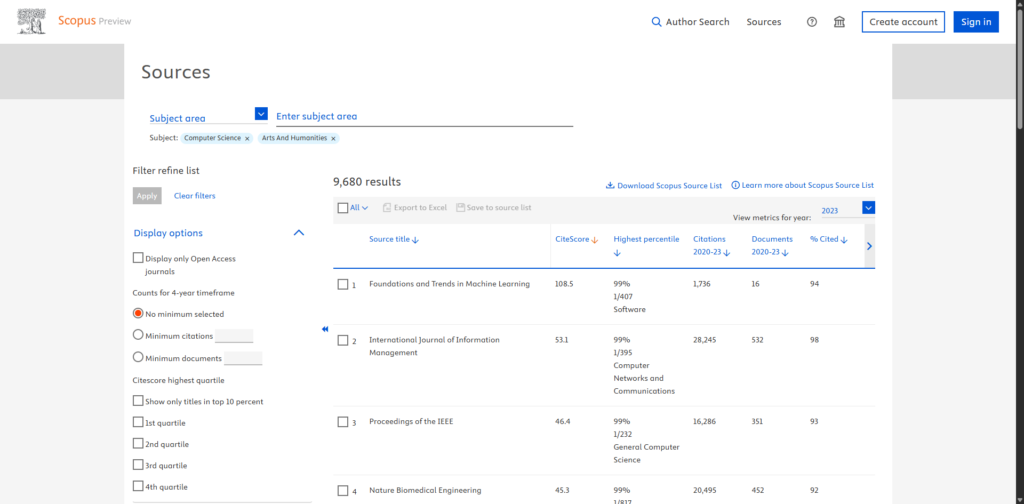
- Discipline: Multidisciplinary
- Provider: Elsevier
- Coverage: 90+ million articles
- Key Features: Advanced analytics, h-index tracking, and peer-reviewed filters.
- Export formats: RIS, BibTeX, EndNote, CSV
- Best used when: You are conducting formal academic research that requires accurate citation tracking and peer-reviewed sources.
- Limitation: Requires institutional subscription for full access.
More Specialised Databases for Specific Fields
10. PubMed
PubMed is a vital resource for anyone working in biomedical and life sciences. It provides access to a vast, authoritative collection of over 36 million citations maintained by the U.S. National Library of Medicine. It offers detailed abstracts, related article suggestions, and links to full-text papers when available through PubMed Central (PMC). 
- Discipline: Medical and Life Sciences
- Provider: U.S. National Library of Medicine
- Coverage: 36+ million citations
- Key Features: MeSH (Medical Subject Headings) indexing and high-quality peer-reviewed data.
- Export formats: MEDLINE, XML, BibTeX
- Best used when: You are working in medicine or life sciences and need authoritative, curated research with structured indexing.
- Limitation: Focused strictly on biomedical fields.
11. ERIC
ERIC is an excellent choice for education researchers because it specialises entirely in teaching, learning, and policy-related literature. With over 1.6 million indexed items, ERIC offers focused coverage and government-backed indexing, making it a reliable source for high-quality, education-specific research. 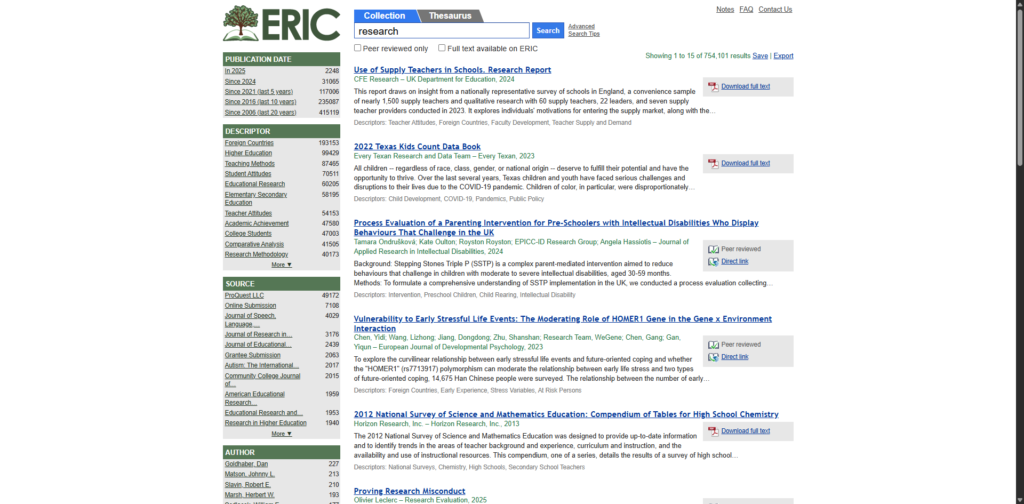
- Discipline: Education
- Provider: Institute of Education Sciences (U.S.)
- Coverage: 1.6+ million items
- Key Features: Specialised education filters and policy documents.
- Export formats: RIS, BibTeX
- Best used when: You are researching education topics, policies, or teaching methodologies.
- Limitation: Narrow focus limited to education-related content.
SSRN is a strong alternative for anyone working in social sciences, economics, law, and business. It focuses on early-stage research and working papers that often appear long before journal publication. Its emphasis on preprints makes it ideal for staying ahead of new theoretical developments. 
- Discipline: Social Sciences, Economics, Law, Business
- Provider: Elsevier
- Coverage: 1.2+ million papers
- Key Features: Immediate access to “working papers” and emerging ideas.
- Export formats: APA, MLA, Chicago, RIS
- Best used when: You want early access to working papers and emerging ideas in social sciences, law, and economics.
- Limitation: Many papers are not yet peer-reviewed.
Other High-Impact Open-Access Alternatives
13. arXiv
arXiv is a foundational tool for researchers in physics, mathematics, and computer science. It provides immediate access to new preprints long before they are published in traditional journals. It remains one of the best sources for accessing cutting-edge scientific research without paywalls. 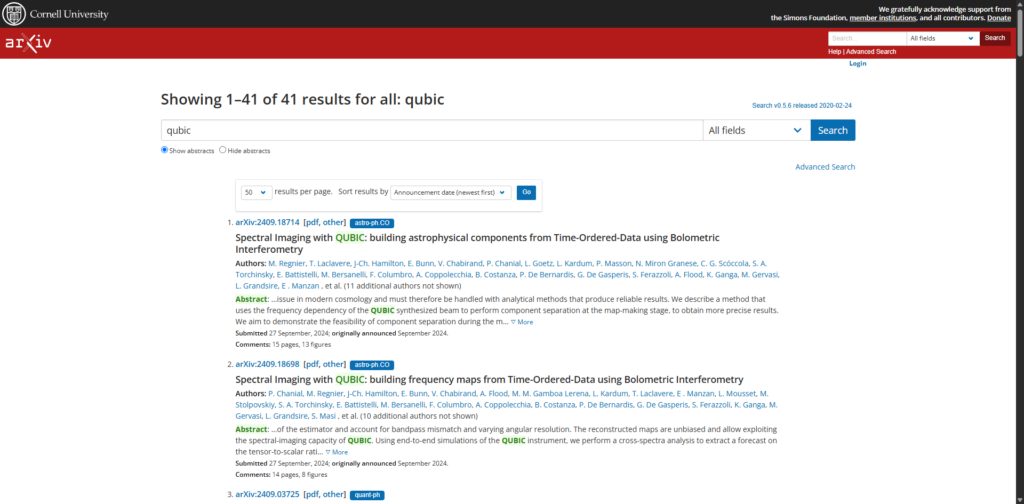
- Discipline: Physics, Mathematics, Computer Science
- Provider: Cornell University Library
- Coverage: 2+ million preprints
- Key Feature: Rapid dissemination of new scientific findings.
- Export formats: BibTeX
- Best used when: You want immediate access to cutting-edge research before formal journal publication.
- Limitation: Content is not peer-reviewed at the time of publication.
14. ResearchGate
ResearchGate is a practical Google Scholar alternative because it combines research access with social networking. It allows users to connect directly with authors and request full texts that may not be available elsewhere. Its community-driven approach makes it useful for collaboration and accessing hard-to-find papers. 
- Discipline: Multidisciplinary
- Coverage: 135+ million publication entries
- Key Features: Author interaction and direct full-text requests.
- Export formats: RIS, BibTeX
- Best used when: You want to connect with researchers and request full-text papers directly from authors.
- Limitation: Content availability depends on author uploads and permissions.
15. OpenAIRE
OpenAIRE is an essential resource for researchers who prioritise open access and want to explore publications connected with related outputs such as datasets and software. As an EU-supported initiative, it focuses on transparency and linking different research outputs. 
- Discipline: Multidisciplinary (EU-funded research focus)
- Provider: OpenAIRE (EU initiative)
- Coverage: 100+ million research outputs
- Key Feature: Strong focus on interconnected datasets and open science.
- Export formats: BibTeX
- Best used when: You want to explore EU-funded research linked with datasets, software, and open science outputs.
- Limitation: Stronger focus on European research initiatives.
Actionable Tips for Using Multiple Research Platforms
Navigating academic research in 2026 requires a multi-faceted approach. By diversifying the tools you use, you can build a more efficient and insightful research workflow.
1. Use Specialised Databases First
Do not start every search on a broad platform. If you are in medical research, use PubMed. For law and business, use SSRN. This ensures that the results you see are already curated for your specific field of study.
2. Focus on Open-Access Sites to Save Costs
Platforms like arXiv, OpenAIRE, and CORE offer free access to millions of papers. This is especially helpful if you do not have institutional access to expensive paid journals.
3. Keep Your Citations Organised
Whether you use Google Scholar or an alternative, always use a reference manager like Zotero or Mendeley. These tools allow you to save time on formatting and collaborate with your research team more effectively.
Conclusion
While Google Scholar is a go-to for many researchers, it is definitely not your only option. The alternatives explored in this guide offer more advanced features, better access to full-text articles, and improved search filters. Whether you are a student, academic, or independent researcher, using a combination of these tools will help you find better sources and strengthen your academic work.
Ready to master Google Scholar for your research?
Finding the right alternative is helpful, but mastering the primary tools is essential for a successful literature review. Explore our comprehensive guide on How to Use Google Scholar for Research to fully optimise your academic workflow.
Frequently Asked Questions
What is the best free alternative to Google Scholar?
Semantic Scholar and Dimensions are considered the best free alternatives. They offer AI-powered insights and broader data connections that go beyond standard search results.
Is Scopus better than Google Scholar?
Scopus is generally more reliable for formal academic evaluation because it only indexes peer-reviewed content. However, it requires a paid subscription, whereas Google Scholar is free.
Can I find free papers on these alternatives?
Yes, platforms like BASE, CORE, and arXiv are specifically designed to provide access to open-source and free research papers.
Do these platforms support citation exports?
Most of these alternatives support standard export formats such as BibTeX, RIS, and EndNote, making them compatible with all major reference managers.