


Unriddle AI is an AI-powered research workspace designed to help academic researchers read, interrogate, organize, and write from scholarly sources with less friction and more traceability. It tackles a problem that most graduate students and research staff recognize immediately: it is increasingly easy to collect a large corpus of papers, and increasingly difficult to convert that corpus into defensible claims, structured notes, and coherent draft text without losing track of what supports what. The cost is not only time. The cost is confidence, because the weakest point in many workflows is the chain of evidence between a statement in a draft and the specific passage, table, or appendix that warrants it.
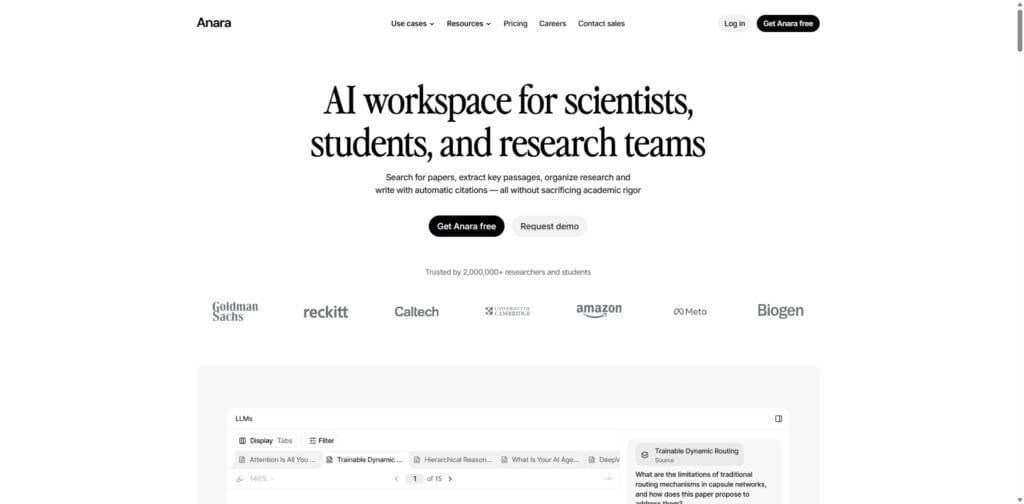
One clarification upfront, because it affects what you will see online: Unriddle AI has been rebranded as Anara, and current product information is published at anara.com. In many research communities, however, the tool is still commonly referred to as Unriddle AI in conversations, older reviews, and shared lab notes. For clarity, this article uses Unriddle AI when discussing the workflow concept that many readers first encountered, and it uses Anara when referring to the current name and official materials.
What matters most is not the label. What matters is whether this kind of system can accelerate reading and synthesis while preserving the standards that make academic work credible: careful qualification, transparent sourcing, and the ability to verify claims quickly.
What Unriddle AI is in practical terms
Unriddle AI is a research workflow tool that lets you build a project library of documents, ask natural-language questions over that library, and receive structured responses that are intended to stay anchored to the underlying material through links to specific passages. In day-to-day terms, it is a way to treat your reading corpus as a queryable knowledge base rather than a stack of PDFs you must re-skim every time you forget a detail.
This emphasis on “anchored to the material” is the key point. Many tools can generate fluent summaries. The reason researchers reach for Unriddle AI is usually more specific: they want to locate evidence quickly, compare claims across papers, extract methods details consistently, and keep the verification step close at hand.
A good way to position Unriddle AI is as a bridge between reading and writing. It sits in the zone where you move from raw sources to structured understanding, then from structured understanding to draft prose.
Why research teams are adopting AI workspaces now
The current research environment amplifies three pressures.
The literature is expanding faster than individual attention
Across many fields, the pace of preprints, conference proceedings, and incremental variants of established methods has increased. Even in disciplines with slower publication cycles, the sheer availability of related work has grown.
Research artifacts are more complex
Modern papers often include supplementary materials, code, preregistration documents, and dataset documentation. Reading “the paper” frequently means reading a bundle.
Collaboration demands speed without sacrificing auditability
When a lab is writing a grant, preparing a rebuttal, or onboarding a new student, decisions must be made quickly. At the same time, senior researchers rightly expect junior colleagues to justify claims precisely.
Unriddle AI is attractive in this context because it promises to reduce the time cost of two expensive activities: retrieving the relevant passage and comparing multiple sources while keeping provenance visible.
Core capabilities of Unriddle AI, and what they mean for rigor
Different readers will care about different features, but the research value tends to cluster around a few capabilities that affect epistemic discipline.
Building a library that supports retrieval
Unriddle AI is most useful when you treat your corpus as a deliberately curated library. That means you import papers, reports, and notes into a workspace that you can search and query. The practical benefit is that you can stop relying on memory, desktop folder structures, or ad hoc naming conventions as your primary retrieval method.
From a rigor standpoint, a library-first approach makes it easier to keep a clean boundary around what you are claiming. You can ask, “Does my corpus support this statement,” and you can answer that question without leaving the workspace.
Asking questions that target methods, assumptions, and limitations
Researchers rarely need a generic summary. They need targeted extraction.
Unriddle AI is typically used to ask questions such as:
What is the operational definition of the central construct?
What is the sample, and what is the sampling frame?
What is the identification strategy, and what assumptions does it require?
Which robustness checks are included, and what do they imply?
Where do the authors describe limitations or threats to validity?
These questions are not trivial. They often require reading across multiple sections. Unriddle AI can accelerate the navigation, but the scholar still must evaluate whether the extracted material is interpreted correctly.
Linking answers back to evidence for verification
A tool becomes academically useful when it shortens the distance between an answer and the original text. Unriddle AI is often evaluated on whether it makes verification easy: you should be able to jump directly from a claim to the passage that supports it.
In a graduate workflow, verification is not optional. It is the mechanism that turns an AI-assisted process into a defensible process.
Supporting writing as a downstream activity
Once notes and evidence links exist, Unriddle AI can assist with outlining and drafting. The responsible use pattern is to treat it as a composition aid, not a claim generator. You want help with structure, flow, and clarity, while keeping the responsibility for claims and citations with the researcher.
How Unriddle AI fits with your existing toolchain
Many researchers already have a stable stack: a reference manager, a PDF reader, a note system, and a writing environment. The question is not whether Unriddle AI replaces these tools. The question is where it reduces friction without introducing new failure modes.
Reference managers
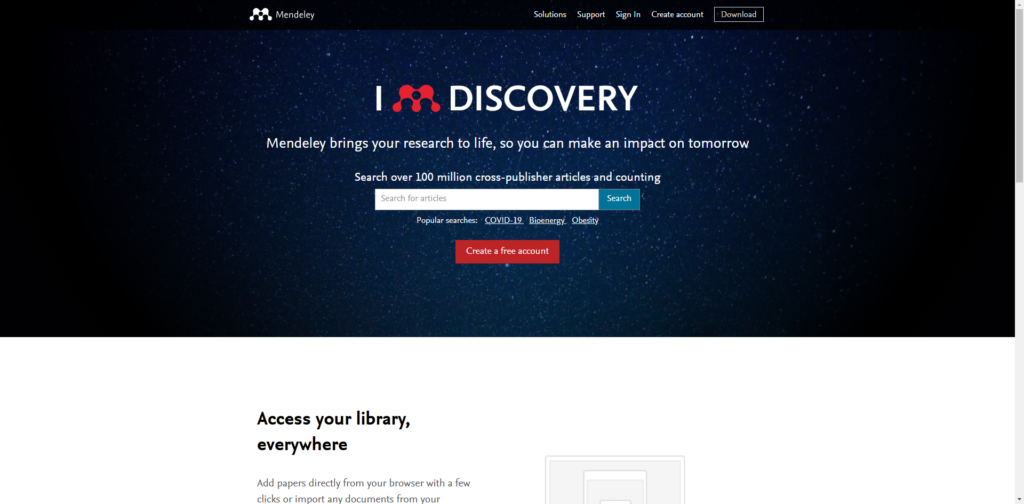
Reference managers remain important for bibliographic organization and citation formatting. Unriddle AI can complement them by improving passage-level retrieval and cross-document querying.
A practical integration approach is to store authoritative citation records in your reference manager, while using Unriddle AI for reading, extraction, and evidence-linked notes.
Note systems
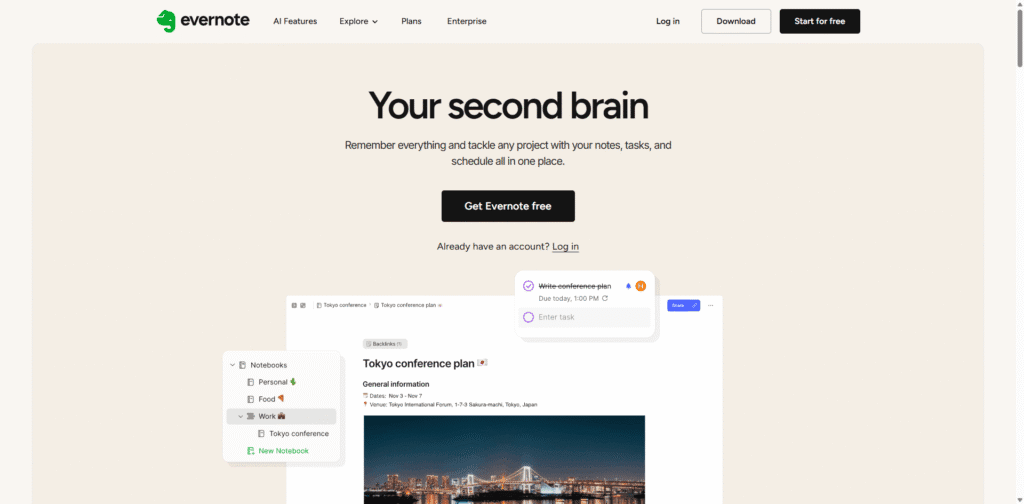
If you use a knowledge base or lab notebook system, consider whether you want Unriddle AI to be your primary reading note store or a front-end that produces structured outputs you then copy into a canonical system.
A common compromise is to use Unriddle AI for extraction matrices and project-specific notes, then move final distilled claims into a durable note system after verification.
Writing environments
Writing remains a separate discipline. The best results typically occur when Unriddle AI outputs feed an outline, and the researcher writes the argument with explicit attention to logic, scope, and qualification.
If you treat Unriddle AI as a replacement for scholarly reasoning, you will likely produce text that sounds plausible but fails under committee-level scrutiny.
A literature review workflow with Unriddle AI that survives scrutiny
If you are doing graduate research, you need a workflow that is not only fast, but also defensible. The following approach uses Unriddle AI as a structured reading accelerator while preserving auditability.
Triage: separate relevance from novelty
Start by using Unriddle AI to quickly answer: “What is this paper actually doing, and is it in scope?” Ask constrained questions that force specificity:
What is the research question?
What data or experimental system is used?
What is the main contribution relative to prior work?
Your goal is not to write a summary. Your goal is to decide whether deeper reading is warranted.
Extraction: standardize what you pull from each paper
Once a paper is in scope, use a stable extraction script. For example:
Construct definitions and measurement
Sample characteristics and inclusion criteria
Analytic methods and model choices
Key results, including effect directions and uncertainties
Limitations and threats to validity
Unriddle AI can help you find each of these elements quickly, but you should still confirm interpretations, especially for methods and statistical claims.
Cross-paper synthesis: ask comparative questions explicitly
Synthesis is where many literature reviews become impressionistic. Unriddle AI is most valuable when you ask questions that require mapping differences:
How do operational definitions vary across studies?
Which outcomes are common, and which are idiosyncratic?
Where do findings conflict, and what design choices might explain it?
Which limitations appear repeatedly, indicating a field-level constraint?
Comparative questioning helps you avoid the trap of writing a chain of paper-by-paper summaries. It pushes you toward claims about patterns, clusters, and disagreements.
Drafting: separate composition from evidentiary claims
When you move into writing, use Unriddle AI to generate outlines, section transitions, and alternative phrasings of your own ideas. Treat it as an editor and organizer.
For evidentiary claims, keep a strict rule: every empirical assertion should be tied to a passage you can verify. Unriddle AI can help you locate that passage quickly, but you are responsible for confirming that the passage actually warrants the statement in your draft.
Practical prompting for graduate-level work in Unriddle AI
Prompting, in this context, is simply asking better research questions. The strongest results come from prompts that specify what kind of output you need and what constraints matter.

Use constrained questions rather than broad ones
A broad prompt invites generic prose. A constrained prompt invites targeted retrieval.
Less effective: “Summarize the paper.”
More effective: “Identify the primary outcome, how it is measured, and the main threats to internal validity discussed by the authors.”
Request structure that matches your research task
If you are building an extraction matrix, request a consistent schema:
Definition
Measure
Sample
Method
Result
Limitation
Notes for comparability
Using Unriddle AI this way reduces the inconsistency that accumulates when you extract manually over weeks.
Ask for contrasts and boundary conditions
Research credibility is often about boundaries. Ask prompts such as:
“Under what conditions do the authors claim the result holds?”
“What would falsify the interpretation offered?”
“Which alternative explanations are acknowledged, and how are they tested?”
These prompts shift the tool away from promotional summarization and toward critical reading support.
Force attention to uncertainty
Where relevant, ask the system to identify uncertainty markers: confidence intervals, sensitivity analyses, robustness checks, and acknowledged measurement limitations. Then verify them directly.
Unriddle AI is useful when it helps you locate these elements quickly. It is not useful if it encourages you to speak more confidently than the paper does.
Mini case studies: realistic uses of Unriddle AI in academic life
Abstract descriptions are less persuasive than scenarios. Here are three ways Unriddle AI can change a workflow when used with discipline.
Case study 1: A systematic review extraction matrix
A doctoral student is conducting a systematic review with a large included set. The standard failure mode is uneven extraction quality: early papers receive detailed notes, later papers receive rushed summaries, and the final synthesis relies on memory.
With Unriddle AI, the student can apply the same extraction script to every paper, then populate a matrix. The tool helps the student locate inclusion criteria, outcome definitions, and limitations quickly. The key is that the student verifies every extracted statistic before it enters the matrix. Over time, the matrix becomes the authoritative artifact, and Unriddle AI becomes a navigational aid that keeps extraction consistent.
Case study 2: Methods replication and implementation details
A graduate student is replicating a published method, but the paper’s implementation details are scattered across the main text, supplement, and code documentation. The student uses Unriddle AI to ask: “Where is the preprocessing described,” “What hyperparameters are specified,” and “What ablation results are reported.” The tool accelerates retrieval, but the student still must implement carefully and may discover that some details are underspecified.
In this case, Unriddle AI reduces the time spent searching. It does not eliminate the need for judgment about what is missing, ambiguous, or inconsistent.
Case study 3: Preparing for a lab meeting outside your subfield
A postdoctoral researcher is assigned a paper outside their immediate expertise for a lab meeting. The goal is to understand the question, the method, and the weakest link in the argument.
Unriddle AI can support this by producing a structured breakdown of the research question, dataset or experimental design, main result, and stated limitations. The researcher then uses the evidence links to validate what they plan to present. The final outcome is not a perfect summary. It is a set of credible discussion points and two or three genuinely informed questions for the group.
Anara (formerly Unriddle)
If you encounter Unriddle AI and Anara in the same week, you are not alone. Anara is the current name for the product that many researchers still refer to as Unriddle AI. In practice, the workflow concept remains the same: a research workspace for importing sources, querying them, and moving from evidence to notes to writing with traceability.
When you read product pages, onboarding guides, or feature announcements, you will increasingly see the Anara name. When you talk to colleagues, you may still hear Unriddle AI, especially in labs that adopted the tool earlier or shared internal training materials that have not been updated.
For researchers, the practical takeaway is simple: treat the naming shift as a labeling change rather than a conceptual shift. The relevant question remains whether the workspace supports your method of doing careful reading and synthesis.
FAQ: Is Unriddle AI the same as Anara?
In functional terms, yes, Unriddle AI and Anara refer to the same product lineage. Unriddle AI is the earlier name that remains common in conversation and search behavior, while Anara is the current branding and home for official product information.
If you are evaluating the tool for a lab or department, the safest approach is to focus on capabilities and governance: how it handles document ingestion, evidence linking, collaboration, and data sensitivity. Names change more often than core workflow requirements.
Limitations and failure modes you should assume
Even when Unriddle AI performs well, predictable risks remain. Recognizing them is part of responsible use.
Table and statistics misreads
AI systems can misinterpret tables, confuse model specifications, or miss conditional language. A statement can be directionally correct but technically wrong, which is often worse than being obviously wrong.
Mitigation: verify numeric claims and statistical interpretations directly in the source, especially if they will appear in your writing or your talk.
Over-smoothing disagreement into false consensus
When asked “What does the literature say,” a system may present a tidy synthesis that hides heterogeneity. Research fields rarely behave that neatly.
Mitigation: ask explicitly for disagreements, competing explanations, and differences in design. Then verify.
Missing caveats and boundary conditions
Many papers place important qualifications in less prominent locations: appendices, limitations sections, or a sentence that begins with “However.” Unriddle AI can still miss these if your prompt does not request them.
Mitigation: always ask for limitations and threats to validity as part of extraction, and do not accept an answer that lacks them.
Corpus dependence and ingestion quality
If your PDFs are poorly scanned, missing pages, or have complex layouts, retrieval may degrade. If your corpus is incomplete, the tool cannot correct that.
Mitigation: curate deliberately, confirm document completeness, and keep a clear boundary between what you have imported and what you have not.
Research ethics, privacy, and governance for labs and graduate programs
Adopting Unriddle AI in a research setting raises practical governance questions that go beyond personal productivity.
Sensitive and unpublished materials
Many projects involve unpublished manuscripts, embargoed results, proprietary datasets, or human subjects content. Uploading such materials into any external system requires caution.
Mitigation: establish a lab policy. Decide what is allowed, what requires approval, and what is prohibited. Coordinate with institutional guidelines when applicable.
Different disciplines treat AI assistance differently. Even when AI use is permitted, transparency expectations may apply, especially when the tool contributes to drafting.
Mitigation: keep a record of how Unriddle AI was used, and follow the norms and policies relevant to your department, venue, or funder.
Reproducibility and audit trails
If a claim in a paper or thesis depends on a synthesis step, you should be able to reconstruct how you arrived there. AI-assisted steps can complicate this if outputs are not stored or if the verification trail is not preserved.
Mitigation: treat evidence-linked notes as the durable artifact. Store the passages and the final verified claim in your own words.
Team consistency
If some lab members use Unriddle AI heavily and others do not, extraction styles and evidence standards can diverge.
Mitigation: define shared practices, including a standard extraction script and a verification expectation for any statement that will enter a draft.
Common misconceptions about Unriddle AI
“If it provides citations, it cannot be wrong”
Evidence links reduce the cost of checking. They do not guarantee correctness. A system can cite a relevant passage while still drawing an incorrect inference from it.
“Using it means I am not doing real scholarship”
Scholarship is not measured by time spent searching within PDFs. It is measured by judgment, conceptual clarity, methodological care, and the ability to defend claims. Used responsibly, Unriddle AI reallocates effort from mechanical retrieval to intellectual evaluation.
“It replaces my reference manager”
Unriddle AI can support passage-level retrieval and synthesis, but reference managers remain valuable for bibliographic control and citation formatting. Many strong workflows use both.
“It is only for literature reviews”
Literature review is a common entry point, but Unriddle AI can also support replication work, lab onboarding, grant background sections, and interdisciplinary translation.
Key Takeaways
Unriddle AI is best used as an evidence navigation and synthesis workspace, not as an authority.
The tool has been rebranded as Anara, and official materials are now hosted at anara.com, while the Unriddle AI name remains common in research conversations.
Constrained, methods-oriented questions produce more reliable outputs than broad “summarize” prompts.
Verification is the workflow step that protects rigor, especially for tables, statistics, and causal claims.
The most defensible pattern is to use Unriddle AI for retrieval, extraction, and structure, then write verified claims in your own words.
Labs should address governance early, especially for sensitive, unpublished, or human-subjects-related materials.
Conclusion: next steps and further directions for careful use
Unriddle AI reflects a broader shift in research practice: moving from linear reading and scattered notes toward interactive interrogation of a curated corpus, with verification built into the workflow. For graduate researchers, the value is not simply speed. The value is a tighter loop between questions, evidence, and writing, which can make literature work more systematic and less dependent on fragile memory.
If you want to evaluate Unriddle AI in a way that respects academic standards, run a bounded pilot. Choose a real project, import a representative set of sources, and apply a standardized extraction script for one week. Track two outcomes: time saved and the frequency of corrections discovered during verification. If you see meaningful time savings without a rise in correction burden, expand gradually and formalize lab norms.
For deeper conceptual grounding, focus your further reading in three areas. First, evidence synthesis methods in your discipline, since they define what “good” synthesis looks like. Second, guidance on responsible AI use in academic writing, since norms vary by field and venue. Third, the general idea of retrieval-augmented question answering, since it clarifies why source linking helps, and also why it does not eliminate the need for careful human judgment.
Used with discipline, Unriddle AI can help you spend less time searching and more time thinking, which is the allocation that most research projects need.