

I have completely understood the appeal of using advanced tools to polish a rough draft, but many researchers do not realize how easily automated tools can spot machine polishing. If you have ever wondered, can universities detect ChatGPT editing, the short answer is an absolute yes. While you might think you are simply fixing grammar or improving clarity, modern university submission portals are fine-tuned to flag the exact, low-entropy syntactic patterns that artificial models leave behind when they touch your research paper.
This guide outlines the precise ways academic institutions spot algorithmic prose changes and how you can preserve your authentic voice. My goal is to help you move past the anxiety of submitting a processed manuscript by showing you how to prevent AI editing flags before they go to your department. I will explain how to spot the specific structural footprints left by generative tools so you can confidently maintain your original writing voice and navigate institutional compliance metrics without setting off any unexpected alerts.
Can Universities Detect ChatGPT Editing
When you use generative platforms to sharpen a rough draft, it is easy to assume you are just performing a high-tech grammar check. However, understanding if universities can detect ChatGPT editing requires realizing that AI tools do not write like human editors. Instead of polishing your work naturally, software reconfigures your text using predictable mathematical sequences. Modern university scanning platforms are explicitly built to identify these structural adjustments, converting your well-meaning edits into standard academic misconduct warnings.
1. Flagging the Uniformity of Stylistic Flattening
The primary reason submission engines catch machine revisions is a phenomenon called stylistic flattening. Every student has a unique writing voice marked by inconsistent punctuation choices, casual transitions, and varying sentence dynamics, all of which disappear after artificial processing.
- Linguistic homogenization: Artificial intelligence homogenizes text by stripping out individual phrasing quirks and replacing them with perfectly uniform, standard corporate structures.
- My Experience: I regularly analyze flagged reports where a student’s initial paragraph used complex, personalized syntax, but the subsequent sections suddenly shifted into the ultra-clean, sterile tone characteristic of machine output.
- Detection outcome: This sudden change in structural complexity creates an immediate alert on the professor’s evaluation dashboard, making it obvious that an external processor altered the text.
How scanning engines isolate flattened prose
- The software establishes a stylistic baseline by evaluating your document’s overall vocabulary choices and syntactic rhythm.
- It isolates specific sections where your natural sentence variations suddenly convert into uniform, equal lengths.
- The program flags paragraphs that display an unnatural lack of minor human errors, such as missing commas or uneven phrasing.
- It calculates an overall probability score based on how closely the text mirrors a standard, pre-programmed language template.
2. Monitoring Document Telemetry and Data Modification Flags
Modern institutional software platforms like Turnitin do not just evaluate the final words on your page. The backend portals track advanced behavioral telemetry, analyzing exactly how a student interacts with the submission screen over time.
- Telemetry tracking: Updated evaluation systems monitor background indicators, specifically looking for low modification logs and pasted text flags.
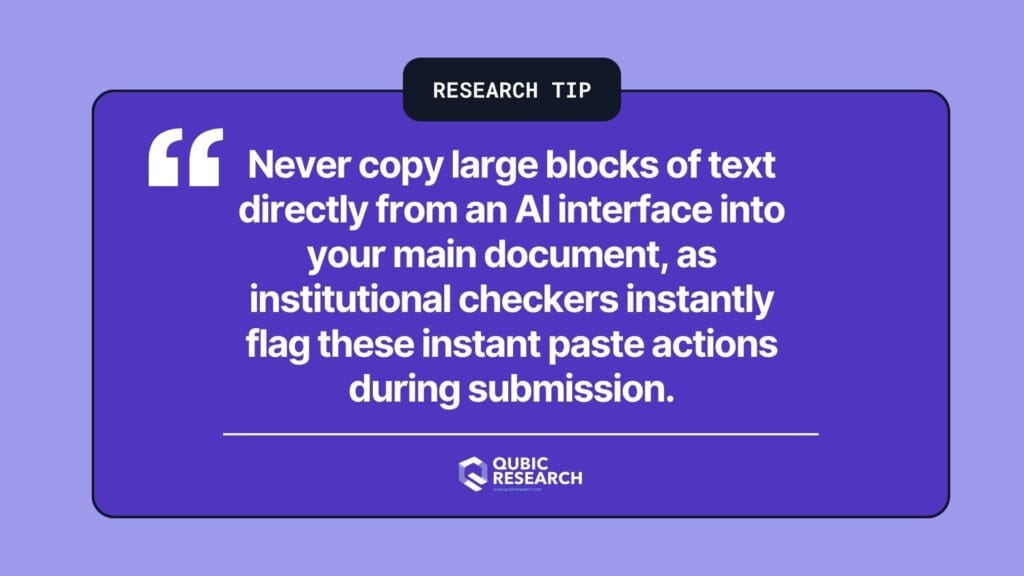
- My Experience: Attempting to prevent AI editing flags by copying a massive block of text out of a chat terminal and dropping it into your document instantly registers as an automated paste event on modern university dashboards.
- The data footprint: Writing a document naturally produces a chaotic path of keystrokes, pauses, and backspaces, whereas pasting an AI-polished section creates an instantaneous block insertion with zero typing time.
Managing your digital writing footprint safely
- Compose your research paper entirely within your active cloud document space to maintain an unbroker track of manual keystrokes.
- Never use copy-and-paste functions to move large blocks of revised text directly from an AI chat box into your main draft.
- If you use an AI prompt to brainstorm a sentence structure, manually type out the words yourself to keep your low modification flags clean.
- Ensure your version history timeline displays a continuous, multi-hour progression of typing rather than a series of bulk text dumps.
3. Tracking Hyper-Predictable Transitional Patterns
Large language models rely heavily on highly specific, repetitive transition words to connect disparate ideas. These conversational signposts act as an immediate digital signature for modern evaluation software.
- Lexical predictability: Algorithms look for a heavy concentration of specific introductory markers like “moreover,” “furthermore,” “delve,” and “it is crucial to consider.”
- My Experience: I have watched otherwise solid papers fail compliance checks simply because a student used an AI tool to polish their transitions, introducing low perplexity patterns that software easily uncovers.
- Algorithmic triggers: Because human writers rarely use these formal transition phrases with such rigid, predictable frequency, their clustering tells the scanner that a machine edited the text.
Removing robotic linguistic indicators from your draft
- Open your document and use the search function to locate overused AI terms like “delve,” “testament,” “moreover,” or “furthermore.”
- Delete those formal, machine-favored vocabulary words and replace them with simpler, direct alternatives like “and,” “also,” or “but.”
- Vary the placement of your transitional words, occasionally placing them in the middle of a clause rather than always at the beginning.
- Read your work aloud to ensure the narrative voice flows with the casual, uneven rhythm of authentic human speech.
4. Executing Manual Style Comparisons Against Past Submissions
The final layer of modern institutional verification does not rely on software metrics at all. Professors possess a deep, intuitive understanding of their students’ structural limits and language profiles based on prior classroom interactions.
- Comparative analysis: Faculty members routinely cross-reference a suspicious assignment with your previous essays, exam papers, and in-class writing exercises.
- My Experience: If a student who normally struggles with complex English syntax suddenly submits a flawless paper filled with advanced passive voice constructions, the professor will immediately investigate, regardless of the software score.
- The human audit: This manual review overrides any automated percentage, meaning you must maintain your original writing voice throughout the term to protect your credibility.
Aligning your polished papers with your personal writing profile
- Review two or three of your previous, successfully graded assignments to analyze your typical vocabulary choices and sentence structures.
- Compare your new, edited draft against that baseline to ensure it still sounds like your personal voice rather than an external textbook.
- If an automated editing tool suggests a highly complex sentence structure, simplify the vocabulary to match your typical academic level.
- Be fully prepared to explain the exact definitions of any advanced terminology used in your paper if your instructor requests an oral review.
Final Thoughts on Can Universities Detect ChatGPT Editing
I believe that utilizing digital resources to refine your academic work is a natural extension of modern scholarship, but relying blindly on generative processors can easily compromise your hard-earned research. When evaluating if universities can detect ChatGPT editing, the reality is that submission portals are specifically optimized to flag the flat, low-entropy structures left behind by AI rewriters. By focusing on maintaining your stylistic flaws, protecting your typing logs, and tracking structural variance, you can keep your writing authentic and robust. Ultimately, your personal scholarly voice is your greatest academic asset—do not let an automated linguistic model smooth it away into an institutional compliance issue.
Worried that automated systems might still misinterpret your unique writing style?
If you are concerned that your natural phrasing choices closely resemble predictable patterns, you can actively protect your work from algorithmic bias. Read my complete guide on how to reduce AI detection in academic writing to master formatting adjustments that prevent false integrity flags.
Frequently Asked Questions
Can Turnitin distinguish between an essay written by AI and one edited by ChatGPT?
Turnitin generally cannot distinguish whether a document was fully generated from a blank prompt or deeply edited by a machine. Because both processes inject the same predictable mathematical rhythms, uniform sentence lengths, and specific transitional sequences, the evaluation platform flags the text under a single AI probability threshold.
Is using ChatGPT to fix minor grammar mistakes considered academic misconduct?
Using artificial intelligence for basic punctuation fixes is usually acceptable, but letting the tool completely rewrite sentences or change paragraphs crosses into unauthorized editing. If the software homogenizes your personal voice, the submission scanner will flag the sections, which may trigger an academic integrity inquiry by your faculty advisor.
How do professors manually verify if a student used ChatGPT to polish a paper?
Professors manually catch AI adjustments by performing an analytical style audit against your previous essays and classroom assignments. If an evaluation copy suddenly displays advanced passive verbs, flawless technical phrasing, and sterile vocabulary that deviates from your typical style, instructors will flag the document for a viva review.
Does copying and pasting text from ChatGPT into an assignment leave an unalterable flag?
Yes, bulk copy-and-paste actions leave a noticeable data trail within modern institutional document portals. When you drop a large block of text into a cloud platform instantaneously, it skips the gradual typing, pausing, and editing patterns characteristic of human writing, creating an immediate paste indicator on the administrator’s dashboard.
Standard premium grammar tools are safer if used strictly for isolated punctuation corrections. However, if you accept bulk stylistic overhauls or automated full-paragraph rephrasings, those tools utilize the exact same large language model logic that alters your burstiness metrics, making the final paper look machine-generated to an institutional checker.