

I completely understand the anxiety of hitting the submit button on an important assignment, especially now that universities use advanced monitoring frameworks to review every paragraph. If you want to know how professors check AI research writing, the process is far more comprehensive than a simple digital scan. Academic institutions have moved past basic text matching, combining enterprise-grade pattern classifiers with specialized human observation to review research submissions for automated structures.
This guide explains the specific tracking mechanisms instructors use to identify machine-generated text in your academic drafts. Understanding these methods helps you protect your hard work, ensuring you can prevent research AI flags during university review processes. I will break down the combination of background metrics and manual editing assessments that educators use so you can effectively validate original research writing and keep your authentic academic voice perfectly secure.
How Professors Check AI Research Writing
When you submit a research paper, your work undergoes an incredibly advanced validation process. If you want to know exactly how professors check AI research writing, you need to understand that the modern evaluation workflow combines real-time data science with deep manual text analysis. Instructors do not just guess if a text is artificial; they look at a collection of hidden technical markers, text structure statistics, and source verification files. Evading a false accusation means knowing how these layered evaluation frameworks actually function behind the screen.
1. Scanning with Automated LMS Integration Portals
The first line of institutional review happens automatically right when you upload your document to your university portal. Modern learning management systems (LMS) like Canvas and Blackboard handle bulk submissions by running them through automated sentence-classification tools.
- Algorithmic probability scoring: Systems like Turnitin, Copyleaks, and GPTZero analyze documents using strict mathematical models to check word choice predictability and structure uniformity.
- My Experience: I regularly see academic reports where the portal flags a high score simply because the text exhibits extremely low sentence length variance, which machine learning models interpret as automated writing.
- The Core Metrics: Scanners focus heavily on perplexity (how predictable your next word is) and burstiness (how much your sentence lengths vary), flagging text that feels too structurally balanced.
How enterprise scanners break down research submissions
- The portal ingests your Word or PDF file and splits the prose into individual sentences and paragraphs.
- An integrated language classifier maps your word choice patterns to calculate an overall linguistic predictability rating.
- The system evaluates structural burstiness, checking if your sentences are all roughly the same length.
- A colored probability heat-map is generated for the professor, highlighting specific paragraphs that look machine-generated.
2. Reviewing Submission Metadata and Live Editing Records
University evaluation tools look at far more than just the words on the page. Professors now have access to deep administrative data exports that display exactly how a document was assembled before submission.
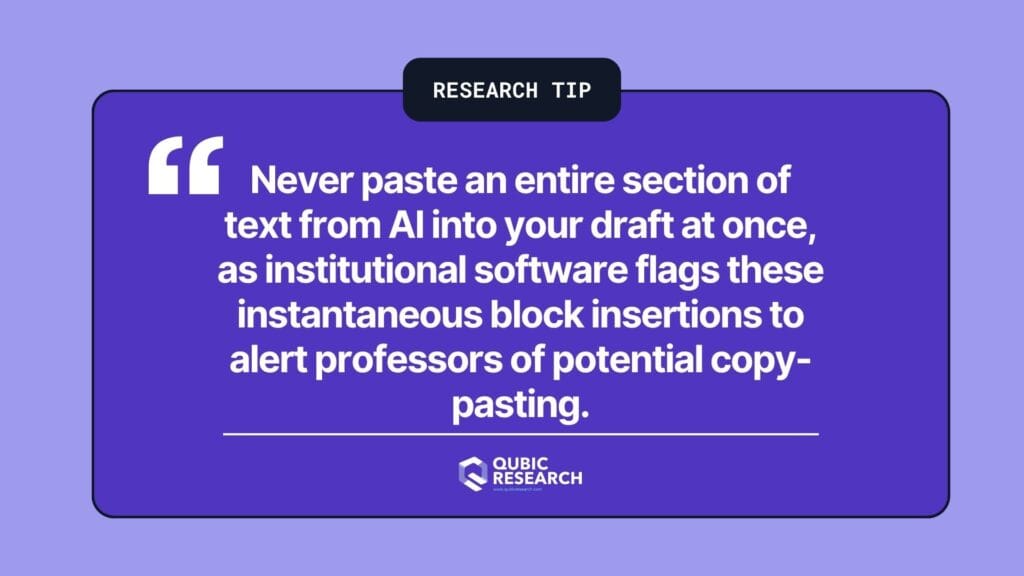
- Writing time anomalies: Learning platforms track advanced background indicators, including low modification logs and quick paste flags, to catch unusual file creation steps.
- My Experience: In my work with academic boards, a paper that jumps from a blank page to a massive final draft without any intermediate saves or typing time is instantly treated as an automated copy-paste event.
- Process validation: Natural human drafting leaves behind a messy, irregular path of keystrokes, edits, and revisions, while machine-assisted work shows abrupt block text updates.
How instructors audit your digital writing timeline
- The professor opens the assignment dashboard to review the submission’s hidden file metadata.
- They check the total creation time to see if the document was compiled over several weeks or uploaded instantly.
- The administrator checks for low modification flags, which show if large blocks of text were pasted all at once.
- If suspicion rises, the instructor will formally request to view your Google Docs or OneDrive version history logs.
3. Cross-Checking Citation Integrity and Source Fabrications
One of the most reliable manual methods professors use to spot machine generation is a direct audit of your bibliography. While AI models can write smooth prose, they struggle with real-world database lookups and often invent realistic-looking sources.
- Reference verification: This process involves checking your citations against primary academic databases to catch hallucinated journals, incorrect volumes, or mismatched author names.
- My Experience: I have found that verifying just two or three random sources is the fastest way for a marker to spot AI writing, as machine-generated papers often combine real author names with completely fake titles.
- Structural alignment: Instructors notice when your citations look beautifully formatted but do not actually support the claims made in your text.
Executing a manual citation accuracy check
- The grader scrolls to your reference list and selects several random DOI links or journal titles.
- They search for those exact papers within databases like Google Scholar, Scopus, or PubMed.
- The professor checks that the volume, issue number, and publication year match your bibliography entries perfectly.
- They confirm that the cited study actually contains the data or arguments you used it to support.
4. Running Manual Stylometric Comparison Reviews
The ultimate test used by academic departments relies entirely on human observation. Faculty members have a strong understanding of their students’ linguistic limits based on daily classroom interactions, forum posts, and previous assignments.
- Linguistic profiling: This method compares the voice, tone, and vocabulary of your new research paper with your verified past submissions and in-class writing exercises.
- My Experience: When a student who usually writes with simple sentence structures suddenly submits an essay filled with advanced passive voice and textbook-style transitions, it immediately triggers a manual review.
- Voice consistency: Protecting your credibility means making sure you maintain your original writing voice across all assignments to prevent style mismatches.
How instructors perform a comparative voice analysis
- The professor opens your current submission alongside your previous graded essays or exams.
- They look for sudden, drastic changes in your typical vocabulary choices, sentence structures, and punctuation patterns.
- The marker highlights repetitive, robotic transition sequences like “furthermore,” “moreover,” or “in summary.”
- If the text reads like a polished encyclopedia entry rather than your personal analysis, you may be called in for a formal review.
Final Thoughts on How Professors Check AI Research Writing
I believe that understanding the mechanics of academic scrutiny changes the way you approach your submission strategy entirely. When looking closely at how professors check AI research writing, it is obvious that they rely on a layered defense combining text structures, background file metadata, and manual citation checks. Attempting to bypass these platforms with quick surface-level tricks is an unnecessary risk when you can easily stand behind real human data. By keeping your live cloud editing logs intact and protecting your signature vocabulary, you can render automated flags completely irrelevant. Trust your own analytical perspective—the depth of your research will always outlast the rigid patterns of any software algorithm.
Want to safeguard your draft chapters from algorithmic bias before clicking submit?
If you are preparing an assignment and want to ensure your structural pacing reads as naturally human to enterprise scanners, check out my complete guide on how to reduce AI detection in academic writing for practical, ethical language strategies.
Frequently Asked Questions
Do professors check AI research writing by looking at document version histories?
Yes, professors frequently request cloud version history logs from platforms like Google Docs or Microsoft OneDrive if a submission triggers an integrity alert. This allows them to examine your step-by-step writing progression, verifying that chapters were built gradually over several weeks rather than pasted instantly from an external tool.
Can Turnitin detect if I used an AI tool simply to find references for my bibliography?
Turnitin cannot track where you discovered your sources, but it will analyze how those citations match the text. If you use a machine learning model to generate a bibliography, the system may create invented sources with broken links, which professors quickly catch during routine database reference lookups.
What happens if a professor falsely accuses my research paper of being AI-generated?
If you face a false accusation, you have the right to challenge the software score by presenting a physical research paper trail. Providing your initial proposal drafts, date-stamped notes, and cloud editing records serves as objective proof of your authorship and will easily override an automated probability percentage.
How does a professor’s manual style audit expose machine-assisted text?
An instructor’s style audit involves comparing your current submission against your previous essays and in-class exams. If your writing suddenly shifts from a conversational voice into an incredibly sterile, academic prose style that relies on repetitive, formulaic transitions, the professor will mark the paper for an inquiry.
Are short-form research assignments less likely to flag automated writing metrics?
Yes, brief responses under a few hundred words are far more difficult for sentence classifiers to analyze accurately because they lack the necessary structural data. Automated scanners require substantial blocks of text to evaluate sentence length patterns and calculate stable perplexity scores effectively.