

I know how challenging it can be to navigate the blurry boundary between utilizing a digital research assistant and committing a serious academic integrity violation. If you are trying to figure out how to use AI without plagiarism, you are asking the single most important question for today’s academic landscape. AI models can be fantastic tools for mapping out arguments or dissecting complex topics, but crossing the line into letting a machine write your assignments will quickly pull your work into dangerous territory.
This guide explains exactly how to integrate machine learning assistants into your study workflow ethically and safely. Adhering to these strict boundaries will help you easily prevent AI academic misconduct while still maximizing your study efficiency. I will show you how to shift your tools into an administrative support role so you can confidently maintain human research ownership and submit assignments that pass both automated scans and personal faculty reviews.
How to Use AI Without Plagiarism
When you are balancing a heavy course load, incorporating advanced technology into your study routine can feel like a massive relief. However, discovering exactly how to use AI without plagiarism requires shifting your perspective on what these tools are for. Academic integrity rules do not ban technology entirely—they protect the value of original human analysis. The secret to using these systems safely is to treat them as collaborative research partners for early stage preparation rather than relying on them to generate your final paragraphs.
1. Reorienting Models Into Structuring and Brainstorming Tools
The safest way to keep your workflow secure is to restrict automated assistants to tasks that happen before you ever write a line of your draft, such as building outlines or organizing ideas.
- The conceptual boundary: Asking an application to generate a thematic outline for a literature review is entirely safe because it does not inject machine-flattened text into your document. The final writing voice remains completely your own.
- My Experience: I routinely advise graduate students who use chat models to create initial essay structures. Their overall submission scores stay at absolute zero because they handle the actual writing labor entirely by hand.
- Structural balance: Utilizing technology to break down complex institutional rubrics helps you organize your thoughts without introducing the hyper-predictable sentence rhythms that trigger scanners.
How to safely build an essay framework using technology
- Copy the official writing prompt from your assignment syllabus and paste it into your chat workspace.
- Instruct the model to break the prompt down into four distinct analytical themes or section targets.
- Review the generated subheadings manually and adjust them to match your personal research interests.
- Move that custom structural plan into your cloud file to use as a manual writing template.
2. Deconstructing Complex Source Material Safely
Another powerful and ethical use of language assistants is utilizing them to unpack dense academic terminology, convoluted research methodologies, or complex historical data.
- Linguistic interpretation: You can safely ask a language engine to simplify difficult journal articles or explain confusing industry terms in everyday language so you can grasp the core concepts faster.
- My Experience: I have watched international students significantly improve their comprehension scores by using chat models as targeted vocabulary decoders, translating dense textbook concepts into clear, manageable summaries.
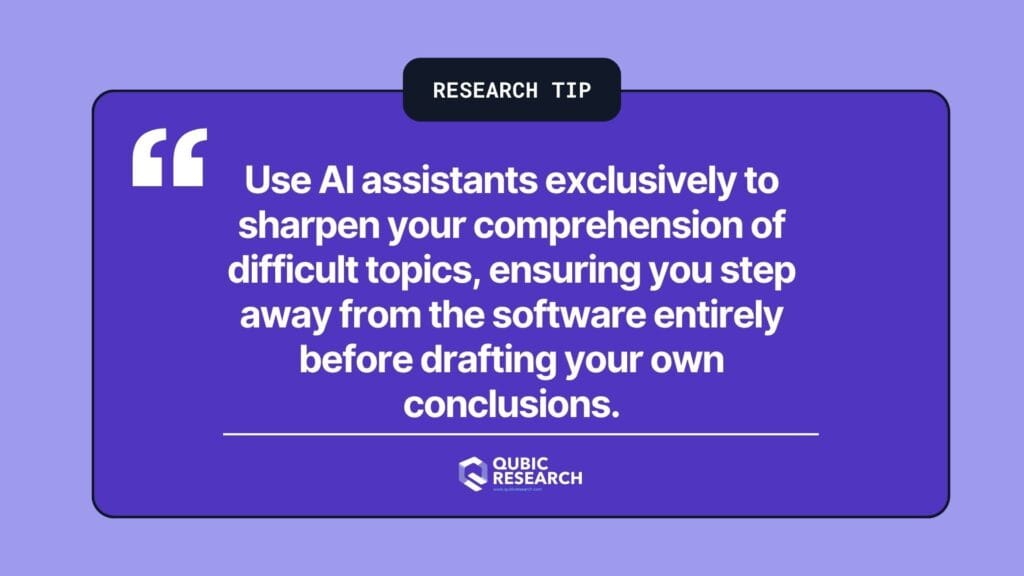
- The boundary rule: Use the application to improve your understanding of a topic, but close the tool completely before you start typing your own evaluation of that material.
How to safely decode peer-reviewed studies
- Isolate a complex, jargon-heavy paragraph within a primary source document that you are struggling to interpret.
- Paste that specific text block into your workspace and ask the model to summarize the main point in three bullet points.
- Read the simplified points to make sure you fully understand the author’s underlying argument.
- Minimize the program window and write your own evaluation of the study’s points from scratch.
While automated tools can explain concepts, they struggle immensely with handling specific data lookups, meaning you must manage your source references completely by hand.
- The hallucination threat: Large language models are designed to predict word orders rather than check real databases. When you ask them to find data citations, they frequently invent fake journal names and broken URLs.
- My Experience: I regularly see integrity investigations triggered because a student trusted a chat program to compile their bibliography, resulting in a list of fake sources that professors spot instantly during an audit.
- Verifiable tracking: Compiling your references manually through reliable search portals like Google Scholar or institutional libraries keeps your bibliography clean and completely authentic.
How to cross-verify research references manually
- Locate the academic source names or reference paths suggested during your background discussions.
- Search for those exact titles inside your institutional university library network or Google Scholar.
- Verify that the author names, publication dates, and volume numbers match real, peer-reviewed documents.
- Format the final citation into your essay document manually using your department’s approved style guide.
4. Documenting Your Learning History for Institutional Security
Since modern academic scanners operate on unpredictable statistical patterns, your best protection against false alerts is to keep a clear trail of your personal research path.
- Process telemetry data: Writing your research papers inside an active cloud platform like Microsoft OneDrive or Google Docs automatically creates a continuous, unalterable timeline of your typing activity over time.
- My Experience: In my consults during university integrity reviews, a student presenting an active, step-by-step editing log will always override an automated probability score.
- The validation shield: Keeping your early brainstorming outlines, custom notes, and draft files provides solid evidence of human research that completely protects your academic reputation.
How to establish a secure human creation history
- Create a dedicated folder inside your cloud space for your essay project before looking up any data sources.
- Draft your paragraphs gradually over several days to build a clear record of manual keyboard updates.
- Keep all of your early conceptual outlines, research printouts, and rough drafts saved in your project file.
- Review your document’s version history logs to ensure they display your multi-day editing steps before submitting.
Final Thoughts on How to Use AI Without Plagiarism
I believe that finding a balance between advanced research technology and genuine human scholarship is the best way to future-proof your academic career. When learning how to use AI without plagiarism, the defining boundary comes down to separating cognitive synthesis from drafting labor. Allowing a machine to formulate your final prose will consistently trigger institutional pattern flags. However, delegating structural brainstorming, text outlining, and complex concept decoding to software keeps your unique voice safely at the center of the assignment.
Keep your workspace secure by capturing your analytical progress inside monitored cloud systems, handling your primary source tracking by hand, and protecting your personal stylistic quirks. By making technology your assistant rather than your co-author, you ensure that every paper you hand in remains fully and indisputably your own.
Does Copy-Pasting From ChatGPT Get Detected?
If you want to know how clipboard telemetry logs and instant text drops leave a permanent digital footprint on your university dashboard, read my guide on does copy-pasting from ChatGPT get detected to stay ahead of automated traps.
Frequently Asked Questions
Is it considered academic plagiarism if I use ChatGPT to help me brainstorm essay topics?
No, using interactive platforms to brainstorm conceptual themes, clarify complex writing prompts, or generate initial topical paths does not constitute plagiarism. Because you are only gathering loose abstract ideas rather than copying actual block sentences, no unoriginal text elements enter your final document.
How can I make sure an automated screen does not flag my work if I used AI for research?
The most reliable way to secure your submission is to write your entire assignment manually from a blank page. Restricting your tool use to early structural preparation, tracking your source files inside independent folders, and typing your body paragraphs into active cloud history portals easily proves your personal authorship.
Can I safely trust an automated chat assistant to generate the bibliography for my paper?
No, you should never trust a language model to handle your citation lists. Large language models operate on word-prediction sequences rather than checking live academic databases, meaning they frequently generate hallucinated references, invented journal titles, and broken URL paths that professors catch instantly.
What is the exact line separating ethical writing assistance from an integrity violation?
The boundary line sits firmly between research ideation and actual composition. Using software to build an informational outline, summarize long text passages, or define industry terminology is completely ethical. Allowing an application to formulate your actual thesis statements or draft full paragraphs crosses the line into unoriginal work.
Does rephrasing machine-generated sentences by hand make an assignment safe to submit?
No, manual paraphrasing rarely prevents automated tracking flags. While swapping words with simple synonyms can occasionally bypass basic plagiarism matches, it leaves the uniform phrase pacing and low-entropy language models untouched, which university compliance scanners look for specifically.