

I know how deeply frustrating it is to spend days researching a paper, only to read over your paragraphs and realize they sound like they were spat out by a corporate chat robot. If you are trying to figure out how to avoid AI-sounding academic writing, you are running directly into a modern stylistic trap. Ever since universities deployed advanced pattern checkers, the ultra-clean, perfectly balanced prose that once earned top marks is now exactly what automated filters label as machine-generated text.
This guide explains how to break free from formulaic writing habits and inject natural, human textures back into your work. Adjusting your stylistic patterns will allow you to confidently bypass robotic language filters and write with genuine authority. I will break down the specific linguistic habits that trigger pattern scanners so you can successfully restore your unique writer signature and protect your essays from false compliance alarms.
Avoid AI-Sounding Academic Writing
When you are striving to make your essays sound as professional as possible, it is incredibly easy to fall into a hyper-formal tone that copies institutional textbooks. However, learning how to avoid AI-sounding academic writing requires recognizing that extreme structural neatness is exactly what pattern classifiers flag. Large language models are trained on optimized, highly clean datasets, meaning they write with perfect, unvarying structural balance. To keep your research looking completely authentic, you must consciously avoid formulaic language traps and embrace the natural, slightly asymmetrical rhythms of real human communication.
1. Eliminating the Algorithmic Transition Clichés
The fastest way to signal a machine footprint to both an automated scanner and an experienced professor is relying heavily on predictable corporate transition templates and overused vocabulary markers.
- The linguistic profile: Automation models rely heavily on specific structural bridges to move between analytical arguments. Overusing transition strings like “furthermore”, “moreover”, “consequently”, or “in conclusion” flattens your personal text texture.
- My Experience: I routinely analyze university submission files where a human student’s original essay flags at 40% purely because they loaded their paragraphs with generic filler phrases like “it is important to remember” or “a testament to.”
- The vocabulary solution: Swapping out these robotic, empty vocabulary markers for direct, action-driven verbs immediately restores individual creative character to your paragraphs.
How to strip automated vocabulary patterns from your drafts
- Open your completed assignment file and run a fast keyword search for common transition flags like “delve”, “pivotal”, and “furthermore.”
- Delete those redundant structural terms and replace them with simpler, direct sentence connections.
- Convert passive, overly formal declarations into active, voice-driven explanations that feature a clear subject.
- Ensure your analytical points transition naturally through the logical growth of your arguments rather than relying on formulaic text markers.
2. Shattering Uniform Sentence Lengths manually
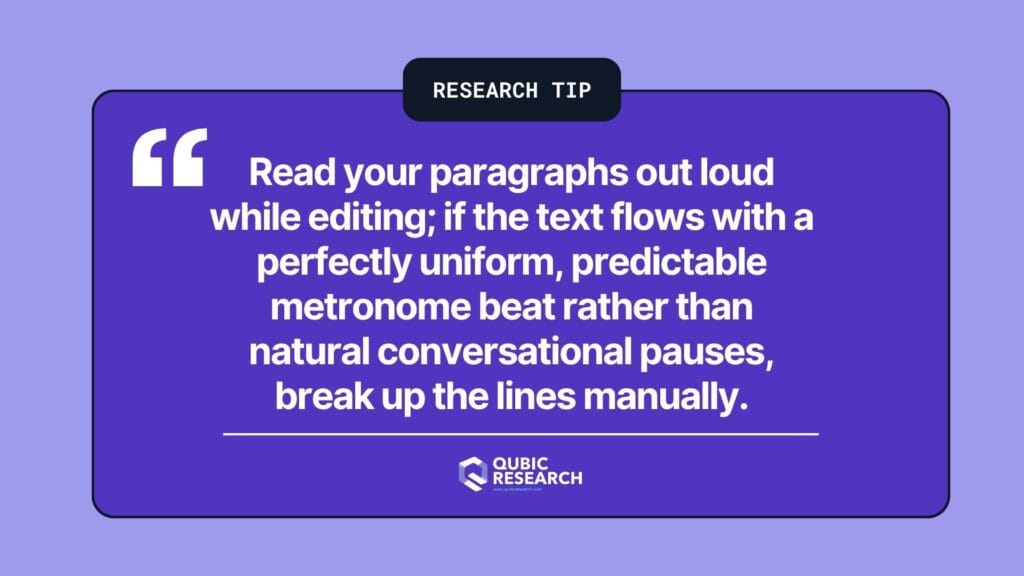
Large language models compose text using highly regular clause lengths, resulting in a flat, predictable writing pacing that compliance software flags as low burstiness.
- The burstiness barrier: Human writers naturally fluctuate their phrase pacing—mixing ultra-short, punchy declarations with sprawling, multi-layered explanations. Software platforms maintain a highly predictable, balanced line length across entire sections.
- My Experience: In my consults during university integrity disputes, the absolute most effective editing adjustment I use to resolve pattern false alarms is manually breaking long, uniform text tracks into uneven, varied lines.
- Rhythm disruption: Forcing your sentences to change length drastically breaks up the predictable pacing signatures that text scanning algorithms target.
How to manually introduce natural burstiness into your chapters
- Count the exact word totals of five consecutive sentences within your main body paragraphs.
- If every line falls within a narrow range of 15 to 20 words, your writing pacing is dangerously flat.
- Shorten at least one statement into a direct, punchy summary consisting of fewer than 8 words.
- Expand an adjacent clause by incorporating specific parenthetical remarks, structural em-dashes, or localized sub-points.
3. Embedding Hyper-Specific Primary Evidence Paths
Automated text generation is inherently limited to generalizing topics because it cannot experience physical research or seamlessly track down real-world niche contexts.
- The specificity deficit: Automated essays often loop through vague, repetitive descriptions because they lack real access to live databases. Human scholarship relies on dense, highly specific reference data paths and specialized historical data points.
- My Experience: I have seen academic review boards drop a high software pattern flag the moment a student embeds precise data metrics, localized institutional case studies, or deeply detailed historical chronologies into their text.
- Grounded analysis: Grounding your paragraphs in absolute facts leaves no room for the generic, high-level summaries that characterize automated writing profiles.
How to enrich your text chapters with concrete evidence
- Review your body paragraphs and locate any vague analytical statements like “many experts agree on this outcome.”
- Replace those sweeping, generalized assertions with specific author surnames, publication years, and exact quotation references.
- Inject concrete, numerical statistics or localized geographical context data to support your primary claims.
- Detail the precise research methodologies utilized within your cited studies rather than just summarizing the overall results.
4. Validating Individual Academic Voice Consistency
Your ultimate protection against false software alerts is ensuring your assignment style matches your authentic unedited background performance footprint.
- Comparative evaluation: Faculty members do not judge your papers in isolation; they compare your long-form assignments to your classroom forum posts, unedited project journals, and past diagnostic exam grades.
- My Experience: A student who routinely leaves their natural conversational habits and structural formatting quirks in their text will easily defeat an automated flag during a manual review with their department head.
- Linguistic integrity: Attempting to edit your text until it reaches an impossible standard of mechanical perfection destroys the authentic human markers that verify your authorship.
How to lock in your personal stylometric signature safely
- Examine two or three of your previously graded essays to map out your typical language levels and punctuation preferences.
- Reintroduce your signature phrasing choices into your current research paper drafts.
- Resist the urge to run your original chapters through online grammar polishers that perform large-scale text smoothing.
- Confirm that your final document includes your natural writing imperfections before uploading the file to your learning portal.
Final Thoughts on How to Avoid AI-Sounding Academic Writing
I believe that trying to write with absolute mechanical perfection is a trap that ultimately strips your essays of their human character. When exploring how to avoid AI-sounding academic writing, the structural evidence proves that robotic tones stem from overly formulaic transitions, uniform sentence structures, and predictable patterns. Attempting to pass an assignment by cleaning away all your unique writing habits only plays into the hands of pattern-scanning software.
Protect your academic standing by embracing varied sentence lengths, adding deep, localized research specifics, and trusting your authentic writing voice. Your individual style, including its unique variations and imperfections, is something an algorithm simply cannot duplicate—making it your most powerful asset for passing institutional screening checks.
How to Use AI Without Plagiarism
If you want to know how to use digital models ethically for brainstorming and structuring outlines without leaving a machine footprint, read my complete guide on how to use AI without plagiarism to keep your academic workflow safe.
Frequently Asked Questions
Why does high-quality human academic writing sometimes trigger AI detector flags?
High-quality academic writing often sets off automated flags because formal university assignments naturally rely on structured layouts, technical terms, and complex vocabularies. Because pattern classifiers correlate these highly organized, predictable phrasing choices with machine language models, original human text can easily trigger a false positive.
Which specific transition words or phrases sound the most robotic to scanning software?
Transition strings such as “furthermore,” “moreover,” “consequently,” “in conclusion,” “it is crucial to note,” and “a testament to” sound highly robotic to scanning engines. These words create highly predictable links between paragraphs, lowering your document’s text texture and mimicking machine generation.
How can I test the burstiness and pacing of my essay manually?
You can check your text’s pacing manually by counting the exact words in a sequence of sentences. If your counts consistently fall into a narrow range (like 15 to 20 words per line), your writing rhythm is flat. Break up this layout by adding short, punchy summaries or complex, uneven clauses.
Will a professor clear my name if my authentic writing voice triggers an automated system flag?
Yes, your professor will clear your name during a manual audit if your writing matches your authentic academic voice profile. Faculty members cross-reference flagged files against your previous essays, classroom forum posts, and unedited logs to confirm stylometric consistency.
Should I run my finished essays through online grammar optimization tools to polish the text?
No, you should avoid using aggressive online grammar optimization tools or automated text extensions to polish your final drafts. These platforms rely on language models that perform large-scale text smoothing, which strips out your unique phrasing quirks and replaces them with robotic, low-entropy signatures.