

I know the frustration of looking at an AI-generated draft that contains great points but reads with the cold, lifeless tone of an instruction manual. If you are trying to figure out how to make AI writing sound natural, you are tackling the ultimate hurdle in modern digital drafting. Automated models are brilliant at compiling raw facts, but their underlying text-generation loops lack the organic friction, rhythm variations, and stylistic imperfections that define true human communication.
This guide explains how to take structured machine outputs and breathe authentic human life back into every paragraph. Reworking these mechanical layouts will allow you to effectively humanise robotic text structures and keep your audience fully engaged. I will show you exactly how to identify and break the mathematical formatting loops used by automated tools so you can confidently inject individual writing character into your files and pass any standard evaluation.
How to Make AI Writing Sound Natural
Taking a raw digital draft and refining it into an engaging piece of prose requires going far beyond basic spelling and grammar checks. When analyzing how to make AI writing sound natural, the core issue is that algorithms compose text by calculating the next most likely word sequence. This statistical smoothing creates an ultra-sanitized, monotonous rhythm that screams machine generation. To inject true vitality into these drafts, you must systematically introduce stylistic variety, disrupt the flat sentence architecture, and embed the organic irregularities that characterize authentic human communication.
1. Shattering the Low-Burstiness Metronome Beat
The single biggest giveaway of automated text is its lack of structural variety. Language models produce sentences that stay remarkably uniform in length and structure, creating a flat, robotic pacing.
- The mathematical pattern: Machine-generated paragraphs typically alternate between standard compound structures of roughly fifteen to twenty words. Humans do not write that way—we weave short thoughts with sprawling, conversational clauses.
- My Experience: When I edit corporate or academic drafts, the very first thing I do is slash every third sentence in half. Shortening a line down to just three or four words instantly gives the reader a mental break and shatters the machine rhythm.
- The pacing solution: Mixing ultra-short punch lines with multi-tiered, complex explanations creates the natural visual and auditory “burstiness” that makes content enjoyable to read.
How to manually introduce structural variance into flat drafts
- Scan your paragraphs and highlight three sentences in a row that look roughly identical in physical length.
- Take the middle sentence and break it into two distinct, standalone thoughts.
- Add a long, rolling sentence immediately after it, using em-dashes or parenthetical asides to build out the thought.
- Read the adjusted passage aloud to ensure the text mirrors the varied cadence of natural speech.
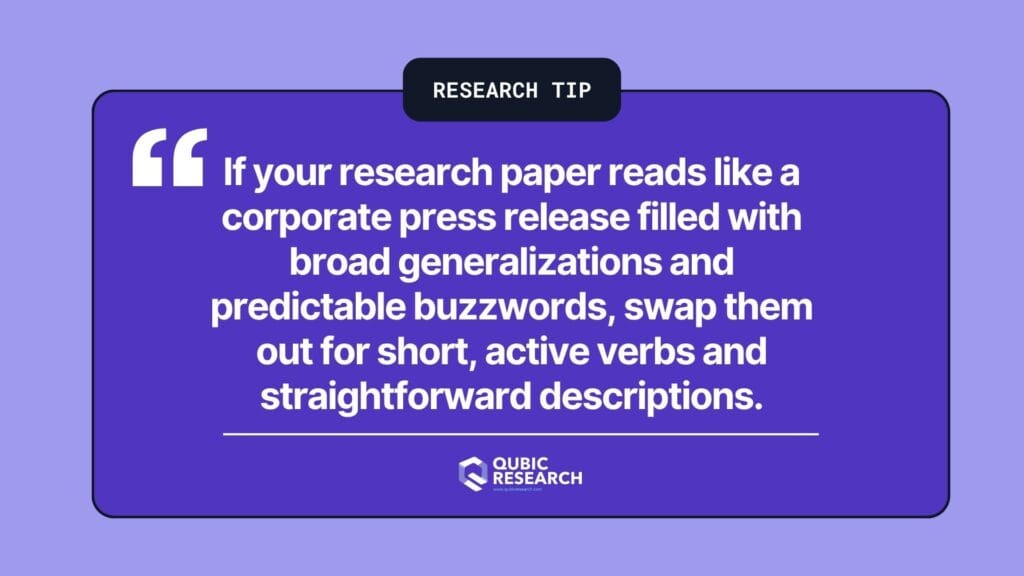
2. Purging Corporate Buzzwords and Empty Fillers
Automated platforms love specific, dramatic filler words and hyper-formal transition setups that real people rarely use in day-to-day work or research environments.
- The algorithmic vocabulary: Words like “delve,” “testament,” “pivotal,” “beacon,” and “moreover” are massively overrepresented in machine databases. They function as safe statistical bridges, but they immediately make your text look generic and sterile.
- My Experience: I can spot an unedited copy-paste job in seconds simply by looking for sentences that open with “It is important to consider…” or contain the phrase “…in today’s digital landscape.” Stripping these out instantly elevates the quality.
- Grounded language choices: Swapping pompous, predictive buzzwords for simple, direct language makes your arguments sound far more authentic and authoritative.
How to strip predictive text clichés from your drafts
- Open your document and run a quick search for common automation identifiers like “delve” or “furthermore.”
- Delete the fluff phrase entirely and start the sentence directly with your core subject or point.
- Replace inflated verbs like “utilize” with everyday alternatives like “use” or “apply.”
- Rewrite formulaic conclusions so they avoid stating the obvious or summarizing the text with generic wrap-up templates.
3. Grounding Your Claims in Niche, Specific Details
Because language engines do not have personal experiences or real-time access to physical environments, their default writing style relies heavily on high-level, generic abstractions.
- The abstraction trap: An automated draft will confidently explain that a strategy is “highly beneficial for market growth” without ever pinning down the exact parameters, data metrics, or situational nuances that make it true.
- My Experience: The fastest way to transform flat copy into something compelling is to drop a hyper-specific, real-world case study or precise statistic right into the middle of a generalized explanation.
- Concrete evidence tracks: Embedding localized context data and unique perspectives makes it obvious to your reader that a human mind directed the research strategy.
How to anchor abstract paragraphs with realistic references
- Identify any sentences that make broad, unbacked assertions like “many organizations struggle with communication.”
- Inject a specific name, historical example, or verified data metric to support that claim immediately.
- Incorporate specialized terminology or situational constraints unique to your industry or field.
- Detail the exact mechanics of how a concept functions rather than just repeating that it is important.
4. Injecting Flawed human Textures and Stylistic Quirks
Algorithms compose text with absolute, unvarying grammatical neatness. This sounds good in theory, but it results in a sterile reading experience completely devoid of personal voice or emotion.
- The perfection anomaly: True human writing features minor structural asymmetrical design choices—we use rhetorical questions, add personal asides, split infinitives, and lean into conversational styling habits.
- My Experience: When rewriting content, I deliberately leave in specific stylistic habits or unique phrases that mirror my personal speaking patterns. This authentic flavor is something software platforms cannot simulate.
- Voice alignment: Allowing your text to remain slightly imperfect and character-driven is what transforms cold text strings into an authentic, trustworthy narrative.
How to align text drafts with your authentic creative voice
- Read through your rough draft and identify sections that sound overly rigid, dry, or formal.
- Rewrite those specific blocks as if you were explaining the concept directly to a colleague over coffee.
- Incorporate interactive elements, such as brief questions or targeted scenarios, to keep your reader engaged.
- Leave some of your natural punctuation preferences intact rather than smoothing them away with automated extensions.
Final Thoughts on How to Make AI Writing Sound Natural
I believe that refining an automated draft into a truly engaging piece of work requires moving past simple word adjustments and focusing on structural character. When figuring out how to make AI writing sound natural, the digital footprints reveal that true human expression relies on structural irregularity, vocal contrast, and absolute situational specificity. Trying to bypass robotic layouts by polishing your text until it is perfectly clean only leaves it looking more sterile.
Protect the impact of your writing by hacking apart uniform sentence paths, stripping away generic corporate transition buzzwords, and grounding your claims in real-world evidence. By taking total ownership of the final editing stage, you transform predictive text streams into a dynamic, voice-driven narrative that connects with readers and stands out as completely your own.
How to Avoid AI-Sounding Academic Writing
If you want to know how to eliminate robotic textbook patterns and keep your essays from triggering university compliance filters, read my guide on how to avoid AI-sounding academic writing to safeguard your student submission files.
Frequently Asked Questions
Why does raw AI-generated content sound so artificial and robotic to readers?
Raw AI text reads artificially because language models calculate text using statistical word probabilities. This process flattens the writing style, creating a highly uniform rhythm with identical sentence lengths and generic transition selections that lack the organic variation found in human communication.
Can I make an AI draft look completely human just by using online word spinners?
No, running text through online spinners or automated rewriters rarely fixes the issue. These tools apply the exact same mathematical patterns to adjust vocabulary, leaving the flat phrase lengths and hyper-predictable structural flows intact, which pattern scanners spot easily.
What does ‘burstiness’ mean, and how does it affect content quality?
Burstiness measures the variation in sentence structures and lengths across a block of text. Machine-generated prose displays low burstiness because its sentence lengths remain uniform, whereas human writing features high burstiness, mixing short, punchy thoughts with sprawling, complex clauses.
Words like “delve,” “testament,” “pivotal,” “beacon,” “moreover,” and “furthermore” serve as clear indicators of machine generation. These terms act as safe mathematical bridges in language model databases, but they quickly sound empty and formulaic to an experienced reader.
How can I naturally inject my personal creative voice into a structured draft?
You can naturally inject your voice by reading the draft aloud and rewriting rigid sentences as if you were speaking directly to a friend. Adding real-world case studies, personal insights, rhetorical questions, and irregular phrase lengths helps dismantle the mechanical framework and humanise the text.