


The best research databases include Google Scholar, Scopus, Web of Science, PubMed, JSTOR, and ScienceDirect. Together, these platforms help students, educators, and professional researchers find peer-reviewed articles, conference papers, books, and credible reports across virtually every discipline.
But simply knowing the names isn’t enough. Different databases excel at different jobs: some are best for discovery across fields, others are strongest for peer-review filtering, citation tracking, or finding full text. This guide compares the most useful academic databases (free and subscription), shows you how to access PDFs legally, and helps you pick the right tool for your research question.
Quick Comparison: Best Academic Research Databases
Use this quick table to pick the right database fast. Details like peer-review filtering and full-text access are explained in the database sections below.
| Database | Best for | Access |
|---|---|---|
| Google Scholar | Fast discovery + citation chaining | Free |
| ResearchGate | Author sharing + requesting PDFs | Free (account required) |
| Scopus | Peer-reviewed discovery + metrics | Subscription (often via universities) |
| Web of Science | Citation indexing + curated coverage | Subscription (often via universities) |
| PubMed | Biomedical/life sciences literature | Free |
| ERIC | Education research + reports | Free |
| IEEE Xplore | Engineering + computer science | Subscription (some free) |
| ScienceDirect | Full-text journals + book chapters (Elsevier) | Subscription (some open access) |
| DOAJ | Open-access journals (free full text) | Free |
| JSTOR | Humanities + social sciences archives | Subscription (some free) |
Top 10 Best Academic Research Databases
Google Scholar
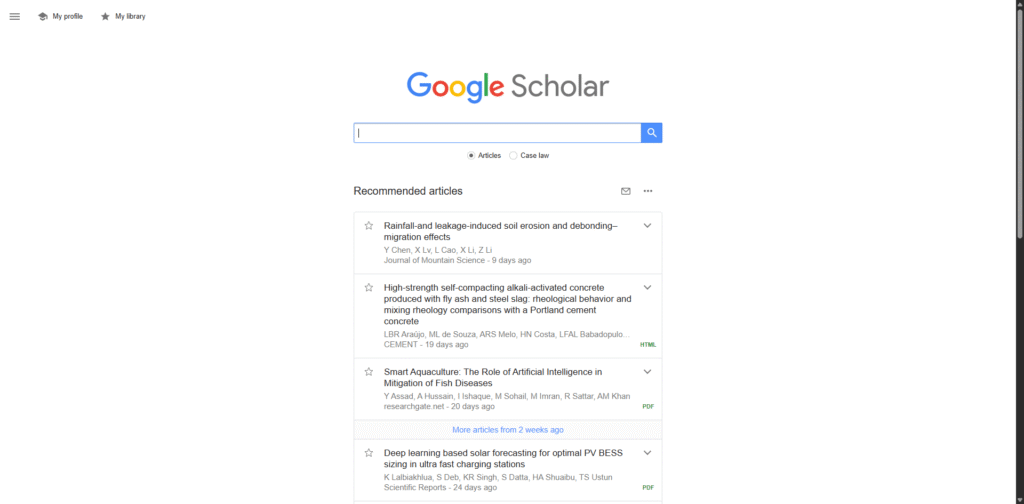
Google Scholar is a freely accessible search engine that indexes scholarly articles, theses, books, and conference papers across multiple disciplines. It’s a strong starting point for most projects, and it’s especially useful for citation chasing (“cited by”) and finding related papers quickly.
Key Features
- Covers a wide range of academic disciplines
- Shows citation counts and “Cited by”/related articles
- Links to full text when available (publisher, institutional, or open access)
Access: Free
ResearchGate
ResearchGate is a professional network for researchers. It can be useful for discovering papers, following authors, and requesting full-text copies directly from researchers when legal sharing is allowed.
Key Features
- Access to millions of research articles (availability varies)
- Collaboration and networking opportunities
- Option to request full texts from authors
Access: Free (registration required)
Scopus
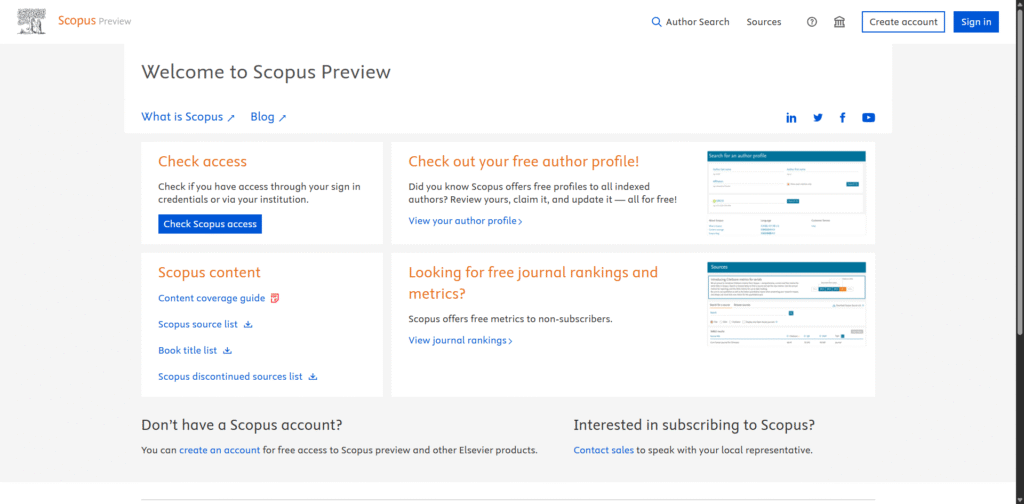
Scopus is a leading multidisciplinary abstract and citation database covering peer-reviewed journals, conference proceedings, and books. It’s widely used for systematic searching, citation analysis, author profiles, and journal evaluation.
Key Features
- Large multidisciplinary coverage and strong indexing
- Advanced citation tracking and analysis tools
- Author and journal metrics
Access: Subscription-based (often via universities); limited previews may exist
Web of Science
Web of Science is a curated citation index spanning the sciences, social sciences, arts, and humanities. It’s particularly useful for citation mapping, identifying influential studies, and building a defensible literature search strategy.
Key Features
- Curated indexing with strong citation networks
- Citation searching across multiple disciplines
- Tools for journal and author evaluation
Access: Subscription (commonly available through academic institutions)
PubMed
PubMed is a free resource maintained by the National Center for Biotechnology Information (NCBI). It’s the default database for biomedical and life-science literature discovery, and it often links to free full-text via PubMed Central (PMC) when available.
Key Features
- Extensive biomedical citations and abstracts
- Links to full text (PMC, publisher sites, institutional access)
- Strong filters and structured fields (MeSH, publication type, dates)
Access: Free
ERIC (Education Resources Information Center)
ERIC is a comprehensive database for education research. It includes journal articles and a large amount of grey literature (reports, policy documents, conference papers), making it valuable beyond traditional journals.
Key Features
- Large education-focused index
- Covers all education levels and subfields
- Includes reports and conference materials
Access: Free
IEEE Xplore
IEEE Xplore is a major digital library for engineering, computer science, and technology. It’s especially strong for conference proceedings (often where new results appear first in CS/EE), plus journals and standards.
Key Features
- Deep coverage of engineering and computing
- Conference proceedings, journals, and standards in one place
- Advanced search and filtering
Access: Subscription-based (some content free)
ScienceDirect
ScienceDirect is Elsevier’s full-text platform for journals and books. It’s highly useful when your institution subscribes, and it’s often where you’ll land after discovering papers via Google Scholar, Scopus, or Web of Science.
Key Features
- Large collection of journal articles and book chapters
- Strong browsing by topic and journal
- Includes open-access content alongside subscription items
Access: Subscription-based (some open access)
Directory of Open Access Journals (DOAJ)
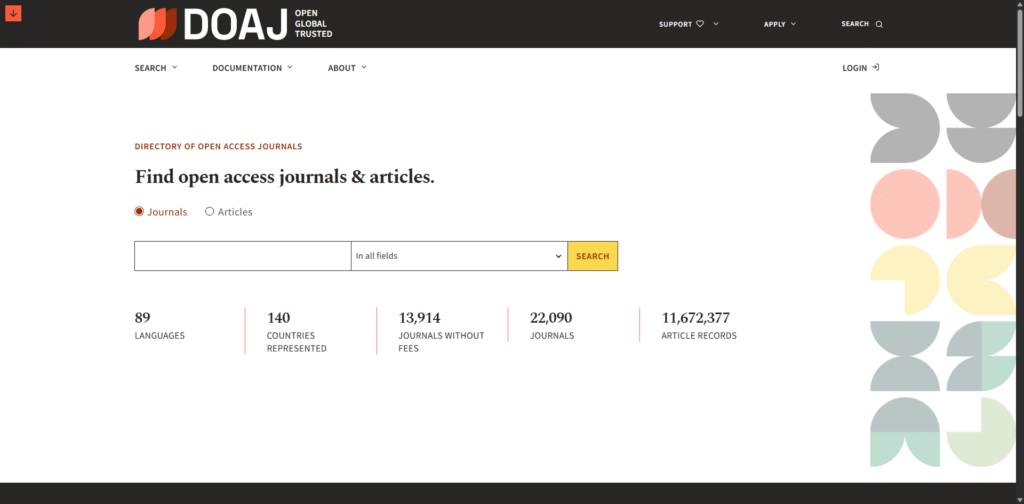
DOAJ indexes high-quality open-access journals. If you specifically want free-to-read, legally accessible papers, DOAJ is one of the cleanest starting points.
Key Features
- Open-access journals across all disciplines
- Useful filters for journal and article discovery
- All content is free to access
Access: Free
JSTOR
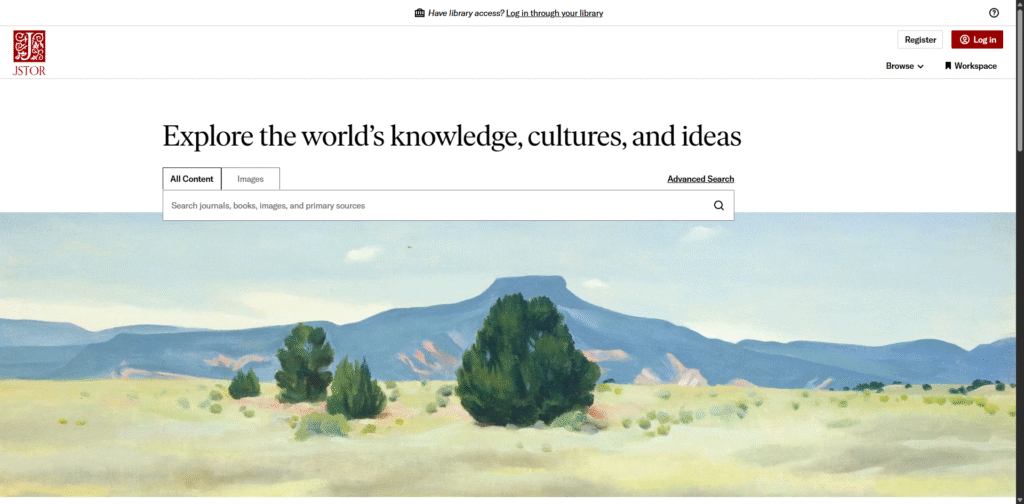
JSTOR is a core database for humanities and social sciences, with strong journal archives, books, and primary sources. It’s a go-to when you need foundational literature, classic papers, or historical coverage.
Key Features
- Strong humanities and social science coverage
- Journals, books, and primary sources
- Mix of subscription content and free/open materials
Access: Subscription-based (some free content)
More Research Databases (Highly Recommended)
The “top 10” above are a strong baseline, but many researchers get better results by adding a few field-specific or open-access discovery tools. Here are additional academic databases worth using.
Embase
Embase is widely used for biomedical and pharmacological research, especially systematic reviews. It complements PubMed with broader European and drug-focused coverage.
- Strong biomedical + pharmacology indexing
- Useful controlled vocabulary for structured searching
- Common requirement for systematic reviews
Access: Subscription
Cochrane Library
Cochrane is best for evidence-based medicine, including high-quality systematic reviews and clinical evidence summaries.
- Systematic reviews and clinical evidence
- Useful for healthcare decision-making and research
- Trusted methodology standards
Access: Subscription/free varies by country/institution
arXiv
arXiv is a major preprint server for physics, mathematics, computer science, and related fields. It’s ideal for early access to emerging research.
- Free preprints (fastest access to new ideas)
- Strong coverage in CS, math, physics
- Useful for staying current before journal publication
Access: Free
SSRN
SSRN is popular for preprints and working papers in social sciences, economics, business, and law. It’s useful for early drafts and discussion papers.
- Working papers and preprints
- Strong in economics, business, law, social sciences
- Email alerts for topic updates
Access: Free (some items may have restrictions)
BASE (Bielefeld Academic Search Engine)
BASE is a large academic search engine focused on open-access content harvested from repositories worldwide.
- Great for repository and OA discovery
- Strong filtering options
- Helpful for theses, dissertations, and institutional outputs
Access: Free
CORE
CORE aggregates open-access research outputs from repositories and journals, making it useful when you want legal full-text PDFs.
- Open-access aggregation
- Good for full-text discovery
- Works well alongside Google Scholar
Access: Free
Dimensions
Dimensions is a research discovery platform that links publications, grants, patents, clinical trials, and policy documents (coverage and access vary by version).
- Connects research outputs with funding and policy
- Useful analytics and discovery features
- Good for mapping a research area
Access: Free version + paid plans
OpenAlex
OpenAlex is an open catalog of scholarly works and metadata. It’s especially useful for large-scale discovery, bibliometrics, and building datasets.
- Open scholarly metadata
- Useful for bibliometrics and literature mapping
- Great for advanced users and tooling
Access: Free
Taylor & Francis Online
Taylor & Francis Online is a publisher platform with extensive coverage in social sciences and humanities, plus some STEM areas.
- Strong journal catalog in social sciences/humanities
- Useful when you already have a citation and need the full text
- Open-access articles available within some journals
Access: Subscription (some OA)
SpringerLink
SpringerLink is a major platform for journals and books across STEM, medicine, and social sciences.
- Large full-text journal/book library
- Good filtering and topic browsing
- Often available via institutional subscriptions
Access: Subscription (some OA)
Wiley Online Library
Wiley Online Library is another major full-text platform for journals and reference works.
- Full-text journals and reference content
- Strong in life sciences, chemistry, medicine
- OA content available on many titles
Access: Subscription (some OA)
ACM Digital Library
The ACM Digital Library is essential for computer science research, especially conferences and journals in computing and human-computer interaction.
- Top-tier CS venues and proceedings
- Excellent for HCI, software engineering, systems
- Often used alongside IEEE Xplore
Access: Subscription (some content may be free)
ProQuest
ProQuest provides access to dissertations, theses, newspapers, and many specialized databases (availability depends on institutional subscriptions).
- Excellent for dissertations and theses
- Helpful for historical newspapers and reports
- Strong in humanities and social sciences
Access: Subscription (usually institutional)
EBSCOhost
EBSCOhost is a platform that hosts many subject databases (e.g., Academic Search, PsycINFO via partners, business indexes). What you can access depends on your library.
- Common library platform with many subject indexes
- Strong filters, subject headings, and full-text options
- Great for students using university library access
Access: Subscription (via libraries)
APA PsycInfo
PsycInfo is a core database for psychology and behavioral sciences, widely used for literature reviews and systematic searching.
- Best-in-class psychology indexing
- Strong controlled vocabulary and filters
- Essential for psych literature reviews
Access: Subscription
Oxford Academic
Oxford Academic provides access to Oxford University Press journals and books, often relevant for humanities, social sciences, and medicine.
- High-quality journals and monographs
- Strong in humanities/social sciences
- OA options available on some content
Access: Subscription (some OA)
Cambridge Core
Cambridge Core hosts Cambridge University Press journals and books, especially strong in humanities, social sciences, and some STEM fields.
- Journals + books from Cambridge University Press
- Strong humanities/social sciences coverage
- OA content available in some collections
Access: Subscription (some OA)
Sites Like JSTOR (Best Alternatives)
If you searched “sites like JSTOR,” you’re usually looking for humanities and social science archives, book chapters, or primary sources. These are the most useful alternatives, depending on what you need.
- Project MUSE (journals and books in humanities/social sciences)
- Cambridge Core (journals and books)
- Oxford Academic (journals and books)
- ProQuest (dissertations, newspapers, specialized databases)
- EBSCOhost (subject databases; depends on library subscriptions)
- DOAJ and BASE (open-access discovery)
If you want, you can also publish a dedicated “JSTOR alternatives” post and link it here with a focused list + comparisons. For now, the section above answers the intent directly on-page.
How to Find Peer-Reviewed Articles (Fast Workflow)
If your goal is “peer-reviewed papers,” the best approach is to combine a discovery tool with a database that has strong filters and indexing.
- Start broad: search in Google Scholar to understand keywords and key authors.
- Switch to a curated index: use Scopus or Web of Science to refine results and reduce noise.
- Use filters: limit by document type (article/review), year range, subject area, and source title.
- Follow citations: open the most relevant paper, then review its references and “cited by” network.
- Get the PDF legally: check open-access links, PubMed Central (biomed), your institution’s library, or email the author.
- Save everything properly: export to Zotero, EndNote, Mendeley, or Paperpile and attach PDFs.
Tips for Maximising Your Research Database Use
Define Your Research Scope
Before diving into any database, clearly define your research topic, objectives, and the type of sources you need. Knowing your scope helps you choose the most relevant academic databases and scientific databases. For instance, PubMed is ideal for life sciences and medical research, ERIC is excellent for education studies, and Scopus or Web of Science cover a wide array of disciplines.
Utilise Advanced Search Features
Most best research databases offer powerful search capabilities beyond basic keyword searches. Learn to use Boolean operators (AND, OR, NOT), filters for publication date, document type, and subject area, as well as field-specific searches like author, journal, or DOI.
Stay Organised
With multiple searches across various academic databases, it’s easy to lose track of sources. Reference management tools like Zotero, EndNote, Mendeley, or Paperpile can help you organise your library, attach PDFs, and automatically format citations.
Access Through Institutions
While some scientific databases offer free access, many premium databases require subscriptions to view full-text articles. Academic institutions, universities, and libraries often provide free access to these databases for students, faculty, and staff.
Combine Multiple Databases
No single database contains all research, so using multiple academic databases can significantly enhance the breadth and depth of your search. Combining platforms like Google Scholar, Web of Science, Scopus, and PubMed helps you capture a wider range of articles, including interdisciplinary studies, preprints, and open-access papers.
Evaluate and Filter Sources
Even within trusted best research databases, not all articles carry the same weight. Evaluate sources based on peer review status, journal reputation, citation counts, and recency.
Track Your Searches
Documenting your search strategies—including keywords, filters, databases used, and date of search—helps maintain consistency and reproducibility in your research. This is particularly important for systematic reviews or long-term projects.
How to Choose the Right Database for Your Field
Choosing the right database depends on your topic and discipline. Using the most relevant academic databases ensures you get accurate and high-quality results.
- PubMed is ideal for biomedical research.
- Web of Science and Scopus cover a wide range of scientific fields.
- JSTOR focuses on humanities and social sciences.
- IEEE Xplore and ACM Digital Library are strong for engineering and computer science.
- ERIC is best for education studies.
- PsycInfo is a core resource for psychology.
Understanding Database Features
Most databases offer tools to help you organise and track research efficiently.
- Citation tracking to monitor influential studies.
- Search alerts to keep up with new publications.
- Saved searches for repeated or ongoing projects.
- Analytics tools to assess impact and trends.
Access and Subscription Options
Some databases require subscriptions, but many offer access through universities or libraries. Understanding your options helps you legally access full-text articles.
- Institutional access via universities or libraries.
- Limited free access or trial periods on some platforms.
- Direct downloads for open-access articles where available.
Integrating Databases with Reference Management Tools
Reference managers help you save citations, PDFs, and notes efficiently. Most databases integrate with tools like:
- Zotero
- EndNote
- Mendeley
- Paperpile
Tips for Advanced Searching in Scientific Databases
Using advanced search tools makes your queries more precise and effective. Most best research databases support:
- Boolean operators (AND, OR, NOT)
- Quotation marks for exact phrases
- Field-specific searches (author, journal, DOI)
- Filters for date, document type, and subject area
FAQ: Best Databases for Academic Research
What are the best databases for academic research?
For most people, the best starting combination is Google Scholar for discovery plus a curated index like Scopus or Web of Science for high-quality filtering and citation tracking. Then add a field database (e.g., PubMed for medicine, ERIC for education, IEEE Xplore/ACM DL for computing).
What databases can you use to find scholarly articles?
You can find scholarly articles in Google Scholar, Scopus, Web of Science, PubMed, JSTOR, IEEE Xplore, ScienceDirect, and DOAJ. If you need open access specifically, DOAJ, CORE, and BASE are excellent.
What is the best database for peer-reviewed articles?
There isn’t one universal “best” database, but Scopus and Web of Science are widely used for peer-reviewed discovery and citation analysis. For biomedical research, PubMed (plus Embase for systematic reviews) is often best.
What are the best free research databases?
Top free options include Google Scholar, PubMed, DOAJ, ERIC, arXiv (preprints), CORE, and BASE. These can cover a large portion of the literature, especially in open-access fields.
What sites are like JSTOR?
Good JSTOR alternatives include Project MUSE, Cambridge Core, Oxford Academic, ProQuest, and EBSCOhost (availability depends on your library). For open-access discovery, try DOAJ, CORE, and BASE.
Conclusion
Selecting the appropriate research database is crucial for the success of your academic endeavours. By understanding the strengths and specialisations of each platform, you can locate high-quality sources faster, build stronger literature reviews, and access full texts legally and efficiently.
Want more free ways to find research papers?
If you’re looking specifically for free options, explore our guide to Free Online Databases for Research for a curated list of freely accessible academic resources you can use right away.