


If you search for academic literature, track your citations, or report your metrics, you have almost certainly used Google Scholar and Scopus or at least heard both names. Many researchers treat them as if they were interchangeable, but they actually serve different purposes and follow very different rules for what they index.
This guide puts the most important information at the top so that you can quickly understand how Google Scholar and Scopus differ, when each one is stronger, and when it makes sense to use both. After that, we will go deeper into coverage, document types, search features, and metrics, so you can choose the right tool for each task.
At A Glance: How Google Scholar and Scopus Differ
Here are the key points you should keep in mind whenever you compare Google Scholar and Scopus:
Google Scholar is free and crawls the academic web very broadly, while Scopus is a subscription database with curated content.
Google Scholar and Scopus count different types of documents, so citation numbers almost never match.
Scopus focuses on peer reviewed sources and offers clean metadata and structured author profiles.
Google Scholar is great for quick discovery and grey literature, but it is noisier and less standardized.
For reproducible, systematic searches, Scopus is usually more reliable; for broad exploration, Google Scholar and Scopus together give the fullest view.
If you remember only this, you already understand the core difference: Google Scholar and Scopus represent two different ways of seeing the same research world, one wide and messy, the other selective and structured.
What Google Scholar And Scopus Actually Are
Before comparing features, it helps to be clear about what Google Scholar and Scopus each try to do.
What Google Scholar is
Google Scholar is a free academic search engine. It scans the web and attempts to identify anything that looks like scholarly content. It can index:
Journal articles
Conference papers
Preprints and postprints
Theses and dissertations
Books and book chapters
Reports, working papers, and other grey literature
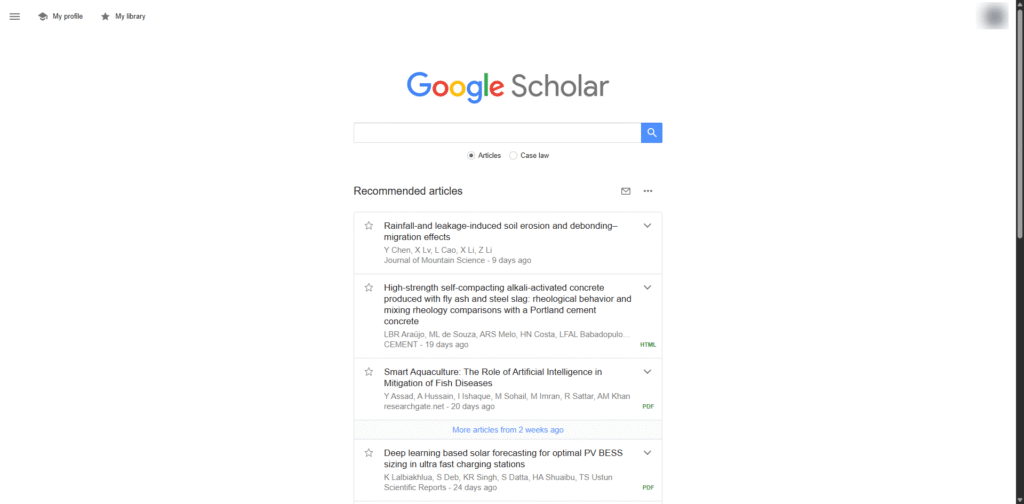
If a document is on an academic site or a publisher platform and looks like research, Google Scholar is likely to pick it up. This loose inclusion policy is why citation counts in Google Scholar and Scopus are usually quite different. Google Scholar often finds more citations, because it includes many informal or less visible sources.
What Scopus is
Scopus is a large abstract and citation database provided by a commercial publisher. It indexes:
Peer reviewed journals
Selected conference proceedings
Books and book series
Some trade publications that meet quality criteria
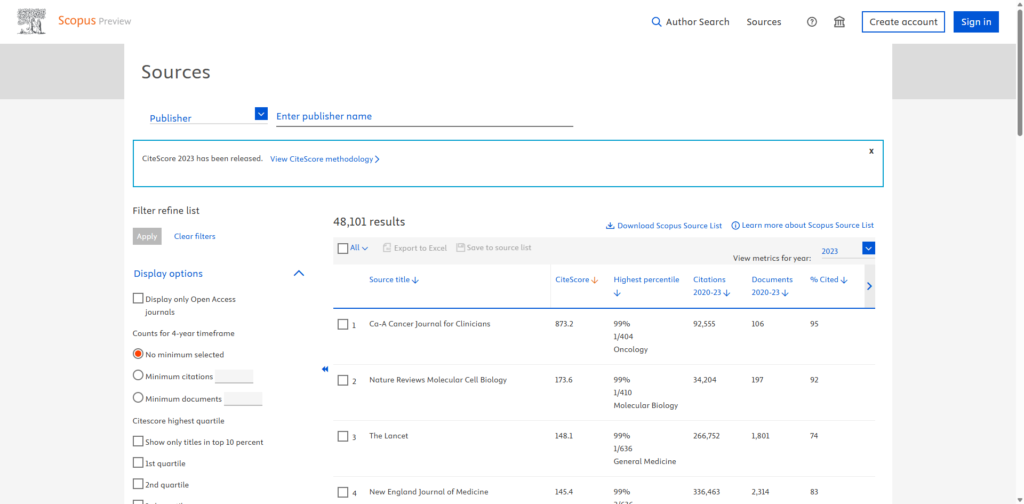
Unlike Google Scholar, Scopus does not simply crawl everything. Journals and conferences are evaluated by editorial boards, and only selected sources are included. That means Google Scholar and Scopus reflect two different philosophies: one emphasizes openness and breadth, the other emphasizes curation and consistency.
Why The Difference Between Google Scholar And Scopus Matters
At first, the choice might seem like a minor technical detail, but it has real consequences. The difference between Google Scholar and Scopus affects:
How many papers you retrieve in a search
Which countries, languages, and disciplines appear most visible
The citation counts shown for your own publications
The h index or other metrics that appear on your profile or in your reports
If your institution bases decisions on Scopus data, while you are more familiar with Google Scholar and Scopus results from your personal searches, you may see very different numbers. Understanding why the numbers differ helps you explain your track record more clearly and avoid confusion or anxiety when you see lower values in one system.
Coverage: How Broad Are Google Scholar And Scopus?
Coverage is usually the first thing people think about when they compare Google Scholar and Scopus.
Breadth versus selection
Because of its crawling approach, Google Scholar indexes a very wide range of content across many disciplines, languages, and document types. It does not rely on formal applications from journals, and it does not limit itself to specific lists of approved sources.
Scopus takes a different path. Editors and review committees decide which journals, conferences, and book series are included. Once accepted, a source is monitored over time. If quality drops, it can be removed. This makes the contents of Google Scholar and Scopus quite different in nature:
Google Scholar aims for maximum breadth.
Scopus aims for curated breadth, with a strong emphasis on formal peer review.
As a result, Google Scholar and Scopus answer different questions. If you want to know everything that might exist on a topic, Google Scholar helps you cast a wide net. If you want to see a cleaned up view of recognized journals and proceedings, Scopus is usually closer to that goal.
Subject and regional differences
The contrast in approach has consequences across disciplines and regions. In many scientific and technical fields, the overlap between Google Scholar and Scopus is fairly large for major journals, but Google Scholar will still include more theses, preprints, and local sources.
In social sciences and humanities, where books, local journals, and non English publications are important, Google Scholar often shows a richer picture than Scopus. On the other hand, Scopus still captures many key journals and conferences and offers better tools for structured searching.
Because of these patterns, people who work in policy, education, or area studies often rely on both Google Scholar and Scopus to avoid missing important work outside mainstream journals.
Document Types: What Gets Counted?
Another important difference between Google Scholar and Scopus is the range of document types each one indexes.
What Google Scholar indexes
Google Scholar includes many types of material:
Articles from journals of very different quality levels
Preprints on repositories and author websites
Theses and dissertations hosted by universities
Books, book chapters, and sometimes even book reviews
Conference papers from both formal proceedings and informal sources
Working papers, policy briefs, and reports
All of these can contribute citations in Google Scholar. When you compare citation counts from Google Scholar and Scopus, the extra citations often come from dissertations, preprints, and reports that would never appear in Scopus at all.
What Scopus indexes
Scopus focuses on:
Peer reviewed journals that pass its selection process
Conference proceedings that meet defined standards
Books and book series chosen by its editorial board
This narrower range means that citations from a master thesis or a local report usually do not affect metrics inside Scopus. In turn, this keeps Scopus citation data more conservative, but also more standardized. Differences between Google Scholar and Scopus are most visible when your work is heavily cited in theses, working papers, or local outlets that Scopus does not track.
Citation Counts And Metrics: Why Numbers Do Not Match
A very common shock for researchers is to discover that the same paper has, for example, one hundred citations in Google Scholar and half of that in Scopus. This is a normal effect of how Google Scholar and Scopus choose what to index.
Why Google Scholar often shows more citations
Google Scholar scans a much wider variety of sources and, in many cases, indexes new items quite quickly. That means:
Citations from theses, reports, preprints, and low visibility journals show up.
Early citations can appear in Google Scholar before they appear in more selective databases.
Citations in non English sources or local journals are more likely to be counted.
For these reasons, citation counts in Google Scholar and Scopus will almost always be higher in Google Scholar, sometimes substantially so. This is particularly true in fields with strong grey literature traditions, such as economics, public policy, and education.
Why Scopus metrics are often preferred for formal evaluation
Even though Google Scholar and Scopus both provide citation data, many universities and funding agencies rely mainly on Scopus for official reporting. The reasons are simple:
Scopus applies clear selection standards.
The metadata for authors and affiliations are more consistent.
It is easier to audit exactly which documents are counted.
In practice, both Google Scholar and Scopus can tell a similar story about which authors or papers are relatively more cited, but Scopus does so using a controlled dataset. That is why it is common to see official guidelines ask for metrics based on Scopus, while individuals still use Google Scholar for their own curiosity.
Search Features And User Experience
The daily experience of searching in Google Scholar and Scopus is also quite different.
How it feels to use Google Scholar
Google Scholar is designed to feel familiar to anyone who uses standard web search. You get:
A simple search box
Basic filters for date range and sorting
“Cited by” links to see who has cited a paper
“Related articles” suggestions
Easy access to full texts when available
This makes Google Scholar and Scopus very different in terms of learning curve. Almost anyone can type a query into Google Scholar and get something useful right away, which is ideal for quick checks and first explorations.
However, Google Scholar has limitations for serious, reproducible searching:
Limited control over specific fields such as title, abstract, or keywords
Fewer options to refine by document type, subject area, or language
Harder export of large result sets for systematic reviews
For casual searching, Google Scholar and Scopus both work, but Google Scholar is the faster and more convenient option.
How it feels to use Scopus
Scopus offers a more complex, but more controllable, interface. You can:
Search specific fields such as title, abstract, keywords, author, or affiliation
Filter by subject area, document type, source title, country, and more
Build complex Boolean queries
Generate citation reports and visualizations
This design makes Scopus more suitable for systematic reviews, advanced literature searches, and bibliometric studies. It takes a little longer to learn, but once you understand the structure, you can do things that are very difficult to reproduce in Google Scholar.
When you need detailed control and clear documentation of your search process, Google Scholar and Scopus are not equal. Scopus generally serves you better for those more demanding tasks.
Strengths of Google Scholar
When you put Google Scholar and Scopus side by side, Google Scholar has several clear advantages:
It is free to use, which is crucial for researchers without access to large institutional subscriptions.
It covers a huge range of material, including grey literature and early versions of papers.
It tends to pick up new citations quickly, especially from preprints and theses.
It is extremely simple and fast for initial exploration of a topic.
For independent researchers, smaller institutions, or people in countries with limited access to commercial databases, Google Scholar and Scopus are not equally available. In that situation, Google Scholar alone can still provide a powerful starting point, as long as you remember that its data are not curated in the same way.
Strengths of Scopus
Scopus has its own strengths when you compare Google Scholar and Scopus directly:
It offers a curated set of sources with explicit quality criteria.
It provides structured author profiles and identifiers, which are very useful for tracking careers and resolving name variants.
It supports refined searching and reproducible search strategies.
It integrates with research management systems and reporting tools used by many universities.
If your institution bases assessments on Scopus data, understanding the Scopus view of your outputs is important, even if you personally prefer the convenience of Google Scholar. For tasks such as promotion dossiers, departmental benchmarking, or collaboration analysis, Google Scholar and Scopus play very different roles, and Scopus is usually the official reference.
When To Use Google Scholar, Scopus, or Both
There is no single correct answer; it always depends on your purpose. A practical approach is to think of Google Scholar and Scopus as complementary tools rather than competitors.
For quick exploratory searches
If you are just starting to explore a topic:
Use Google Scholar to see what comes up first.
Scan titles and abstracts to identify key papers.
Check “Cited by” counts to see which works are especially influential.
In this situation, Google Scholar and Scopus are not equally convenient. Google Scholar usually wins for speed and ease.
For systematic reviews and structured searches
For any project that requires transparency and reproducibility, such as a systematic review or a meta analysis:
Start in Scopus and build a precise search strategy.
Use field specific searches and filters to control the scope.
Export your results into reference management or review software.
You can then add an extra layer by using Google Scholar and Scopus together:
Take a few key articles from your Scopus set.
Use Google Scholar to follow citation trails and spot additional relevant items, especially grey literature.
Decide, based on your protocol, whether and how to include this extra material.
For tracking your own citations and h index
If you want to know how your work is being cited:
Look yourself up in Scopus and check your author profile.
Look yourself up in Google Scholar and, if you wish, maintain a Google Scholar profile.
Compare the citation counts and h indexes.
When you see that Google Scholar reports higher numbers than Scopus, remember that both are correct within their own rules. Those differences simply reflect the distinct coverage of Google Scholar and Scopus.
Common Misconceptions About Google Scholar And Scopus
Because both tools are widely used, some myths have grown up around them.
Myth 1: Google Scholar is not trustworthy, Scopus is perfect.
Reality: Google Scholar does contain more duplicates and some non scholarly items, but Scopus also has errors, especially in author names and affiliations. Both require critical thinking.
Myth 2: If a journal is not in Scopus, it must be low quality.
Reality: Many reputable journals, especially smaller, local, or niche ones, are not indexed. The absence of a journal from Scopus does not automatically mean it is poor. In many fields, you need to look at both Google Scholar and Scopus, and you may need other discipline specific databases as well.
Myth 3: Citation counts are directly comparable across systems.
Reality: Citation counts from Google Scholar and Scopus reflect different sets of documents. You should always say which database you used when you quote a citation total or an h index, and avoid comparing raw numbers from one system with those from another.
Practical Tips For Using Google Scholar And Scopus Together
If you have access to both tools, you can build a workflow that makes good use of Google Scholar and Scopus at the same time.
Start with a structured search in Scopus.
Define your keywords, fields, and filters. Export your initial set of results.Use Google Scholar to expand the picture.
Search for the same topic and see what additional types of documents appear, such as theses or reports. Decide whether they are relevant for your project.Follow citation chains in both systems.
Pick a few key articles and follow their references and citing documents in Google Scholar and Scopus. Each system will reveal slightly different networks of related work.Keep notes on your database choices.
In your methods section or internal notes, record which databases you used, including whether you searched Google Scholar and Scopus, which years you covered, and how you combined results.Review your profiles regularly.
In Scopus, check your author profile and correct any errors through the feedback mechanisms. In Google Scholar, clean up your profile to remove duplicates or non scholarly items so that the numbers you see are as meaningful as possible.
Bringing It All Together
Google Scholar and Scopus are two of the most important tools in modern academic life. They shape how we discover literature, how we measure influence, and how institutions report research performance. Yet they do this in fundamentally different ways.
Google Scholar offers extraordinary breadth, fast access, and a low barrier to entry. Scopus offers curated content, powerful search features, and standardized metrics. When you understand these differences, you can decide when to rely mainly on Scopus, when to lean on Google Scholar, and when to use both together.
Rather than asking which one is better in the abstract, it is more useful to ask which strengths of Google Scholar and Scopus match your current goal. For quick exploration, Google Scholar is hard to beat. For rigorous, documented searching and formal evaluation, Scopus is often the safer foundation. Used together, Google Scholar and Scopus give you a richer, more balanced view of the research landscape and help you make better, more informed decisions about your own work.