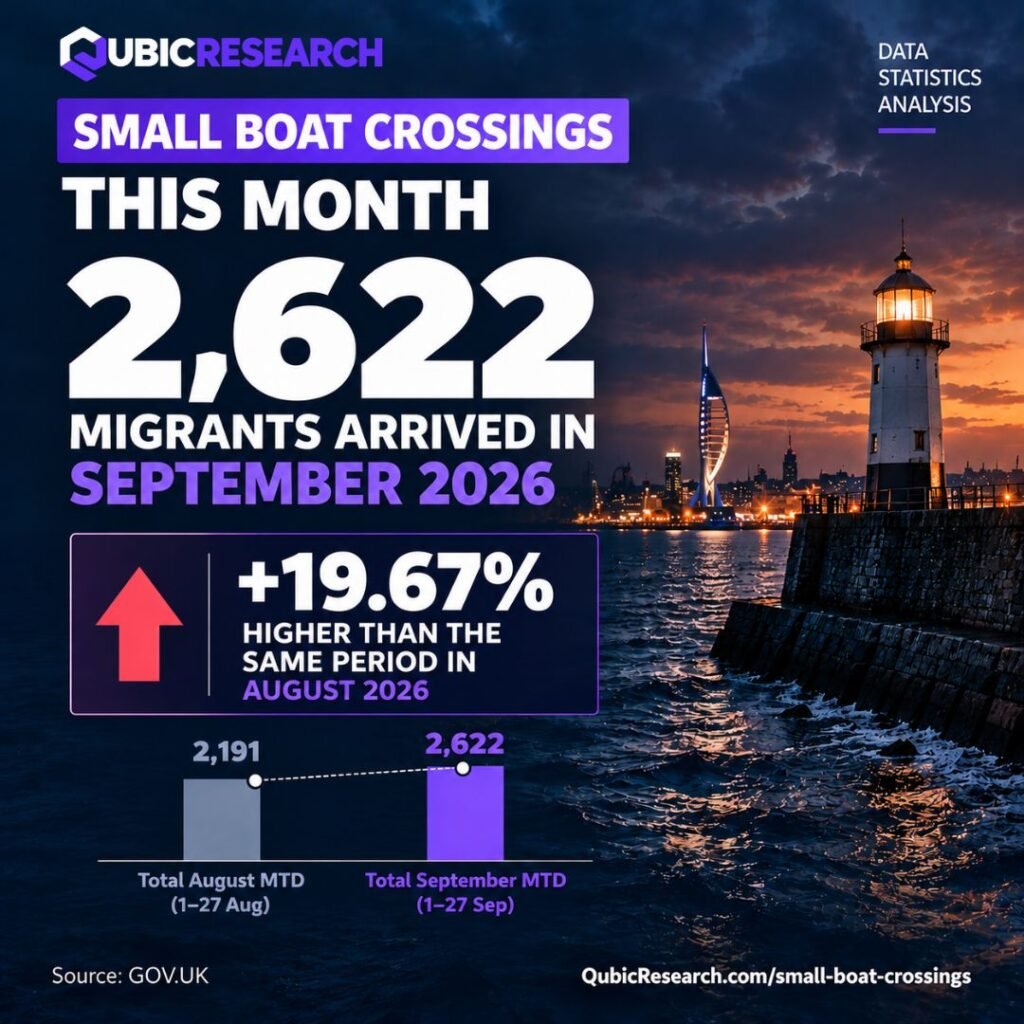
Channel migration figures for September 2026 show a sharp month-to-date escalation in small boat arrivals compared to the same period in August. Official Home Office data published on GOV.UK confirms that 2,622 migrants arrived in the United Kingdom between 1 and 27 September 2026. This represents a 19.67% increase compared to the 2,191 arrivals logged during the corresponding 1–27 August timeframe, revealing an intense late-summer surge across northern European maritime routes.
The 19.67% month-to-date rise highlights how human trafficking syndicates capitalized on temporary weather windows across the Dover Strait to launch concentrated multi-boat armadas. While full monthly totals fluctuate based on sea conditions, comparing identical calendar windows demonstrates accelerated migrant crossings during the primary weeks of September. As Border Force units and reception centers manage increased intake volumes along the Kent coast, transparent statistics provide crucial public insight into ongoing border security challenges.
September Month-to-Date Crossings Jump 19.67% Over August
Official government statistics demonstrate a notable acceleration in Channel crossing activity during the first 27 days of September 2026. Data published on the official GOV.UK reporting portal reveals that 2,622 migrants reached the UK between 1 and 27 September. Compared to the 2,191 arrivals documented during the identical 1–27 August timeframe, crossing volume surged by 19.67%, marking a sharp mid-month acceleration in small boat transits.
1. Month-to-Date Comparative Breakdown (1–27 August vs 1–27 September)
Analyzing equivalent 27-day calendar windows illustrates how smuggler launch patterns shifted between late summer and early autumn.
- Accelerated arrival rate: Processing 431 additional migrants between 1 and 27 September resulted in a 19.67% increase in month-to-date intake pressure compared to August.
- Impact of September weather windows: While August experienced persistent coastal winds during its first three weeks, September featured multiple consecutive days of extremely calm sea states across the Dover Strait.
- High-density mass launch events: Smuggling networks deployed larger fleets in concentrated bursts, including single-day surges reaching up to 781 arrivals in late September.
Key statistical takeaways from the 1–27 September report
- Total September month-to-date arrivals reached 2,622 individuals across official Home Office intake logs.
- The September figure marks a 19.67% increase compared to the 2,191 arrivals recorded from 1 to 27 August.
- Border Force reception centers processed an additional 431 migrants during the September comparison window.
- Official GOV.UK dashboards updated comparative tables to record the mid-month volume escalation.
2. Factors Driving the Month-to-Date Increase
The 19.67% spike in arrivals between identical 27-day periods stems from shifting meteorological conditions and evolving smuggler departure tactics along the northern French coast.
- Favourable maritime weather spells: Prolonged spells of low wind speeds during mid-September opened multi-day sailing windows that were absent during early August.
- Overcrowded boat deployments: Smuggling syndicates increased average passenger densities per craft, cramming over 75 people onto individual rigid-hulled inflatables to maximize launch output.
- Coordinated beach departures: Multiple boat launches occurred simultaneously across broad stretches of coastline near Calais and Dunkirk, seeking to overwhelm French beach patrols.
Operational highlights behind the September surge
- Coastguard and Border Force assets executed continuous maritime escorts during peak September sailing windows.
- French security forces intercepted hundreds of migrants along launch dunes, though multi-boat pushes still breached perimeter lines.
- Dover intake centers mobilized emergency administrative staff to process rapid multi-vessel arrivals.
- Home Office data repositories cataloged verified arrival counts into public data archives.
3. Impact on Onshore Intake and Resource Allocation
The 19.67% month-to-date escalation between August and September placed intense operational pressure on coastal Border Force reception infrastructure in Kent.
- Elevated daily intake throughput: Onshore triage centers at Dover and Manston experienced concentrated periods of high arrival density, requiring rapid administrative processing.
- Mobilization of coastal transport fleets: Moving 2,622 migrants from dockside points to holding centers required continuous deployment of specialized passenger buses throughout September.
- Emergency medical and biometric screening: Security personnel and healthcare teams operated around the clock during multi-boat arrival days to complete mandatory identity checks and health triage.
Key operational takeaways from the 1–27 September intake
- Border Force facilities managed 431 more arrivals during the first 27 days of September than in the equivalent August period.
- Emergency escort protocols were activated continuously across the Dover Strait to safely guide overcrowded inflatables into harbour.
- French law enforcement intensified beach interdictions, preventing dozens of secondary launch attempts during clear weather spells.
- Government statistical portals updated operational records to reflect the 19.67% month-to-date volume increase.
4. Border Security Policy and Autumn Enforcement Outlook
The period-on-period rise in small boat arrivals highlights the ongoing challenge facing joint UK-French enforcement strategies along the northern French coastline.
- Bilateral enforcement scrutiny: The month-to-date volume increase has prompted calls for enhanced surveillance technologies and expanded beach patrol perimeters near launch hot spots.
- Disruption of criminal supply chains: International law enforcement agencies continue targeting human smuggling syndicates in Europe to seize outboard motors and commercial-grade inflatables.
- Public transparency via live data tracking: Transparent daily and monthly tracking metrics ensure policymakers and the public can analyze real-time migration trends against historical baselines.
Summary of mid-month border enforcement developments
- Home Office teams verified 2,622 arrivals across the 1–27 September monitoring window for official archive records.
- Joint intelligence sharing enabled coastal security forces to anticipate major multi-boat departure pushes during clear sea windows.
- Regional processing hubs maintained high operational capacity to handle the period-on-period volume increase.
- Official databases updated comparative metrics to record the 19.67% month-to-date surge over August.
Final Thoughts on September Month-to-Date Crossing Trends
The official figures for 1–27 September 2026—confirming 2,622 small boat arrivals and a 19.67% increase compared to the same 27-day period in August—underline the unpredictable nature of Channel migration. As human smuggling syndicates adapt their departure tactics to exploit calm autumn sea states, UK border security assets face continuous operational pressure. Accessing verified, real-time statistics remains vital for evaluating border management performance and tracking ongoing developments along the southern coastline.
Want to see live channel migration data?
Explore more data, statistics, and analysis on our Small Boat Crossings Dashboard to track daily arrival trends, vessel counts, and historical figures.
Frequently Asked Questions
How many small boat migrants arrived in the UK between 1 and 27 September 2026?
Official Home Office figures show that 2,622 migrants arrived in the UK via small boat crossings between 1 and 27 September 2026.
How do September month-to-date crossings compare to August?
Small boat arrivals between 1 and 27 September were 19.67% higher than the 2,191 arrivals recorded during the identical 1–27 August timeframe.
Why did small boat crossings increase month to date in September?
The 19.67% rise was primarily driven by several multi-day windows of calm maritime weather across the Dover Strait, allowing organized smuggling rings to launch multiple overloaded boats simultaneously.
Where are small boat arrivals processed upon reaching the UK?
Interdicted passengers are brought to coastal processing facilities in Dover and Kent for medical checks, biometric identification, and administrative intake.
Where can I track official daily and monthly small boat crossing statistics?
Official government figures are published on GOV.UK, and updated daily breakdowns, period comparisons, and historical charts can be tracked directly on our live data dashboard.