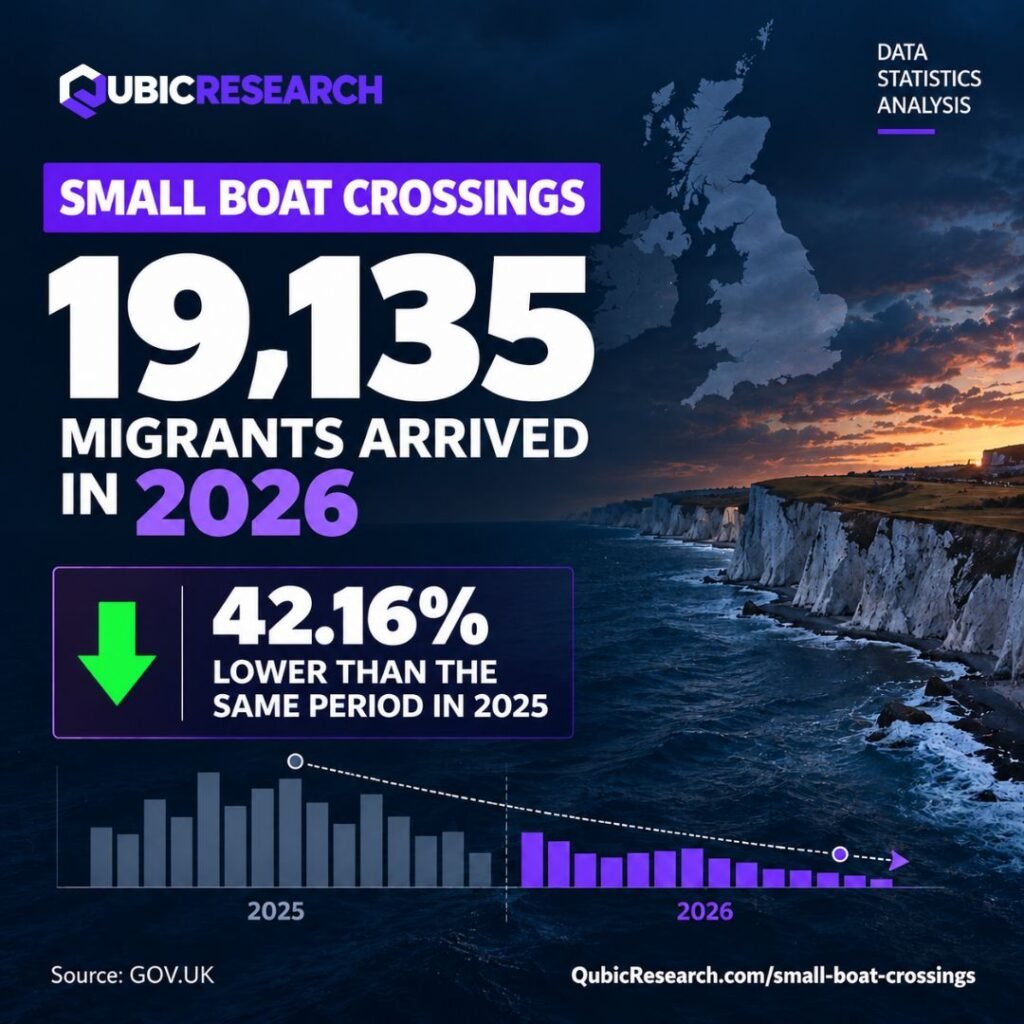
Cumulative Channel crossing figures published by the Home Office show a sharp drop in small boat arrivals for 2026, even as total headcounts cross a major year-to-date milestone. Official GOV.UK tracking data confirms that 19,135 migrants have arrived in the United Kingdom via small boats so far in 2026. This figure represents a dramatic 42.16% decrease compared to the exact same period in 2025, highlighting a significant shift in total maritime migration volume across northern European waters.
The steep 42.16% reduction reflects enhanced bilateral coastal enforcement along northern French beaches, combined with prolonged periods of adverse weather across the Dover Strait. Despite recent single-day spikes during calm autumn sailing windows, annual cumulative data shows a sustained downward trajectory compared to 2025 figures. As border authorities maintain intensive maritime surveillance, transparent daily tracking metrics provide vital public insight into overall border security performance and intake demands.
2026 Channel Crossings Plummet 42.16% Compared to 2025
Official government statistics demonstrate a significant year-on-year drop in overall English Channel migration totals for 2026. Data published on the official GOV.UK reporting portal reveals that cumulative arrivals for 2026 have reached 19,135 migrants. Compared to the corresponding period in 2025, small boat arrival volumes have fallen by 42.16%, marking one of the most substantial sustained reductions in Channel crossing activity observed in recent years.
1. Comprehensive Breakdown of the 42.16% Decrease
Evaluating the 2026 year-to-date total of 19,135 arrivals reveals clear structural trends in maritime migration patterns across northern France and the UK coastline.
- Substantial year-on-year drop: A 42.16% decrease in cumulative arrivals demonstrates that fewer total individuals have reached British shores compared to the high-volume numbers recorded throughout 2025.
- Impact of coastal enforcement: Expanded joint intelligence operations and heavy French police deployments along departure beaches near Calais and Dunkirk have disrupted launch attempts before vessels leave shore.
- Fluctuating monthly volumes: While weather-driven spikes occur during calm sea windows, total monthly totals across spring and summer remained consistently lower than 2025 baselines.
Key statistical takeaways from the 2026 data
- Cumulative 2026 arrivals reached 19,135 individuals across official Border Force intake records.
- The current 2026 total represents a sharp 42.16% decline compared to the equivalent 2025 reporting period.
- Bilateral beach prevention schemes prevented thousands of additional potential crossings before launch.
- Official GOV.UK tracking systems continue to log daily arrival counts into public data archives.
2. Factors Driving the Lower Arrival Numbers in 2026
The sharp reduction in small boat arrivals throughout 2026 stems from a combination of strategic border enforcement measures and extended adverse maritime weather.
- Disruption of smuggling supply chains: International law enforcement raids targeting human trafficking rings across Western Europe have seized equipment and restricted access to engines and inflatables.
- Increased beach interception rates: French security forces prevented over 60% of attempted departures during high-volume summer periods through expanded dune patrols and drone monitoring.
- Extended winter and spring storms: Severe sea states and unfavorable wind directions repeatedly closed maritime sailing windows across the Dover Strait for weeks at a time.
Operational highlights behind the 2026 trend
- Increased intelligence sharing between French and British authorities led to multiple high-profile arrests of smuggling organizers.
- Enhanced shoreline surveillance assets along French launch sites resulted in higher numbers of intercepted inflatables.
- Onshore processing facilities in Dover experienced lower average daily intakes throughout the first three quarters of 2026.
- Home Office data archives confirm a persistent gap between 2025 arrival trajectories and current 2026 totals.
3. Seasonal Projections and Autumn Crossing Trends
Analyzing late-season arrival patterns provides crucial foresight into how total 2026 figures will compare against historic annual totals as winter weather approaches.
- Late-autumn weather window risks: Human smuggling syndicates frequently accelerate launch attempts during brief calm spells in October and November to maximize annual totals before severe winter storms set in.
- Evolving smuggler logistics: Despite the overall 42.16% reduction in arrivals, criminal rings continue attempting to offset beach intercepts by deploying larger, double-hulled inflatables.
- Sustained coastal monitoring: UK Border Force cutters and RNLI lifeboats maintain 24-hour patrols across primary Dover Strait shipping lanes to intercept incoming craft safely.
Key factors shaping the 2026 year-end outlook
- Cumulative arrivals reaching 19,135 keep 2026 on track for one of the lowest annual totals in recent years.
- French security forces continue expanding beach patrol perimeters to cover secondary departure points along the Normandy coast.
- Dover intake centers remain equipped to handle sudden weather-driven spikes during late-autumn sailing windows.
- Official Home Office dashboards update weekly to measure total 2026 figures against historical annual benchmarks.
4. Policy Implications and Future Border Enforcement
The sustained 42.16% drop in small boat arrivals serves as a central data point in ongoing political debates surrounding UK border control and bilateral security agreements.
- Evaluation of international partnerships: Joint intelligence sharing and UK funding for French beach patrols have proven instrumental in lowering total crossing volumes throughout 2026.
- Impact on onshore asylum logistics: Lower total intake figures have reduced immediate capacity pressure on short-term holding centers and regional reception infrastructure in Kent.
- Public demand for verified statistics: Transparent daily tracking ensures that policymakers and the public can monitor real-time migration trends against official government benchmarks.
Summary of annual border security developments
- Home Office enforcement units continue coordinating closely with European law enforcement agencies to dismantle supply networks.
- Biometric screening and rapid processing protocols ensure all 19,135 arrivals in 2026 are fully documented upon landing.
- Regional transport hubs efficiently manage onshore logistics during isolated high-volume crossing days.
- Official statistical repositories maintain transparent public records of all verified small boat arrival metrics.
Final Thoughts on 2026 Small Boat Crossing Statistics
The official data confirming 19,135 small boat arrivals in 2026—a 42.16% drop compared to the same period in 2025—marks a clear shift in Channel migration trends. While brief weather windows still bring isolated single-day surges, increased beach interdictions and targeted law enforcement operations have successfully reduced overall crossing volumes this year. Accessing transparent, real-time statistics remains vital for understanding border security dynamics, evaluating enforcement policies, and tracking ongoing developments along Britain’s southern coastline.
Want to see live channel migration data?
Explore more data, statistics, and analysis on our Small Boat Crossings Dashboard to track daily arrival trends, vessel counts, and historical figures.
Frequently Asked Questions
How many small boat migrants have arrived in the UK in 2026 so far?
According to official Home Office figures, 19,135 migrants have arrived in the UK via small boat crossings in 2026 so far.
How does the 2026 small boat total compare to 2025?
Small boat arrivals in 2026 are currently 42.16% lower than the total recorded during the exact same period in 2025.
Why have small boat crossings decreased in 2026?
The 42.16% decline is largely driven by increased beach interceptions by French police, international crackdowns on human smuggling supply chains, and extended periods of poor maritime weather.
Where do small boat migrants go after arriving in the UK?
After being interdicted in the Channel, migrants are brought to reception facilities in Dover and Kent for medical triage, biometric security checks, and initial processing.
Where can I track daily and historical small boat crossing figures?
Official daily statistics are published on GOV.UK, and comprehensive live updates and interactive charts can be accessed directly on our tracking dashboard.