

Scientific research output serves as a definitive barometer for a nation’s innovation capacity, academic rigour, and geopolitical influence. In 2026, the global knowledge landscape is undergoing a profound transformation; while established powers continue to push boundaries, emerging economies are rapidly scaling their contributions, fundamentally reshaping how the world produces and shares discovery.
About This Data
- The Source: All figures are pulled live from OpenAlex, a world-leading, open-access index of over 250 million scientific works.
- The Ranking: Nations are ranked by the total volume of research papers, preprints, and conference proceedings published in the 2025 calendar year.
- Why Trust It: OpenAlex is a transparent, non-profit database used by governments and major universities globally to track scientific progress objectively.
- Data Snapshot: March 2026. Totals for 2025 may adjust slightly as late-year archival records and metadata are processed by the index.
Key Takeaways
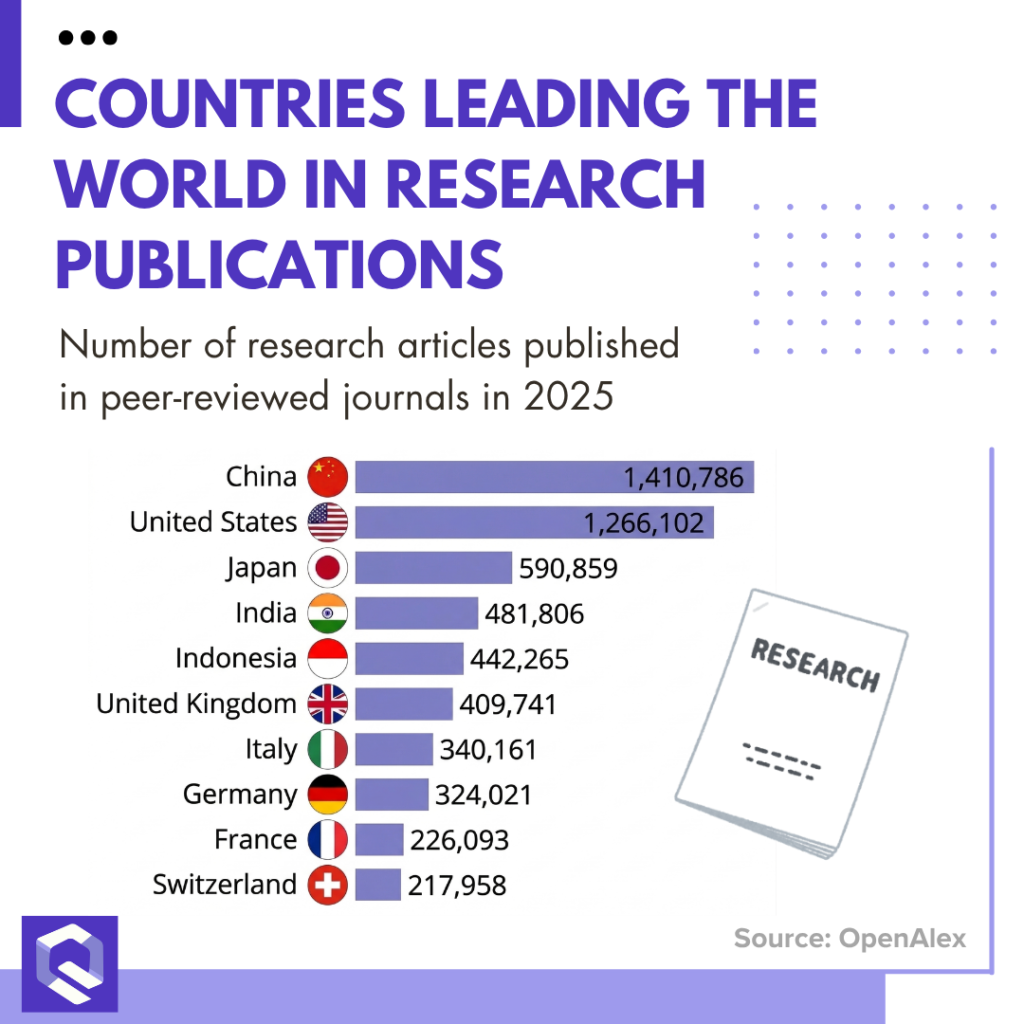
- China has widened its lead over the United States, finishing 2025 as the world’s undisputed volume leader in scientific research.
- Indonesia has emerged as a global powerhouse at number five, remarkably surpassing several G7 and established European nations.
- Traditional research leaders such as Canada and Australia have dropped out of the Top 10, reflecting a significant shift in global knowledge production.
- Japan remains a formidable force at number three, demonstrating incredible resilience and scientific consistency amidst fierce competition.
Top 200 Countries with the Most Research Articles Published in Peer-reviewed Journals in 2025
| Rank | Country | Papers Published |
|---|---|---|
| 1 | China | 1,410,786 |
| 2 | United States of America | 1,266,102 |
| 3 | Japan | 590,859 |
| 4 | India | 481,806 |
| 5 | Indonesia | 442,265 |
| 6 | United Kingdom | 409,741 |
| 7 | Italy | 340,161 |
| 8 | Germany | 324,021 |
| 9 | France | 226,093 |
| 10 | Switzerland | 217,958 |
| 11 | Brazil | 216,015 |
| 12 | Canada | 186,378 |
| 13 | Spain | 185,854 |
| 14 | Australia | 166,502 |
| 15 | Turkey | 147,331 |
| 16 | Russian Federation | 138,946 |
| 17 | Korea Republic of | 136,006 |
| 18 | Netherlands | 107,088 |
| 19 | Poland | 95,661 |
| 20 | Iran Islamic Republic of | 90,406 |
| 21 | Saudi Arabia | 87,427 |
| 22 | Belgium | 81,584 |
| 23 | Pakistan | 79,471 |
| 24 | Malaysia | 70,583 |
| 25 | Sweden | 68,461 |
| 26 | Mexico | 68,234 |
| 27 | Egypt | 61,516 |
| 28 | Taiwan Province of China | 59,807 |
| 29 | Portugal | 54,199 |
| 30 | Nigeria | 53,149 |
| 31 | South Africa | 52,825 |
| 32 | Austria | 52,218 |
| 33 | Denmark | 49,927 |
| 34 | Norway | 49,908 |
| 35 | Czechia | 49,768 |
| 36 | Hong Kong | 49,206 |
| 37 | Ukraine | 46,913 |
| 38 | Singapore | 41,836 |
| 39 | Thailand | 41,806 |
| 40 | Greece | 41,209 |
| 41 | Finland | 40,433 |
| 42 | Iraq | 39,723 |
| 43 | Bangladesh | 38,695 |
| 44 | Israel | 35,859 |
| 45 | Viet Nam | 35,722 |
| 46 | Chile | 34,461 |
| 47 | Ireland | 33,266 |
| 48 | Colombia | 32,827 |
| 49 | Romania | 31,874 |
| 50 | Argentina | 30,639 |
| 51 | Hungary | 30,222 |
| 52 | United Arab Emirates | 29,379 |
| 53 | Ecuador | 28,492 |
| 54 | Morocco | 26,148 |
| 55 | Philippines | 24,719 |
| 56 | New Zealand | 24,455 |
| 57 | Uzbekistan | 20,767 |
| 58 | Peru | 19,989 |
| 59 | Ethiopia | 19,969 |
| 60 | Jordan | 18,533 |
| 61 | Tunisia | 17,753 |
| 62 | Kazakhstan | 16,980 |
| 63 | Slovakia | 16,961 |
| 64 | Serbia | 16,612 |
| 65 | Algeria | 16,431 |
| 66 | Bulgaria | 16,176 |
| 67 | Nepal | 15,640 |
| 68 | Croatia | 15,304 |
| 69 | Slovenia | 15,203 |
| 70 | Kenya | 14,163 |
| 71 | Ghana | 13,392 |
| 72 | Macao | 12,210 |
| 73 | Azerbaijan | 11,239 |
| 74 | Qatar | 11,101 |
| 75 | Cyprus | 10,078 |
| 76 | Uganda | 8,961 |
| 77 | Lithuania | 8,871 |
| 78 | Tanzania United Republic of | 8,690 |
| 79 | Sri Lanka | 8,611 |
| 80 | Lebanon | 8,559 |
| 81 | Estonia | 7,725 |
| 82 | Oman | 7,581 |
| 83 | Belarus | 6,637 |
| 84 | Cameroon | 6,456 |
| 85 | Kuwait | 6,144 |
| 86 | Latvia | 6,115 |
| 87 | Costa Rica | 6,058 |
| 88 | Georgia | 5,793 |
| 89 | Cambodia | 5,361 |
| 90 | Uruguay | 5,314 |
| 91 | Palestine State of | 5,068 |
| 92 | Luxembourg | 4,992 |
| 93 | Armenia | 4,933 |
| 94 | Yemen | 4,852 |
| 95 | North Macedonia | 4,715 |
| 96 | Puerto Rico | 4,667 |
| 97 | Sudan | 4,648 |
| 98 | Mongolia | 4,394 |
| 99 | Tajikistan | 4,350 |
| 100 | Bosnia and Herzegovina | 4,288 |
| 101 | Zambia | 4,212 |
| 102 | Venezuela Bolivarian Republic of | 3,965 |
| 103 | Rwanda | 3,939 |
| 104 | Zimbabwe | 3,905 |
| 105 | Panama | 3,856 |
| 106 | Cuba | 3,554 |
| 107 | Libya | 3,526 |
| 108 | Bolivia Plurinational State of | 3,474 |
| 109 | Iceland | 3,392 |
| 110 | Antigua and Barbuda | 3,065 |
| 111 | Bahrain | 3,047 |
| 112 | Côte d’Ivoire | 2,973 |
| 113 | Myanmar | 2,957 |
| 114 | Albania | 2,908 |
| 115 | Kyrgyzstan | 2,904 |
| 116 | Moldova Republic of | 2,845 |
| 117 | Paraguay | 2,806 |
| 118 | Afghanistan | 2,759 |
| 119 | Congo Democratic Republic of the | 2,752 |
| 120 | Malawi | 2,527 |
| 121 | Senegal | 2,519 |
| 122 | Montenegro | 2,497 |
| 123 | Syrian Arab Republic | 2,471 |
| 124 | Burkina Faso | 2,453 |
| 125 | Benin | 2,337 |
| 126 | Mozambique | 2,260 |
| 127 | Malta | 2,169 |
| 128 | Brunei Darussalam | 2,077 |
| 129 | South Sudan | 1,963 |
| 130 | Botswana | 1,948 |
| 131 | Guatemala | 1,841 |
| 132 | Kosovo | 1,765 |
| 133 | Dominican Republic | 1,659 |
| 134 | Greenland | 1,605 |
| 135 | Nicaragua | 1,524 |
| 136 | Burundi | 1,478 |
| 137 | Somalia | 1,469 |
| 138 | Namibia | 1,260 |
| 139 | Madagascar | 1,244 |
| 140 | Réunion | 1,214 |
| 141 | Honduras | 1,193 |
| 142 | El Salvador | 1,183 |
| 143 | Congo | 1,132 |
| 144 | Lao People’s Democratic Republic | 1,052 |
| 145 | Togo | 1,045 |
| 146 | Angola | 1,038 |
| 147 | Mali | 1,034 |
| 148 | Trinidad and Tobago | 979 |
| 149 | Saint Kitts and Nevis | 931 |
| 150 | Fiji | 878 |
| 151 | Maldives | 862 |
| 152 | Niger | 849 |
| 153 | Korea Democratic People’s Republic of | 823 |
| 154 | Mauritius | 767 |
| 155 | Gambia | 761 |
| 156 | Sierra Leone | 731 |
| 157 | Jamaica | 716 |
| 158 | Papua New Guinea | 667 |
| 159 | Grenada | 591 |
| 160 | Gabon | 568 |
| 161 | Turkmenistan | 550 |
| 162 | Guinea | 545 |
| 163 | Guadeloupe | 511 |
| 164 | Barbados | 481 |
| 165 | French Guiana | 432 |
| 166 | New Caledonia | 432 |
| 167 | Timor-Leste | 415 |
| 168 | Guyana | 364 |
| 169 | Martinique | 358 |
| 170 | Bhutan | 348 |
| 171 | Monaco | 348 |
| 172 | Liechtenstein | 326 |
| 173 | Chad | 308 |
| 174 | Eswatini | 293 |
| 175 | Sao Tome and Principe | 283 |
| 176 | Central African Republic | 277 |
| 177 | Curaçao | 276 |
| 178 | Liberia | 251 |
| 179 | French Polynesia | 247 |
| 180 | Lesotho | 240 |
| 181 | Haiti | 222 |
| 182 | Bahamas | 211 |
| 183 | Guam | 210 |
| 184 | Cayman Islands | 201 |
| 185 | Mauritania | 194 |
| 186 | Guinea-Bissau | 184 |
| 187 | Faroe Islands | 178 |
| 188 | American Samoa | 171 |
| 189 | Belize | 159 |
| 190 | Cabo Verde | 157 |
| 191 | Tonga | 140 |
| 192 | Seychelles | 138 |
| 193 | Svalbard and Jan Mayen | 138 |
| 194 | Sint Maarten (Dutch part) | 136 |
| 195 | Suriname | 135 |
| 196 | Virgin Islands British | 132 |
| 197 | San Marino | 116 |
| 198 | Eritrea | 113 |
| 199 | Gibraltar | 113 |
| 200 | Bermuda | 108 |
Global Leaders in Research: A Closer Look
1. China and the United States: The Global Powerhouses
The data shows a clear pattern at the very top. China and the United States continue to dominate global research output by a significant margin, producing well over one million publications each.
This level of output is not accidental. It is driven by long-term investment, strong academic infrastructure, and large research communities.
Key reasons behind their dominance include:
- Massive funding for research and development
- World-leading universities and institutions
- Strong collaboration between academia and industry
- Large populations of researchers and PhD students
While China leads in volume, the United States remains highly influential in terms of innovation, research quality, and global impact.
2. Asia’s Rapid Rise in Research Output
Beyond the top two, Asia is clearly shaping the future of global research. Countries such as Japan, India, Indonesia, and South Korea are all major contributors.
What is particularly notable is how quickly some of these countries are climbing the rankings.
Key trends across Asia:
- India continues to expand its academic and technology sectors
- Indonesia has emerged as a surprisingly strong contributor
- South Korea and Japan maintain high output with strong innovation systems
- Regional collaboration across Asia is increasing
This shift highlights a broader global trend, where research activity is becoming less concentrated and more geographically diverse.
3. Europe’s Consistent and Balanced Performance
Europe remains one of the most stable and reliable regions for research output. Multiple countries consistently appear near the top of the rankings.
Rather than relying on a single dominant country, Europe benefits from a network of strong research nations.
Standout characteristics of European research:
- High levels of international collaboration
- Strong public funding for universities and research institutions
- A focus on quality and impact alongside volume
- Well-established academic traditions
Countries such as the United Kingdom, Germany, Italy, and France continue to perform strongly, while smaller nations like Switzerland and the Netherlands punch above their weight.
4. Emerging Research Nations to Watch
One of the most interesting aspects of the data is the rise of emerging research nations. These countries may not yet compete with the top tier in total output, but their growth is significant.
Countries showing strong upward momentum include:
- Nigeria
- Pakistan
- Bangladesh
- Egypt
- Malaysia
This growth is often driven by improving access to education, increased government investment, and expanding international partnerships.
Over time, these nations could play a much larger role in the global research landscape.
What Drives Research Output?
Research productivity does not happen by chance. It is shaped by a combination of economic, institutional, and policy factors.
The most important drivers include:
- Investment in R&D
Countries that invest heavily in research funding tend to produce more publications. - University Strength
Top-performing universities act as major engines of research output. - International Collaboration
Working with global partners increases both the volume and visibility of research. - Population Size
Larger countries often produce more research simply due to having more researchers. - Government Policy
Strategic focus on science, innovation, and education plays a critical role.
Understanding the Limitations
While this ranking provides valuable insight, it is important to understand what it does and does not measure.
This data focuses on:
- Total number of published research papers
It does not account for:
- The quality or impact of those papers
- Citation counts or influence in the academic community
- Differences between research fields
Because of this, publication volume should be seen as one part of a much bigger picture.
Frequently Asked Questions
China reached the top position through decades of strategic investment in research and development. In 2025, China produced more than 1.4 million papers, which is approximately 144,000 more than the United States. This growth is supported by a large researcher population and strong government policy.
Indonesia has made a remarkable entry into the top five, securing the fifth position globally. With 442,265 papers published in 2025, it has overtaken traditional research powers such as the United Kingdom, Germany, and France.
The data includes a wide range of scientific works such as journal articles, preprints, and conference proceedings. OpenAlex serves as a comprehensive and transparent database used by the global academic community to monitor scientific contributions accurately.
Conclusion
The global research landscape continues to evolve. While established leaders remain dominant, the gap between countries is gradually narrowing as more nations invest in science and education.
What stands out most is the increasing diversity of research activity. More countries are contributing meaningful output, which is helping to create a more collaborative and globally distributed research ecosystem.
As this trend continues, the future of research is likely to be shaped not just by a few leading nations, but by a much broader international community.