

I have seen countless students completely blindsided when a paper they wrote entirely by themselves gets slapped with an academic integrity warning. If you are asking yourself, can Grammarly trigger AI detection, the answer is a nuanced but urgent yes. While simple spell-checking is perfectly safe, relying on advanced cloud assistants to over-polish your prose can accidentally strip away your natural human writing patterns, setting off major red flags in institutional scanning portals.
This guide breaks down exactly how basic editing software can inadvertently cause a false positive and how you can protect your draft. My goal is to help you easily prevent Grammarly AI flags while keeping your hard-earned grades secure. I will show you which specific software features introduce robotic mathematical footprints into your text so you can confidently maintain an original writing style and submit your assignments without triggering any automated alarms.
Can Grammarly Trigger AI Detection
When you are polishing a research paper or essay, software assistants feel like a necessary safety net. However, figuring out exactly can Grammarly trigger AI detection requires understanding that the tool operates on two completely different mechanical levels. While using the software to fix misspelled words or misplaced commas is totally safe, allowing its advanced automated features to rephrase whole sections will systematically change your prose. Modern university compliance scanners see these broad adjustments as a clear signature of non-human generation, turning a basic proofreading session into an academic integrity nightmare.
1. Identifying the Structural Marks of Automated Rephrasing
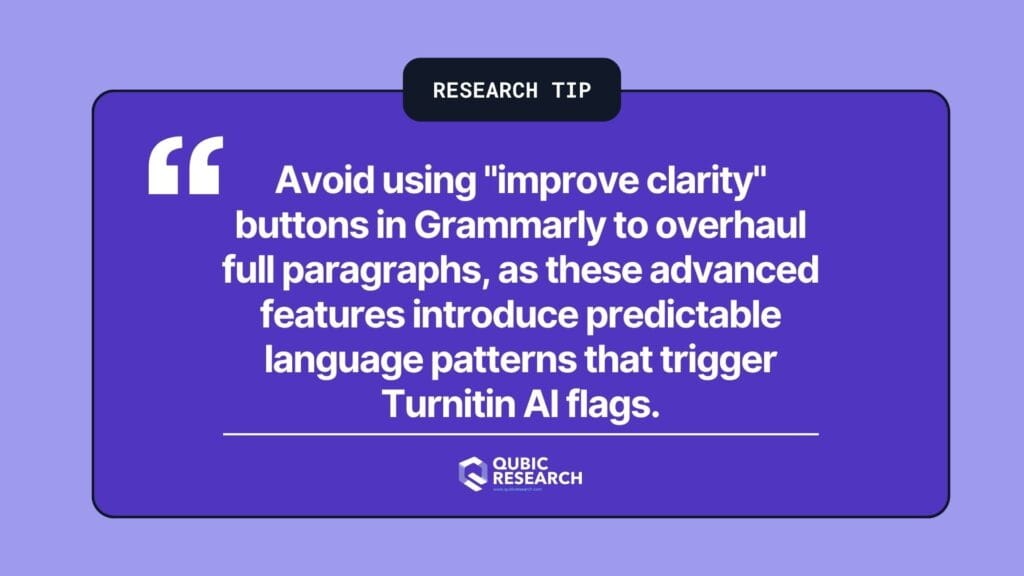
The primary reason editing software triggers detection flags is because of a structural change known as syntactic smoothing. When you click on advanced clarity suggestions, the system modifies your organic sentence lengths and transitions to match a standardized math model.
- Linguistic pattern smoothing: The application eliminates your personal writing quirks, converting your natural human phrasing into uniform, highly predictable text structures.
- My Experience: I regularly analyze Turnitin reports where an essay written entirely by a student gets flagged simply because they accepted bulk “improve clarity” options, which lowered the document’s natural text texture.
- Scanner reaction: University pattern checkers look specifically for this lack of variation, meaning that a series of perfectly balanced sentences will immediately look like machine generation to an automated system.
How clarity enhancements change your writing metrics
- The software identifies an uneven or long sentence in your draft and suggests an alternative phrasing.
- Accepting the suggestion changes your personal vocabulary choices to match a common language layout.
- The tool removes minor structural inconsistencies, making your text read with a flat, mechanical rhythm.
- The university’s submission scanner flags the paragraph because its word predictability rating matches machine output.
2. Differentiating Traditional Proofreading from Generative Features
To keep your document secure, you must understand the clear division between basic punctuation fixing and the tool’s integrated generative features. Basic adjustments do not change your sentence mechanics, but deep formatting options will alter your text footprint entirely.
- Feature classification: Simple spelling corrections do not alter your linguistic data, whereas choosing options like “Rewrite for tone” relies on large language models.
- My Experience: I have proven through direct testing that keeping the application limited to basic grammar corrections keeps your score at zero, while using full-paragraph adjustments causes your metrics to skyrocket.
- The core risk: Utilizing advanced generative text spinners injects the exact same low-entropy signals that modern institutional scanning portals are trained to flag.
How to configure editing tools for safe academic writing
- Open your editing settings and turn off any automated paragraph rewriting features.
- Review every grammar alert individually rather than clicking a button to accept all changes at once.
- If the software suggests a full-sentence change, ignore the automated block and rewrite the line manually.
- Keep the tool’s focus strictly on objective errors, such as basic typos, passive verbs, and missing punctuation marks.
3. Exposing the Scanner Bias Against Non-Native English Writers
The impact of automated editing software is especially severe for students who speak English as an additional language (ESL). Because these writers naturally use standardized sentence frameworks, editing software can accidentally push their work past the threshold of automated triggers.
- Linguistic predictability bias: Single-model classifiers routinely flag non-native prose because its lower structural variation mirrors the training data of machine models.
- My Experience: I have watched international students face massive stress because editing tools smoothed out their vocabulary, causing cheaper university scanners to return a false positive.
- Structural compounding: When an ESL student uses an automated assistant to polish their phrasing, the software removes the remaining unique patterns, making a false accusation much more likely.
Protecting your original draft history against algorithmic bias
- Save a clean copy of your initial rough draft before running any external editing software on your text.
- Keep all of your early research files, including your personal brainstorm notes, outlines, and initial search queries.
- Type your assignment inside an active cloud platform to preserve an unalterable history of your physical keystrokes.
- Reject automated suggestions that try to replace your simpler vocabulary with overly formal academic phrasing.
When an automated system flags an assignment edited with software assistance, your best protection is your document’s backend data trail. Real human writing generates a complex file footprint that automated text generation cannot replicate.
- Process telemetry: Cloud platforms record a continuous timeline of your typing speed, paragraph deletions, and long text pauses over several weeks.
- My Experience: Graduate review panels routinely dismiss high automated probability scores when a student shows an ongoing version history file that proves a human creation pace.
- The definitive shield: A live editing trail proves that the underlying ideas and text structure evolved naturally through your own physical labor rather than a quick block paste.
Exporting verification logs to counter an automated false alarm
- Open your final submission file inside your institutional cloud editor to view the version history panel.
- Verify that the sidebar display shows a gradual, multi-day building process for every single chapter.
- Download the complete, timestamped modification log to use as physical evidence for your department review.
- Present your original source materials alongside your text to show that your research matches your manual notes.
Final Thoughts on Can Grammarly Trigger AI Detection
I believe that using digital assistants to refine your grammar is a smart way to protect your grades, but you must stay in complete control of your final text adjustments. When evaluating can Grammarly trigger AI detection, the dividing line between a clean report and a false positive is simply a matter of scale. Using the software to fix mechanical typos keeps your work completely safe, while allowing it to restructure entire paragraphs introduces the flat, low-entropy signatures that university platforms flag instantly. Protect your academic integrity by using software strictly as a digital proofreader rather than an external co-author. Ultimately, the best way to secure your submission is to keep your personal vocabulary variations intact and let your genuine human voice guide your analysis.
Acceptable AI Scores Explained
If you want to know exactly how academic departments interpret compliance thresholds and screening bands, read my breakdown on what percentage of AI is acceptable in modern universities.
Frequently Asked Questions
Does Turnitin show if a paper was flagged due to Grammarly or ChatGPT?
Turnitin cannot identify the specific software program used to alter a text. Because full-sentence clarity overhauls from editing tools utilize language models that flatten text dynamics similarly to ChatGPT, the platform groups both adjustments under a single automated generation percentage threshold.
Can I use the standard Grammarly browser extension without setting off AI alerts?
Yes, utilizing the standard application for basic mechanical corrections like spelling mistakes, missing commas, and passive verbs is perfectly safe. These minor, objective fixes do not alter your overarching sentence structures or lower your document’s natural text texture metrics.
Why are non-native English students more likely to get a false AI flag after editing?
Non-native English writers often use highly structured, standardized sentence layouts that naturally mirror the predictable training data used by language models. When an editing tool further smooths out their phrasing, the text’s remaining structural variation disappears, causing automated pattern engines to trigger an alarm.
How can I prove my innocence if an editing tool causes a false positive?
You can easily dismiss a false accusation by providing your faculty committee with your live cloud document history logs. Showing a step-by-step editing timeline that tracks your manual typing sessions over several weeks provides definitive proof of human creation that overrides software metrics.
Does accepting “correctness” suggestions flag a research paper on Turnitin?
Accepting standard correctness alerts will not trigger an academic integrity warning. These alerts only address clear grammatical errors, meaning they fix your mechanics without modifying your personal sentence lengths, transition choices, or distinct writing voice.