

I have spoken with dozens of students who are completely terrified to submit their essays because they do not know what number will trigger an academic integrity investigation. If you are wondering what percentage of AI is acceptable on standard university portals, the reality is a bit complicated. Unlike traditional plagiarism checks that use established matching thresholds, modern institutional portals do not actually have a single, universal cutoff score for machine-generated content.
This guide clarifies how different academic departments interpret submission scores and how you can protect your hard work. Understanding these dynamic limits will help you confidently prevent AI threshold flags before your work is evaluated by an academic board. I will explain the difference between automated software scores and manual faculty assessments so you can successfully validate original essay submissions and keep your academic standing completely secure.
What Percentage of AI Is Acceptable
When you look at your assignment dashboard, seeing any number next to an AI metric can make you nervous. However, understanding what percentage of AI is acceptable requires looking past the myth of a single, universal university cutoff line. Academic compliance scanners do not calculate absolute plagiarism; they generate a statistical probability profile based on how predictable your prose reads. Because these classification tools are inherently imperfect, universities treat percentages as initial screening flags rather than standalone verdicts of academic misconduct.
While institutional rules vary between departments, universities generally evaluate submission percentages across three distinct risk bands. These zones determine whether your paper is accepted automatically or marked for an independent review.
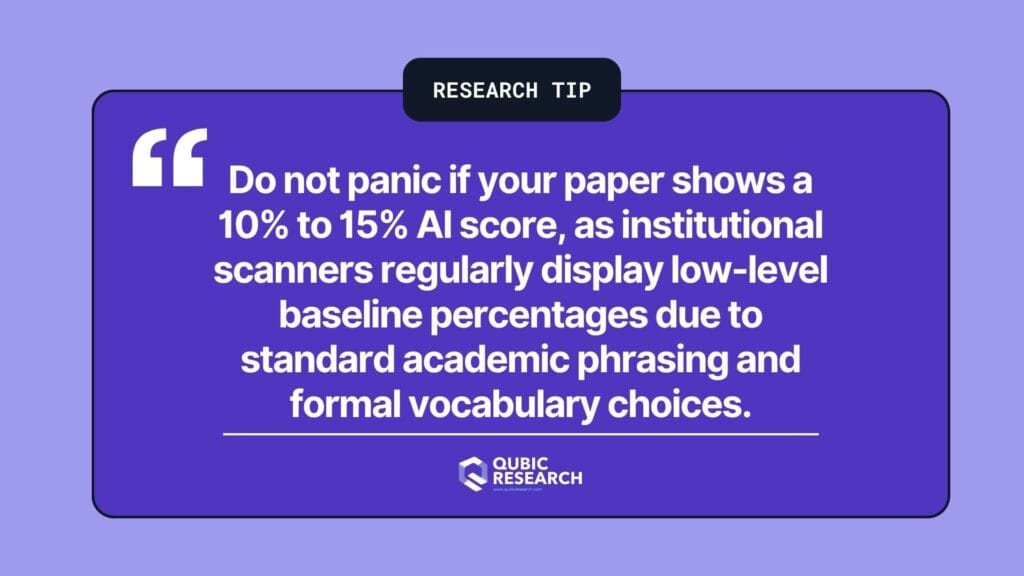
- The Low-Risk Band (0% to 15%): Scores within this initial range are generally accepted without any administrative follow-up. Turnitin deliberately labels scores under 20% with an asterisk to show the data is less reliable and prone to false flags.
- The Moderate Review Band (15% to 30%): Passing into this mid-tier zone does not mean you have failed. It simply means your text exhibits an elevated predictability score, which may prompt your instructor to look closer at your sentence rhythms.
- The High-Scrutiny Band (30% and above): Generating a score in this upper range serves as a strong signal for a department review, where you must show physical proof that you did not use external software tools to write your paper.
How instructors evaluate your compliance score range
- The platform processes your submission and places your document into a specific risk category based on the percentage.
- For papers scoring below 15%, the system clears the file for standard grading without notifying the instructor.
- For moderate scores, the professor reviews the highlighted text blocks to see if the flag is due to technical vocabulary.
- For scores exceeding 30%, the department initiates a formal tracking process to evaluate your authorship tracking data.
2. Exposing the Software Limitations Behind False Positives
Relying completely on a software threshold is dangerous because language classifiers frequently misinterpret authentic human writing. The software relies heavily on pattern metrics, which means high-quality, structured writing can easily be misidentified as machine text.
- Linguistic pattern traps: Scanners flag text that displays low perplexity (highly predictable word orders) and low burstiness (sentences that are roughly the same length).
- My Experience: I routinely help students resolve false integrity claims where their organic writing flagged at 25% simply because they used standard academic templates or formal disciplinary jargon.
- The Error Rate: Enterprise detection platforms openly acknowledge that their systems can generate false flags, which is why a high number cannot be used as the sole basis for disciplinary action.
Why original academic prose triggers automated flags
- Using highly formal transition words like “furthermore” or “consequently” lowers your document’s text texture.
- Writing long sequences of sentences with identical syllable counts mimics the balanced output of large language models.
- Compiling dense technical definitions or legal summaries leaves very little room for individual stylistic variation.
- Adhering strictly to rigid institutional formatting guidelines matches the pre-programmed training data of the scanner.
3. Overriding Software Scores with Human Verification Metrics
The ultimate decision regarding your submission does not belong to an algorithm; it relies entirely on human judgment. University boards prioritize process validation over software percentages, meaning your writing records matter far more than a dashboard number.
- The human audit: Faculty members cross-reference your flagged assignments with your past classroom essays and exam performance to check for sudden changes in your language profile.
- My Experience: I have seen academic committees completely drop a 40% software flag the moment a student demonstrates a clear, conversational understanding of their research during an oral interview.
- Authorship validation: Proving that you can explain the core mechanics and source materials used in your chapters will always override an automated probability score.
How departments conduct a formal submission review
- The professor isolates the specific text segments that the software highlighted as potentially machine-written.
- They check your reference citations to ensure your sources are real and connect logically to your arguments.
- The instructor schedules a brief meeting or oral interview to discuss the underlying concepts of your research.
- You are given the opportunity to present your early drafts, field notes, and cloud version histories to verify authorship.
4. Securing Your Progress Track Against Integrity Audits
Since you cannot predict exactly how an automated classifier will score your writing style, you must build a protective data trail while drafting. Having an unbroker track of your writing steps makes a software percentage completely irrelevant.
- Keystroke logging: Composing your research paper entirely inside a cloud platform creates an unalterable history of your physical editing activity over time.
- My Experience: In my work reviewing academic disputes, presenting a detailed OneDrive or Google Docs version timeline is the single most effective way to close an integrity investigation instantly.
- Data security: Keeping your physical notes, highlighted journal printouts, and initial outlines provides objective proof of a human learning journey.
Building a transparent human drafting profile safely
- Start your project by creating a centralized cloud file to handle all of your brainstorming paths and outlines.
- Write your paragraphs gradually over several days, leaving a clear trail of manual text changes and formatting updates.
- Avoid using external optimization extensions or text spinners that perform bulk, automated sentence adjustments.
- Export a copy of your timestamped edit history as an extra layer of security before submitting the final draft to your portal.
Final Thoughts on What Percentage of AI Is Acceptable
I believe that navigating university submissions should be about showcasing your academic growth, not stressing over an unpredictable dashboard metric. When analyzing what percentage of AI is acceptable, the key takeaway is that you are dealing with an indicator of linguistic probability rather than a definitive plagiarism verdict. Attempting to hit an exact numeric threshold is a moving target, especially since institutional scanners constantly update their scoring algorithms.
Focus your energy on maintaining a transparent writing workflow, preserving your drafting history, and leaning into your unique stylistic imperfections. Your best defense will never be an optimized score—it will always be your verified data history and your ability to stand confidently behind your original thoughts.
Fixing Flagged References
If a pattern classifier has mistakenly highlighted your properly formatted citations, check out my troubleshooting guide on AI detector flagged my references to resolve the issue with your department.
Frequently Asked Questions
Is there a universal percentage threshold where universities automatically fail a student for AI use?
No, there is no standardized percentage cutoff that results in an automatic failure across higher education. Because institutional scanning engines provide probabilistic data rather than concrete evidence of misconduct, universities treat these scores as preliminary screening flags that must be reviewed manually by a faculty member.
Why does Turnitin display an asterisk next to AI scores under 20 percent?
Turnitin places an asterisk next to scores ranging from 1% to 19% specifically to highlight that the data in this low band is less reliable. The platform suppresses exact percentages and text highlights in this range because minor signals are frequently caused by standard academic phrasings or false positives rather than actual machine generation.
Can a document show a zero percent similarity score but a high AI generation percentage?
Yes, these two software metrics evaluate entirely different properties of your text. A similarity score measures direct word-for-word matches against an institutional database of existing papers, whereas the AI score analyzes underlying sentence statistics, length uniformity, and word predictability patterns.
How can an ESL student handle a moderate AI percentage flag caused by structured writing?
Non-native English writers can easily clear a moderate software flag by presenting their initial brainstorming outlines and cloud editing timelines. Because standard scanners are naturally biased against the structured, formulaic vocabulary layouts common to ESL prose, showing a live development history easily disproves the automated flag.
Yes, relying heavily on rigid structural templates, legal outlines, or dense medical glossaries can elevate your score. Because technical language frameworks exhibit very low text perplexity and highly predictable layouts, automated language classifiers frequently misidentify these sections as machine-generated text blocks.