

Integrating generative artificial intelligence into your academic workflow can drastically cut down on administrative friction. When executing a literature review using ChatGPT, the most critical element to understand is that AI should function as a structural co-pilot rather than an automated ghostwriter. Relying blindly on language models to generate text from scratch often results in fabricated citations and superficial analysis, whereas using them to unpack complex datasets can give you a massive advantage.
This post maps out a secure framework for using large language models responsibly without compromising structural validity. Learning how to direct these systems properly will allow you to quickly accelerate source analysis workflows while maintaining absolute academic integrity. These guidelines are calibrated to comply with university AI policies so you can confidently leverage generative AI safely to streamline your synthesis processes from start to finish.
Literature Review Using ChatGPT
Deploying large language models as a research assistant can significantly reduce the time spent on structural planning and initial source sorting. However, attempting a literature review using ChatGPT requires a complete shift in mindset: you must treat the system as a processing engine rather than an oracle of facts. Large language models do not possess an active link to real-time scientific truth, but they excel at breaking down, reformatting, and identifying structural patterns within text that you provide directly to them.
1. Structuring Effective Role-Priming Prompts
The most common mistake when using artificial intelligence is typing short, vague commands like “write a literature review about machine learning.” This always results in a superficial essay packed with generalized platitudes and hallucinated references.
- The principle of context containment: You must explicitly instruct the model on its persona, its operational boundaries, and its exact formatting constraints before asking it to handle academic data.
- The analytical setting: Inform the system that it is an expert academic evaluator specializing in thematic synthesis, and explicitly forbid it from using flowery, repetitive introductory phrases.
- Setting clear guardrails: Force the model to only evaluate ideas present in the provided text, adding a strict penalty rule stating: “If information is not explicitly detailed within the uploaded text block, output ‘Data Missing’ instead of guessing.”
The Ultimate Literature Review Prompt Template
- Copy this exact system prompt framework: “You are an expert academic reviewer specializing in rigorous meta-analysis. I will provide the text of three research paper abstracts. Your sole task is to generate a side-by-side comparative summary detailing where their methodologies align and where their findings conflict. Do not use generic corporate language or filler sentences. Output your evaluation in a clean Markdown table with columns for: Variable, Alignment, and Contradiction. If any cell lacks explicit support in the text, leave it blank.”
- Paste the prompt into the chat window alongside your verified source texts.
- Review the tabular output to ensure it has adhered strictly to your data columns.
- Use the resulting matrix as an objective structural blueprint for drafting your synthesis chapters.
2. Extracting Methodological Variables from Uploaded Documents
Manually scanning through dozens of complex methodology chapters to locate small details like sample sizes, regression models, or geographic constraints takes up valuable hours. Using advanced data analysis features lets you accelerate source analysis workflows instantly.
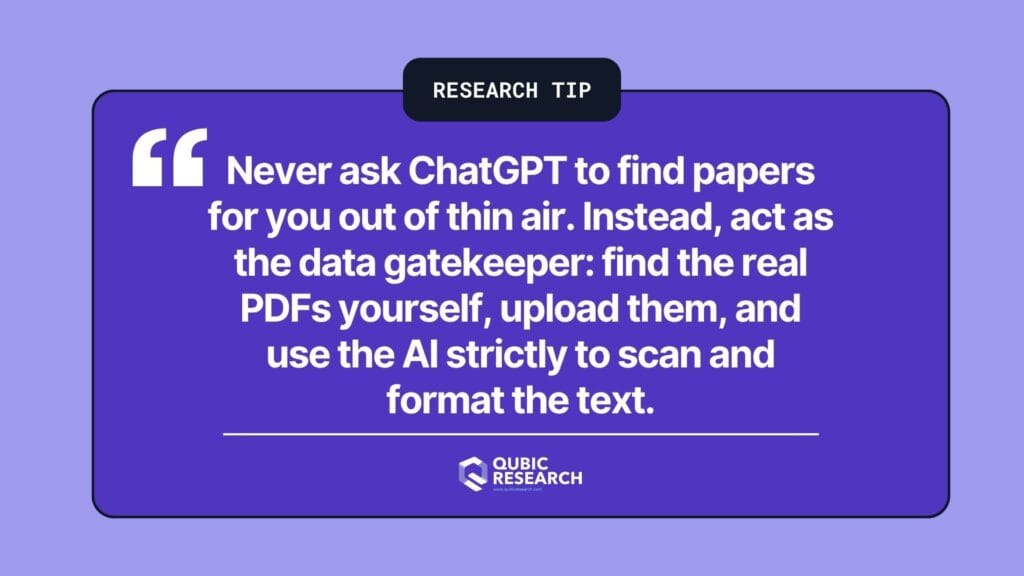
- Uploading verified content: Always use the document attachment feature to feed the AI authentic, peer-reviewed PDFs that you have already downloaded from legitimate databases like Scopus or Google Scholar.
- Targeted query extraction: Instead of asking the model to “explain the paper,” issue highly precise commands targeting explicit structural variables within the text.
- Isolating boundaries: Direct the system to locate the precise statistical boundaries, sample limitations, and future research recommendations explicitly acknowledged by the authors.
How to pull structural data points from an uploaded PDF
- Upload a downloaded peer-reviewed journal article directly into the chat interface.
- Type the following explicit directive: “Identify and list the following specific parameters from this document: (1) Sample size and demographic group, (2) Primary statistical testing method used, (3) Three limitations explicitly disclosed by the authors in their discussion section.”
- Cross-verify the model’s text outputs directly against the original PDF to guarantee absolute citation precision.
- Log these verified, extracted parameters into your master research spreadsheet for side-by-side comparison.
3. Avoiding the Citation Hallucination Trap
The biggest threat to academic integrity when using standard generative tools is the creation of completely fake academic references that look entirely real.
- Why hallucinations happen: Standard large language models work by predicting the next logical word or syllable based on patterns in their training data. They do not look things up in a library catalog; they simply know what a professional citation should look like.
- The danger of fake data: A hallucinated citation will mix real researcher names with invented journal volumes and fake titles, which will instantly trigger a plagiarism or academic fraud investigation by university examiners.
- The secure solution: To leverage generative AI safely, you must disable the model’s license to invent text by enforcing a closed-book parameter, ensuring it only interacts with citations you have already physically verified.
How to bulletproof your reference lists against AI fabrications
- Never ask the tool broad, ungrounded questions like “Give me a list of recent papers on climate economics.”
- If you use AI to help clean up your bibliography formatting, check every single outputted Digital Object Identifier (DOI) manually.
- Paste the generated titles directly into a scholarly database like PubMed or Crossref to confirm the paper actually exists.
- If a search engine yields zero exact matches for an AI-suggested title, delete that source immediately from your draft.
4. Translating AI Structural Outputs into an Authentic Voice
AI text models have incredibly distinct linguistic habits. Piling your literature review with generic, AI-sounding words like “delve,” “testament,” “paramount,” or “moreover” will immediately tip off automated institutional detection tools.
- The danger of passive voice: Generative models favor overly diplomatic, passive phrasing that strips away the sharp, critical argument needed for an exceptional literature review.
- Restructuring layout outlines: Use the AI tool to help build your thematic outline or rearrange the flow of your arguments, but handle the actual sentence-level drafting yourself.
- The ownership shift: True synthesis requires your unique perspective to explain why a data contradiction matters. The AI can help map out the disagreement, but you must write the final paragraph that connects that friction to your research gap.
How to clean your outlines of artificial patterns
- Take the thematic structure or bullet points generated by your chat session and paste them into a blank workspace.
- Scan the text and remove repetitive, predictive transitional words like “crucial,” “beacon,” “revolutionize,” or “furthermore.”
- Rewrite each point using direct, active-voice verbs that show clear academic action (e.g., replace “A study was conducted by Smith” with “Smith analyzed”).
- Ensure that every paragraph transitions into your own original commentary, explaining exactly how the summarized papers justify your upcoming study.
Final Thoughts on Doing a Literature Review Using ChatGPT
Harnessing artificial intelligence during your research phase requires a strict commitment to technical data validation. When executing a literature review using ChatGPT, the evidence demonstrates that large language models must serve strictly as administrative processing units rather than factual authors. Treating generative tools as autonomous writing agents introduces severe risks of citation fabrication, passive linguistic patterns, and catastrophic structural failure during university audits.
Protecting your final submission grades requires deploying closed-book role-priming prompts, uploading verified primary empirical PDFs directly into the platform, and manually drafting every paragraph to maintain your authentic scholarly voice. Controlling your prompt architectures ensures you safely convert AI capabilities into a powerful structural advantage that exposes clear research gaps without crossing ethical boundaries.
How Many Papers Do You Actually Need?
If you want to ensure your bibliography matches the exact structural expectations of your university markers, check our analytical guide on how many papers for literature review development are required across each academic level.
Frequently Asked Questions
Is it considered academic misconduct to use ChatGPT when planning a literature review?
Using large language models for structural brainstorming, outlining chapters, or translating raw data tables is generally accepted as a valid research aid by most institutions. However, allowing an AI model to generate the actual paragraphs, sentences, or citations from scratch violates standard university academic integrity frameworks.
Why do standard AI models fabricate or hallucinate academic journal citations?
Generative language models do not check real-time library databases; they operate by predicting the most statistically probable sequence of syllables based on historical training data. Because of this, they can easily combine real academic names with fake volume numbers and titles that appear highly authentic but do not exist.
How can you safely force an AI model to only evaluate real empirical data?
The safest approach is to enforce a closed-context boundary by manually uploading peer-reviewed source PDFs directly into the chat interface. Combine these files with a strict prompt instruction stating that the system must draw its analysis exclusively from the uploaded text and must display “Data Missing” if a variable cannot be verified.
What distinct linguistic markers flag a literature review as being written by AI tools?
Generative tools rely heavily on predictable transitional phrases and repetitive vocabulary, such as “delve,” “furthermore,” “testament,” and “moreover.” They also tend to favor an overly passive, diplomatic tone that avoids the sharp, critical arguments required for high-scoring academic papers.
Can institutional plagiarism scanners detect if text was generated by a language model?
Yes, modern university submission networks deploy advanced linguistic pattern detectors alongside standard plagiarism checkers. These algorithms flag predictable text distributions, lack of stylistic variance, and passive structures, making it critical that you handle the paragraph drafting yourself.