
Navigating the sprawling landscape of academic publishing can feel like searching for a needle in a digital haystack. When constructing a literature review using Perplexity, you gain a massive advantage over standard language models because the system functions primarily as an answer engine backed by real-time web indexation. Instead of relying on a static training dataset that guesses text probabilities, this platform actively searches live scholastic repositories to pair real academic papers with immediate contextual summaries.
This post breaks down a high-efficiency framework to transform your digital search habits into a fast, accurate data-gathering pipeline. Mastering these advanced search parameters will allow you to quickly streamline real-time academic sourcing and build a rock-solid bibliography. These methods are tailored to preserve academic integrity so you can confidently leverage live citation mapping to organize your next research project with absolute precision.
Literature Review Using Perplexity
Transitioning from manual scholarly queries to an conversational discovery pipeline can radically compress the time it takes to source authoritative data. When engineering a literature review using Perplexity, the system functions as a real-time retrieval-augmented generation engine. Rather than relying on a sealed memory pool, it combs active web repositories to fetch authentic materials. To make this tool work effectively, you must learn to navigate its indexing logic to shield your bibliography from weak digital journalism and unverified blog posts.
1. Isolating the Academic Focus Engine
The primary reason broad web prompts fail in traditional search layouts is that the algorithm tries to balance mainstream readability with clinical data. Entering basic search queries into the default search model often surfaces commercial summaries rather than original studies.
- Activating the scholastic boundary: You must deliberately isolate your search environment by switching the system’s “Focus Mode” directly to the “Academic” filter. This action alters the platform’s routing mechanics, forcing it to ignore mainstream media and search exclusively within peer-reviewed databases like Semantic Scholar and PubMed.
- Verifying inline citation links: Unlike standard language models that predict text strings, the system displays numbered inline citations that anchor every paragraph to a live digital location.
- Evaluating primary literature: This restricted search architecture ensures that every response generated is built entirely upon empirical research, methodology documents, and academic articles.
How to configure a restricted academic search pipeline
- Locate the “Focus” menu situated inside the primary query input field.
- Select the “Academic” icon to apply a permanent filtering mask across your browsing session.
- Input a highly targeted search query, such as: “Identify the core methodology conflicts regarding economic impacts within recent renewable energy infrastructure assessments.”
- Click on the generated inline citation numbers to verify that the target URLs route directly to authentic digital objects or established publishing house repositories.
2. Executing Multi-Step Thematic Sourcing Workflows
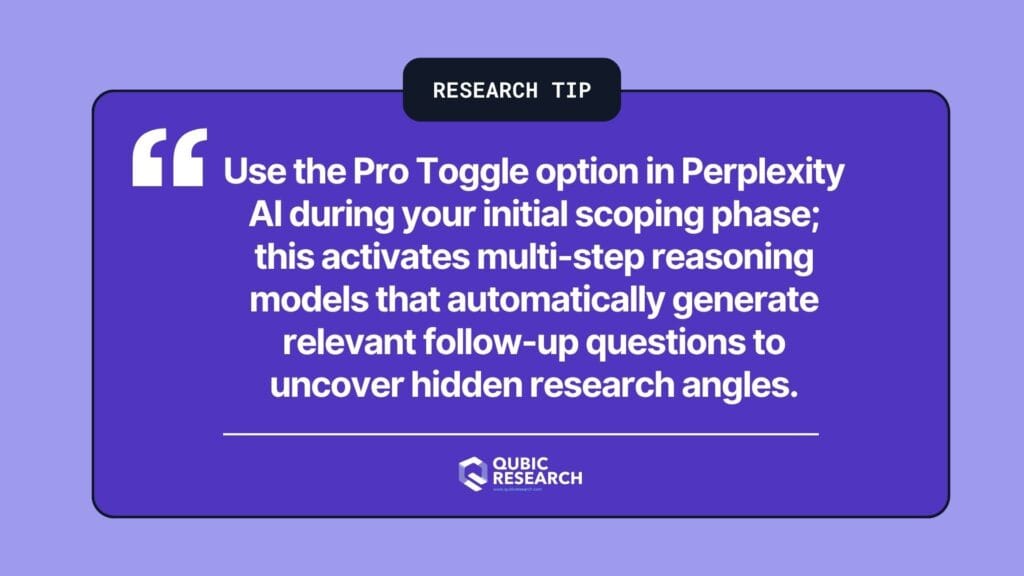
Gathering data for a literature review requires deeper exploration than simple, single-turn question-and-answer interactions. Building a thorough thematic map requires using conversational memory threads to streamline real-time academic sourcing step by step.
- Incremental knowledge expansion: Start by asking for broad theoretical frameworks within a specific discipline, then use follow-up fields to systematically zoom in on narrow methodology debates.
- Isolating regional variables: Use successive prompts to filter the discovered literature based on explicit constraints, such as sample size thresholds, geographic parameters, or historical timelines.
- Mapping scholarly debates: Force the system to compare the retrieved sources side by side, explicitly highlighting where different research camps disagree on key conclusions.
How to extract a multi-source comparative matrix
- Initiate an academic thread with a broad query: “What are the dominant theoretical models used to analyze consumer behavior in digital banking?”
- Once the initial source list compiles, enter the following follow-up directive: “From these specific sources, extract and compare the sample sizes, data collection methods, and primary limitations into a structured table.”
- Refine the data further by adding: “Filter out any publications from this table that were released prior to 2021 to ensure the review remains focused on contemporary frameworks.”
- Export the finalized structural matrix into your personal research log to serve as the blueprint for your body chapters.
3. Tracking Down DOIs and Digital Footprints
A major bottleneck when building a bibliography is finding complete citation data for an interesting study you found mentioned in another article. The real-time crawling capabilities of the system make tracing digital footprints effortless.
- Resolving missing citation details: If you possess a fragmented or partial text citation, you can input those sparse details into the platform to pull the complete academic metadata.
- Extracting precise DOIs: Force the engine to locate and output the exact Digital Object Identifier string for any paper, ensuring your final references route cleanly to official publishing platforms.
- Validating indexation: Cross-referencing real-time links allows you to quickly confirm if a newly discovered paper is fully indexed within major platforms like Scopus or the Web of Science.
How to extract complete publication data from fragmented text
- Paste whatever partial citation details you have into the query field (e.g., “Find the full publication details for a paper on machine learning bias written by Obermeyer around 2019.”).
- Instruct the engine to explicitly return the full title, complete list of authors, original journal name, volume number, and exact DOI link.
- Verify that the returned URL successfully points to a verified hosting service like Elsevier, Springer, or an institutional repository.
- Port the validated citation string directly into your reference management software to leverage live citation mapping cleanly.
4. Sifting Through Probing Questions to Expose Research Gaps
The hardest part of a literature review is identifying what previous researchers missed. You can use the engine’s real-time analysis to quickly isolate the explicit boundaries of existing knowledge.
- Targeting future research recommendations: Peer-reviewed articles almost always end with a section suggesting what future scientists should investigate. The engine can quickly scan across multiple papers to isolate these recommendations simultaneously.
- Uncovering methodology limitations: Direct the search engine to focus heavily on what previous experiments couldn’t control, exposing consistent blind spots in the current literature.
- Isolating unmapped sectors: Use comparative prompts to spot areas where existing data sets fail to address specific modern demographics or changing technological conditions.
How to target structural blind spots across multiple studies
- Enter a target query into the academic focus field: “Analyze the conclusion sections of the top five most cited papers regarding remote workplace performance frameworks.”
- Append this exact command to the prompt: “Isolate the explicit ‘future research directions’ mentioned by the authors, and identify any shared geographic or demographic blind spots across all five papers.”
- Review the response to see if there is an unaddressed gap—such as a lack of data regarding small-scale enterprises or developing economies.
- Use this identified blind spot as your core research gap, framing your entire study as the necessary solution to this empirical limitation.
Final Thoughts on Sourcing a Literature Review Using Perplexity
Transitioning to conversational data discovery can radically accelerate your initial scoping phase if you enforce strict parameters on the underlying search models. When compiling a literature review using Perplexity, the structural evidence demonstrates that the platform must be handled as a targeted navigation compass rather than an unguided text generator. Allowing an AI model to pull data without filtering source locations introduces low-quality media summaries, compromises academic rigor, and weakens the conceptual framework of your background study.
Protecting final evaluation scores means activating the dedicated Academic Focus module, implementing multi-turn conversational workflows to map shifting methodologies, and capturing explicit Digital Object Identifier (DOI) metrics to cross-verify reference locations. Controlling these verification pipelines transforms raw web indexation into a strategic asset that isolates real research gaps and builds an unassailable scholarly foundation.
Is Perplexity a reliable research tool?
If you want to understand how artificial intelligence can safely assist your academic writing, read our comprehensive review on Perplexity as a research tool to discover its benefits and limitations.
Frequently Asked Questions
How does Perplexity’s ‘Academic’ focus filter differ from a standard web query search?
The standard filter scans the entire commercial internet, which pulls up mainstream journalism, commercial blogs, and opinion pieces. The Academic focus filter bypasses these surface-level networks entirely, routing your query strictly into peer-reviewed scholarly indexing databases like Semantic Scholar and PubMed.
Can inline citation numbers generated by conversational search engines be completely trusted?
While the tool maps text to real web URLs instead of guessing word sequences, you must still click and audit every link manually. Occasionally, the text engine may misinterpret a specific data point inside a real paper, making first-hand validation of the original methodology document necessary.
What is the most secure way to trace down missing DOI numbers for a reference list?
Input whatever fragmented metadata you possess—such as the primary author’s surname, publication year, and partial title fragments—into the Academic thread. Instruct the model to locate the definitive publishing host repository and return the exact DOI link to leverage live citation mapping cleanly.
How do you prevent a conversational research log from drifting into irrelevant topics?
Maintain precise thematic boundaries by building sequential workflows. Rather than entering broad commands, use targeted follow-up prompts to screen data by explicit criteria, such as filtering out any studies with small sample sizes or removing materials published over five years ago to streamline real-time academic sourcing.
Will university submission filters flag a paper if Perplexity helped organize the initial bibliography?
No, because utilizing a real-time indexer to locate authentic source URLs and extract structural data parameters is classified as an advanced search method. As long as you write the final paragraphs, comparative sentences, and thematic arguments in your own authentic voice, your text remains secure.