

Assembling a comprehensive academic background study can easily collapse into a chaotic scramble of lost browser history and disconnected draft fragments. When building a modern literature review workflow with AI, the goal is not to outsource your critical thinking to an algorithm, but to eliminate the manual, administrative friction that slows you down. Relying on an unstructured approach to research tools usually leads to scattered datasets and inconsistent arguments, meaning your system must use distinct, sandboxed pipelines for discovery and synthesis.
This guide establishes an end-to-end, engineering-grade routine for tracking down relevant studies, extracting hidden methodology points, and mapping out structural themes. Mastering this structured automation strategy will allow you to quickly optimize digital research automation and protect your drafting phase from structural chaos. These frameworks are designed to keep you in complete control of your data so you can confidently build compliant synthesis pipelines that easily satisfy rigorous university standards.
Literature Review Workflow with AI
Constructing a modern academic thesis demands a highly organized relationship with automated research tools. When constructing a literature review workflow with AI, you must build a series of distinct operational phases where different tools handle specialized tasks. Instead of using a single conversational agent to write your text, a bulletproof pipeline uses specific tools to discover live citations, a separate environment to analyze verified text files, and structural models to arrange your outlines before you write the final draft yourself.
1. Phase 1: Automated Discovery and Citation Sourcing
Starting your research project by typing open questions into standard conversational chatbots is a major security risk. Standard large language models regularly invent fake journal references because they are built to predict text patterns rather than check live library registries.
- Mapping live connections: You must anchor your initial search phase in real-time search engines that have direct access to live global research indexes like Semantic Scholar, Crossref, or PubMed.
- Extracting authentic URLs: Focus on capturing verified data blocks that contain active Digital Object Identifiers (DOIs) and direct links to official publishing platforms.
- Accelerating discovery: This automated discovery phase allows you to optimize digital research automation safely, letting you find the most influential papers in your field without the risk of encountering hallucinated data.
How to execute a safe automated search pipeline
- Open a connected search platform and configure its discovery focus parameters exclusively to “Academic” or “Scholarly” mode.
- Input a highly targeted relational search string, such as: “What are the primary methodological criticisms leveled against remote workplace performance frameworks between 2022 and 2026?”
- Review the generated reference list, clicking each link to confirm it routes to an active, peer-reviewed hosting platform.
- Download the verified primary empirical PDFs directly to your local workstation to prepare for the next step of your workflow.
2. Phase 2: Closed-Book Variable Extraction
Once you have compiled a secure folder of authentic research PDFs, you can use generative tools to dramatically speed up your note-taking and comparison steps.
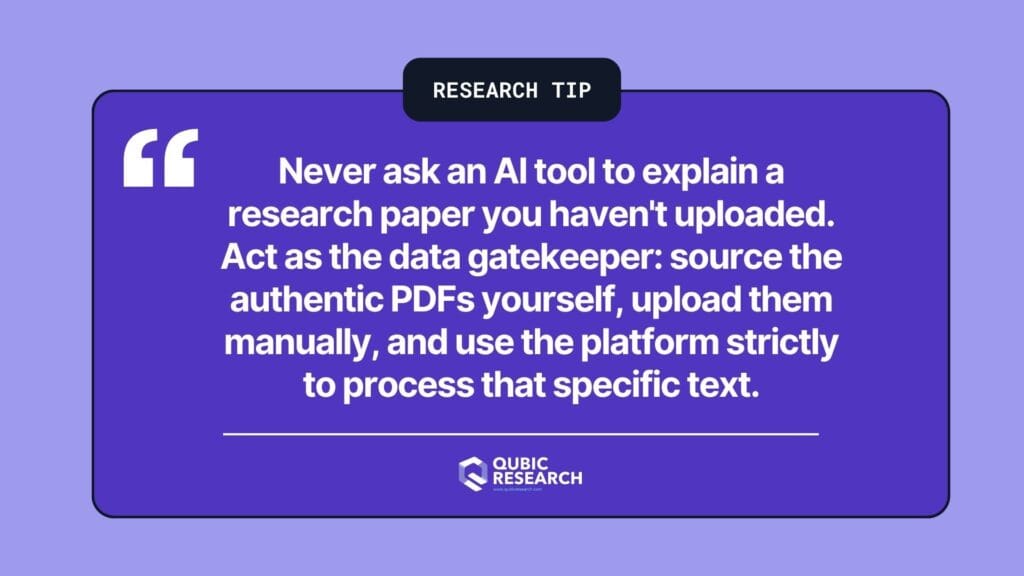
- Enforcing a strict boundary: You must isolate the AI model’s context by uploading your downloaded PDFs directly into a secured workspace window.
- Banning independent guessing: Instruct the platform to draw its answers exclusively from the uploaded files, explicitly telling it to output “Data Not Found” if a specific detail is missing from the text.
- Standardizing your records: This closed-book extraction method allows you to build compliant synthesis pipelines by instantly pulling complex variables out of long papers and formatting them into clean, easy-to-read summaries.
How to automate your variable extraction process
- Upload three to four related empirical PDFs into your secure data analysis chat interface.
- Enter this explicit extraction prompt: “Analyze these attached text files. Generate a Markdown table summarizing the following data points from each document: (1) Primary author and year, (2) Total sample size, (3) Statistical analysis method, and (4) Core limitation explicitly conceded by the authors.”
- Carefully cross-check the generated table values directly against the original PDF text blocks to ensure absolute accuracy.
- Copy the verified data rows directly into your master research spreadsheet to maintain a flawless digital record.
3. Phase 3: Thematic Outline Generation
Sorting a messy pile of extracted research notes into a logical, flowing chapter structure is one of the most frustrating parts of the writing process. This is where the pattern-recognition strengths of large language models are incredibly useful.
- Escaping the summary loop: Avoid the basic mistake of organizing your chapters by individual author names; instead, use the AI to help group your data into distinct conceptual themes.
- Mapping the debate: Instruct the system to analyze your notes and highlight areas where different research teams agree or where their methodologies clash.
- Building a blueprint: This phase creates a detailed, highly organized outline that shows exactly how your sources fit together before you write a single paragraph.
How to generate a concept-driven chapter outline
- Copy the text rows from your completed master research spreadsheet and paste them directly into the chat interface.
- Type this specific structural directive: “Review these research summaries. Group these papers into three distinct thematic subheadings based on their conceptual focus. Under each subheading, provide a bulleted list showing which authors agree with each other and which authors contradict each other. Do not write full paragraphs; output only the structural outline.”
- Evaluate the generated blueprint to ensure it follows a clear, logical progression that directly addresses your main research question.
- Save this finalized layout map as the structural framework for your drafting phase.
4. Phase 4: Human-Centred Synthesis Drafting
The final phase of your workflow must be handled entirely by you. Trying to save time by letting an AI generate the actual sentences and paragraphs for your final submission is an academic dead end.
- The danger of automated text: Machine-generated text relies heavily on highly predictable word choices and passive, repetitive phrases that modern university submission filters can spot instantly.
- Protecting your critical voice: A high-scoring literature review requires a sharp, independent perspective to explain *why* a methodology conflict matters—a human insight that language models cannot duplicate.
- Maintaining ownership: Use the AI-generated tables and structural outlines to keep your information organized, but handle the actual sentence-level writing yourself to keep your scholarly voice authentic and secure.
| Steps | AI Role | Human Role |
|---|---|---|
| 1. Discovery | Finds live URLs and DOIs in databases. | Screens relevance; downloads PDFs. |
| 2. Notes | Extracts variables into a matrix grid. | Cross-checks data against original text. |
| 3. Outline | Groups papers into thematic pillars. | Refines structure to fit thesis scope. |
| 4. Drafting | Banned (Detection Risk) | Writes paragraphs using critical voice. |
How to translate your structured data into an authentic draft
- Open your finalized thematic outline on one side of your screen and a blank word document on the other.
- Write a bold opening topic sentence for your first section that states a clear trend or major debate in the field.
- Use the data from your extraction tables to weave your sources together, using active transition words to show where they agree or differ.
- Conclude the section by explaining exactly how these existing studies leave a research gap that your upcoming project will solve.
Final Thoughts on Building a Literature Review Workflow with AI
Constructing a literature review workflow with AI is not about bypassing the intellectual rigor of academic research, but about systematically eliminating administrative overhead. The structural evidence proves that separating your tools into distinct operational checkpoints—discovery, extraction, outlining, and human-centric drafting—is the only way to insulate your project from technical errors. Treating generative applications as autonomous text machines introduces massive risks of citation fabrication, causes uniform prose patterns, and ultimately leads to catastrophic failures during university audits.
Safeguarding your final grades requires using connected search databases for source discovery, enforcing a strict closed-book sandbox for data extraction, and handling 100% of the paragraph drafting yourself. Controlling these automated lines ensures you safely convert machine processing speeds into a distinct analytical advantage that keeps your critical academic voice front and center.
How to Extract and Log Your Variables Flawlessly
If you want to transition from automated data extraction into an advanced, human-driven spreadsheet logging routine, read our tactical framework on the best way to take notes from research papers to maximize your structural reading depth.
Frequently Asked Questions
Can institutional checkers distinguish between an AI-assisted workflow and AI-plagiarized text?
Yes, completely. Plagiarism scanners do not look at your search or note-taking habits; they evaluate the stylistic properties of your submitted text. Using AI to find links or extract data into matrices leaves no footprint, whereas copying machine-generated paragraphs triggers linguistic pattern alerts due to highly uniform word distributions.
What is a closed-book sandbox prompt parameter, and why is it necessary?
A closed-book sandbox parameter is a prompt instruction that forbids a language model from using its broad, unverified training memory. It forces the system to pull data exclusively from the files you manually attach, which helps you build compliant synthesis pipelines and eliminates the threat of citation hallucinations.
Why should I use a connected search engine instead of a standard chatbot to find sources?
Standard offline chatbots are text predictors that cannot browse live academic repositories. Connected discovery engines browse active, live scholastic indexes in real-time, matching your specific requests directly to authentic URLs and verifiable DOIs to cleanly optimize digital research automation.
How do you handle writing transitions when moving from an AI outline to a human draft?
You use the outline strictly as a map showing which authors share common ideas. When drafting the actual paragraph, use active human voice alongside comparative connectors (e.g., “Conversely”, “Concurrently”, “Building upon this framework”) to show the relationship between the studies without duplicating robotic AI prose patterns.
Is it permissible to use AI to format my final bibliography into APA or Harvard styles?
Using an AI tool to rearrange text snippets into standardized reference styles is generally allowed because it is an administrative formatting task. However, you must manually check every generated output against official style manuals, as language models regularly misplace punctuation or invert volume numbers.