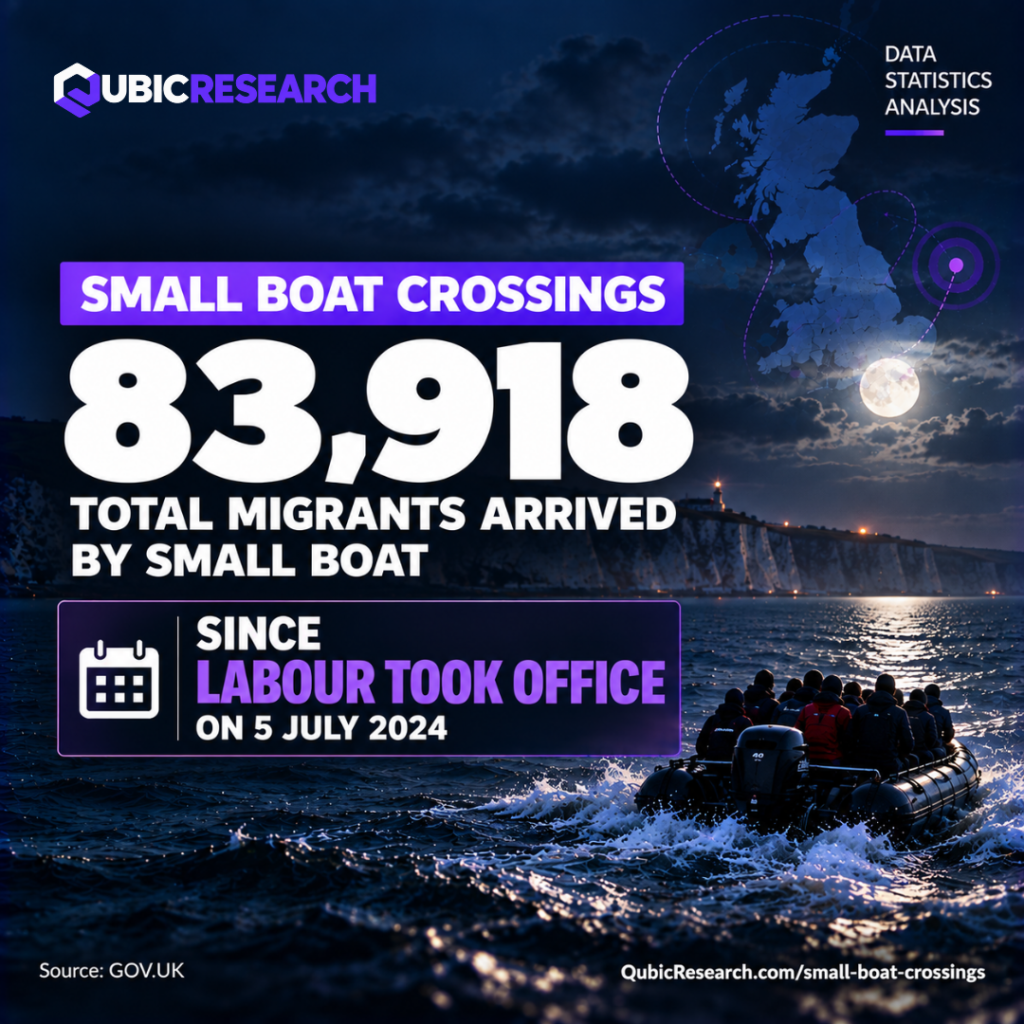
Cumulative Channel migration statistics published by the Home Office confirm that small boat arrivals have surpassed another major milestone under the current government. Official GOV.UK tracking data reveals that 83,918 migrants have arrived in the United Kingdom via small boats since Labour took office on 5 July 2024. This cumulative figure highlights the persistent operational demand placed on UK border enforcement and coastal reception centres over the past two years.
Reaching 83,918 arrivals since the change of government underscores the ongoing challenges facing national security authorities and maritime interdiction fleets. Despite increased bilateral enforcement agreements and joint policing operations along northern French beaches, human trafficking networks continue launching overcrowded inflatables across the Dover Strait whenever weather permits. As political debate intensifies over immigration control and border security performance, verified long-term data provides an essential, transparent record of overall crossing volumes.
83,918 Small Boat Migrants Cross Channel Since July 2024
Official government logs demonstrate the substantial volume of irregular maritime migration managed by border authorities over the past two years. Data published on the official GOV.UK reporting portal confirms that cumulative small boat arrivals have reached 83,918 since Labour assumed office on 5 July 2024. This milestone underlines the continuous scale of transit activity operating across northern European departure zones and English Channel shipping lanes.
1. Tracking Arrival Volume Across the Two-Year Milestone
Analysing the rise to 83,918 cumulative arrivals illustrates how smuggling syndicates have sustained high-density operations across multiple seasonal cycles.
- Sustained multi-year arrivals: Reaching 83,918 headcounts reflects continuous crossing activity spanning the second half of 2024, full calendar year 2025, and the current 2026 figures.
- High passenger loading trends: Organised crime rings have increasingly relied on larger, commercial-grade inflatables, frequently cramming between 60 and 80 passengers onto a single craft to maximise profits per launch.
- Continuous interdiction efforts: UK Border Force cutters and Coastguard surveillance assets have maintained around-the-clock operations across Dover Strait shipping corridors to escort incoming craft safely into port.
Key statistical takeaways from the tenure tracking dataset
- A cumulative total of 83,918 migrants crossed the English Channel between 5 July 2024 and late September 2026.
- All arrivals were escorted to primary coastal processing hubs at Dover and Manston for initial intake.
- The figure represents continuous daily tracking catalogued within central Home Office databases.
- GOV.UK statistics provide an unvarnished public record of border intake during the current government’s term.
2. Onshore Infrastructure and Border Policy Management
Managing nearly 84,000 arrivals over a multi-year period has required ongoing operational coordination across coastal security networks and regional processing centres.
- Reception facility throughput: Onshore intake hubs at Dover have maintained elevated processing capacity to handle rapid biometric identification, medical triage, and administrative logging.
- Bilateral enforcement schemes: The UK government has continued funding joint police operations, drone monitoring, and sand dune patrols along northern French beaches near Calais and Dunkirk.
- Logistical dispersal fleets: Specialised passenger transport units continue operating dockside to transfer newly arrived groups from maritime landing points to regional holding hubs.
Operational highlights across the administration’s timeline
- Border Force personnel permanently expanded digital biometric screening infrastructure at Kent processing hubs.
- Joint intelligence operations between European law enforcement agencies disrupted multiple international smuggling rings.
- French security units intercepted tens of thousands of potential crossers along launch beaches prior to departure.
- Official databases updated permanent historical repositories to reflect the 83,918 cumulative total.
3. Impact on Local Services and Asylum Accommodation
The persistent inflow of small boat arrivals—totalling 83,918 since 5 July 2024—continues to exert significant structural pressure on local authorities, emergency services, and national accommodation networks.
- Asylum housing capacity constraints: Managing short-term holding and longer-term accommodation for tens of thousands of individuals has required ongoing reliance on specialised reception facilities and regional housing infrastructure.
- Emergency and health service strain: Maritime interdictions along the Kent coastline frequently require immediate triage, medical evaluations, and emergency transport deployments from local health trusts.
- Financial burdens on local councils: Regional authorities along coastal landing corridors face sustained operational costs associated with safeguarding, administrative processing, and social service provisions.
Key logistical developments across the two-year period
- Over 83,000 individuals underwent mandatory security screening and health checks upon entering UK processing centres.
- Border Force intake hubs at Dover operated continuously to prevent administrative backlogs during high-volume summer surges.
- Transport networks dispatched hundreds of passenger vehicles to transfer newly arrived groups from dockside landing sites.
- Home Office statistical portals updated cumulative tracking records to provide full public oversight of arrival volumes.
4. Political Accountability and Future Policy Outlook
Passing the 83,918 mark since taking office keeps border enforcement and migration control at the centre of political debate and legislative scrutiny.
- Focus on smashing smuggling syndicates: The government continues prioritising cross-border intelligence initiatives and international law enforcement operations to disrupt human trafficking networks at their source.
- Bilateral negotiations and beach policing: UK-funded French security operations remain under constant evaluation to maximise interception rates along northern launch beaches.
- Public demand for data transparency: Consistent daily and cumulative reporting ensures parliament and the public can evaluate border control efficacy against real-time operational data.
Summary of ongoing border enforcement priorities
- Joint intelligence units continue targeting organised crime groups supplying inflatables and outboard engines across Europe.
- Coastal surveillance assets maintain 24-hour coverage across active shipping lanes to ensure rapid maritime interdictions.
- Biometric logging protocols ensure all 83,918 arrivals since 5 July 2024 are fully catalogued within national databases.
- Government tracking platforms continue publishing updated metrics to maintain transparent public accountability.
Final Thoughts on Small Boat Crossing Trends Since July 2024
Reaching 83,918 small boat arrivals since Labour took office on 5 July 2024 underscores the immense, ongoing challenge of managing Channel migration. While international policing efforts and French beach patrols work to disrupt launch operations, human trafficking syndicates continue exploiting favourable sea states to deploy heavily loaded dinghies. Maintaining accurate, real-time data tracking remains essential for monitoring border enforcement performance, assessing facility capacity, and informing national policy discussions.
Want to see live channel migration data?
Explore more data, statistics, and analysis on our Small Boat Crossings Dashboard to track daily arrival trends, vessel counts, and historical figures.
Frequently Asked Questions
How many small boat migrants have arrived in the UK since Labour took office?
According to official Home Office statistics, 83,918 migrants have arrived in the UK via small boat crossings between 5 July 2024 and late September 2026.
When did Labour assume government office?
Labour officially assumed government office on 5 July 2024, establishing the baseline date for current tenure migration statistics.
Where are small boat arrivals brought after being intercepted?
Migrants interdicted in the English Channel are escorted by Border Force or Coastguard vessels directly to processing facilities in Dover and Kent for initial health and security screening.
What happens to migrants after dockside processing in Kent?
Following biometric identification logging and health checks, individuals are transferred via specialised transport fleets to regional reception centres and temporary asylum accommodation.
Where can I view official government small boat crossing statistics?
Official daily and weekly data is published on GOV.UK, while interactive charts, tenure comparisons, and historical trends can be accessed directly on our live tracking dashboard.