Ensuring the academic validity of your source materials requires verifying their presence within reputable verification networks. When learning how to check if a journal is indexed in Scopus, relying on third-party publisher claims can frequently put your research integrity at risk. Many predatory publishing outfits display fraudulent tracking metrics on their web platforms, which makes it essential to use official, live database search pipelines to confirm whether a specific publication holds authentic status.
This guide outlines a secure cross-referencing process to safeguard your reference list against unverified data sources. Mastering these systematic identification methods allows you to quickly streamline real-time academic sourcing and protect your document from academic integrity alerts. By using official indexing verification tools, you can confidently leverage live citation mapping to build an immaculate scholarly foundation for your next project.
How to Check If a Journal Is Indexed in Scopus
Transitioning from passive internet searches to active administrative tracking is critical to maintaining high academic standards. When evaluating how to check if a journal is indexed in Scopus, you must understand that the master directory updates its database entries continuously. Rather than assuming a publication maintains permanent indexation, you must consult the live source catalog directly. This protective strategy removes low-quality materials from your collection, ensuring that every study you cite stands up to strict departmental audits.
1. Utilizing the Free Public Source Wizard
The most reliable method to evaluate a publication’s indexing status involves using the open-access source directory provided by the database administrator. This lookup tool does not require a premium institutional login, allowing independent researchers to check metadata configurations instantly.
- Accessing live database registries: The public lookup interface provides direct insight into active publication indexes, bypassing the commercial paywalls that restrict access to complete abstract data.
- My Experience: I regularly interact with investigators who assumed a journal was fully indexed because its homepage featured a standard tracking logo, only to discover upon performing a manual registry check that the listing had expired.
- Identifying homoglyph title frauds: Predatory platforms frequently duplicate the exact names of high-impact publications, a dangerous deception that the official directory catches by anchoring each listing to an authentic publisher profile.
How to execute a standard text lookup sequence
- Navigate to the official public search engine page for the indexing repository.
- Locate the primary selection dropdown menu and configure the interface to search by title parameters.
- Enter the complete name of the academic publication into the query box, ensuring your spelling aligns perfectly with official records.
- Analyze the generated tracking panel to verify that the active listing displays a live status marker.
2. Deploying ISSN Identification Code Parameters
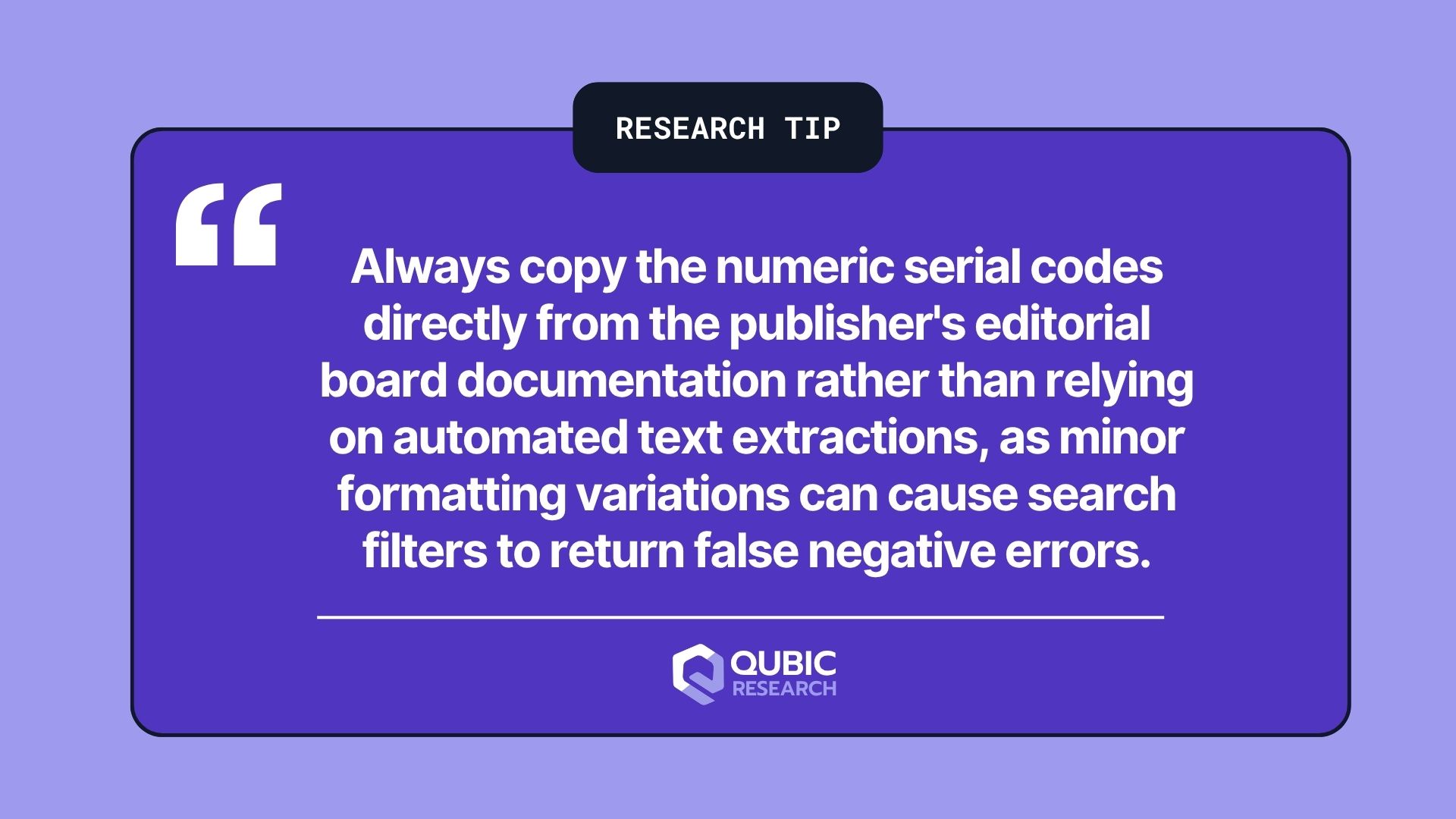
Searching for data by text name can occasionally return confusing results if multiple international publications share identical terminology. Using the International Standard Serial Number provides an absolute identification metric that prevents tracking errors.
- Eliminating naming conflicts: Every verified publication holds a unique eight-digit code sequence that remains completely distinct, regardless of language translations or structural rebrandings.
- My Experience: Trying to prevent AI editing flags by cleaning up citation text manually takes an immense amount of time, but validating your bibliography through numerical serial filters prevents administrative mix-ups.
- Validating print and electronic variants: High-quality indexing spaces track both physical print numbers and electronic variants, allowing you to cross-verify either metadata string with equal precision.
How to audit a publication using numerical serial numbers
- Open the primary homepage of the target journal and isolate the eight-digit numerical code string.
- Return to the official index validation platform and adjust your search filter configuration to track serial codes.
- Paste the complete numerical string into the input field, including any structural hyphen marks.
- Review the database output to confirm that the returned system title matches your target manuscript exactly.
3. Auditing the Master Discontinued Source List
Because the indexation database evaluates publication ethics annually, journals that lower their peer-review standards are regularly removed from the active directory. Reviewing the official spreadsheet of discontinued publications ensures that you do not accidentally cite a source that has recently lost its academic validation.
- Tracking ongoing quality adjustments: The master directory updates its active files continuously, publishing comprehensive tracking logs that detail precisely when and why a journal lost its indexing status.
- My Experience: I have reviewed several background chapters that were rejected by university panels because the researcher cited an article published during a timeframe when the journal was already flagged for predatory behavior.
- Isolating the reasons for removal: The discontinued log specifies the exact trigger metrics for removal—such as irregular publication volume jumps or citation manipulation—helping you evaluate the absolute validity of the text.
How to download and filter the discontinued publication log
- Access the main support portal of the indexing registry and locate the master source information section.
- Download the most recent version of the Excel spreadsheet titled “Discontinued Sources List.”
- Open the data document and utilize the search function to locate the specific title or unique serial identifier of your source.
- Examine the tracking timeline to confirm that your target article was published before any formal discontinuance took effect.
4. Verifying Source Metrics and CiteScore Distributions
The final step in checking a journal involves evaluating its active impact parameters and mathematical citation rankings. Legitimate indexing entries display detailed, multi-year citation distributions that fraudulent lookalike websites cannot replicate.
- Analyzing citation trajectory lines: Authentic entries provide transparent numerical scores that track the exact ratio of published articles to subsequent citations over a rolling four-year timeline.
- My Experience: Checking these performance trackers used to require advanced bibliometric skills, but modern evaluation dashboards present these distribution curves through clean, interactive visualizations.
- Cross-checking subject ranking quadrants: The portal categorizes journals into precise percentiles within their specific scientific fields, allowing you to quickly determine a publication’s relative status.
How to evaluate active journal performance metrics
- Locate the official source dashboard of the verified journal entry within the tracking repository.
- Scroll down to the performance module to examine the current metric configurations and historical values.
- Compare the annual document output counts against the total citation volume to check for irregular data spikes.
- Confirm that the listed publishing entity aligns perfectly with the official institutional owner to ensure your data tracking remains immaculate.
Final Thoughts on How to Check If a Journal Is Indexed in Scopus
I believe that implementing a rigorous verification routine before finalizing your background literature is an absolute necessity for modern researchers, but you must remain vigilant when analyzing indexation timelines. When determining how to check if a journal is indexed in Scopus, the administrative data proves that entries cannot be handled as permanent labels. By focusing on public source lookups, verifying numeric serial strings, and reviewing active discontinued logs, you can keep your background bibliography completely secure. Ultimately, your source selection forms the bedrock of your study’s credibility—do not let predatory publishing shortcuts weaken your academic efforts.
Is Scopus a reliable research tool?
If you want to understand how comprehensive citation databases can protect your academic writing, read our comprehensive review on Scopus as a research tool to discover how to use live registry portals to verify high-impact journals without risking compliance errors.
Frequently Asked Questions
Why should I use the numeric ISSN instead of the title to check indexing status?
Using the numeric serial number is much safer because it provides a unique identifier for that specific publication. Search setups that rely only on title text can easily pull up fraudulent lookalike journals or completely unrelated publications that happen to use similar academic terminology.
Can a journal be removed from Scopus after it has been indexed?
Yes, publications are regularly evaluated, and those that fail to maintain rigorous peer-review standards or engage in citation manipulation are discontinued. The master repository updates its records continuously, which makes it vital to check the active discontinued source logs before finalizing your references.
Do I need a paid university account to check if a journal is indexed?
No, you do not need a premium institutional subscription to verify indexation. The database administrator provides a free, public source lookup tool that allows independent researchers to check active titles, unique serial numbers, and coverage timelines without a paywall.
What does it mean if a journal status says ‘coverage discontinued’ in the directory?
A status of ‘coverage discontinued’ means the repository has permanently stopped indexing new articles from that specific publication due to quality issues or ethical breaches. Any manuscripts published after the official discontinuance date do not carry verified indexation status.
Will a university panel reject my thesis if I cite a journal that was recently discontinued?
Yes, university committees routinely run bibliographies through verification software to evaluate source integrity. Citing a publication that has been discontinued for predatory behavior can severely undermine the validity of your background study and trigger serious academic integrity inquiries.