
OpenAlex is a free, fully open bibliographic search engine and data catalog designed to map out the entirety of global scientific research.
Launched in 2022 by the non-profit organization OurResearch as the spiritual successor to Microsoft Academic Graph, OpenAlex indexes over 450 million scholarly works. It connects papers, authors, physical institutions, publishers, and funding sources into a massive, interlinked database that is entirely accessible without cost.
Highly Recommended
What can you use OpenAlex for?
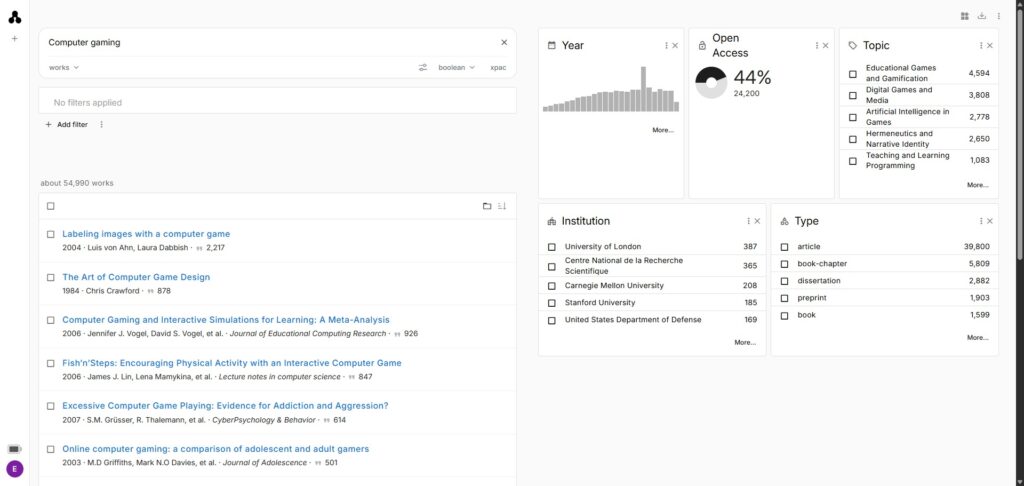
You can use it to track institutional research outputs, analyze global citation networks, and identify specific patterns across academic publishers. The platform allows you to drill deep into metadata structures, searching for items based on Sustainable Development Goals (SDGs), specific funding agencies, or multi-level academic fields.
It also functions as an infrastructure layer for open science. Academic institutions, university libraries, and app developers routinely use its tools to build local literature search applications, populate institutional dashboards, and run complex text-mining operations.
Who is OpenAlex best for?
It is ideal for data scientists, academic librarians, and university research officers who require complete, unrestricted access to scholarly metadata catalogs without proprietary data limits.
It also serves as an excellent resource for software developers and independent researchers looking to design their own specialized AI tools or citation trackers using a reliable data foundation.
Is OpenAlex genuinely free?
Yes. OpenAlex is completely free to search via its main web interface, and it provides a generous free API tier that allows up to 100,000 daily network requests. The platform releases its entire dataset snapshot under a CC0 public domain license, meaning you can download the entire archive for zero cost.
The platform maintains its long-term financial stability by offering optional paid subscription packages. These subscriptions cater to enterprise users and massive institutions that require hourly dataset syncing, millions of daily API requests, or priority technical support tickets.
Should I use OpenAlex as an academic search engine?
Yes. It is an excellent, comprehensive tool for discovering scholarly literature, tracing citation networks, and finding accessible versions of research documents across almost every academic discipline.
Because it covers multiple areas of study in one central place, it makes the initial discovery process fast and straightforward. It serves as an essential starting point for any literary search before diving into niche database systems.
Key Features
- Massive interconnected entity graph
Binds millions of distinct works, authors, institutions, journals, publishers, and funding organizations into a unified schema. - CC0 public domain dataset snapshots
Allows users to download the full, multi-terabyte raw database to run complex offline analyses or host local instances. - Multi-level topic classification
Utilizes advanced machine learning algorithms to automatically tag research works across domains, subfields, fields, and micro-topics. - Integrated repository PDF linking
Cross-references global archives to match search documents directly with available open-access PDF downloads. - High-throughput RESTful API
Supplies programmable query pathways to filter, sort, and gather metadata records instantly using clean code rules.
Best for
- Bibliometric and citation analysis
- Tracking institutional research output
- Harvesting open-access metadata
- Building custom academic software tools
- Large-scale text mining operations
Pros and Cons
Here are the main advantages and limitations of using OpenAlex for academic research.
Pros
- ✓Data is fully open and usable for any project without strict copyright limits.
- ✓One of the largest multidisciplinary indexes available, covering over 450 million entries.
- ✓Excellent author disambiguation systems that link profiles using ORCID identifiers.
Cons
- ✗The default web dashboard is basic compared to feature-heavy commercial discovery engines.
- ✗Requires some degree of programming or API knowledge to leverage its full capabilities.
- ✗Pulls data from a vast array of web crawlers, which can occasionally introduce duplicate citations.
How to Use OpenAlex
Follow this quick guide to perform literature searches, explore research networks, and access the open data API.
- Visit the Website
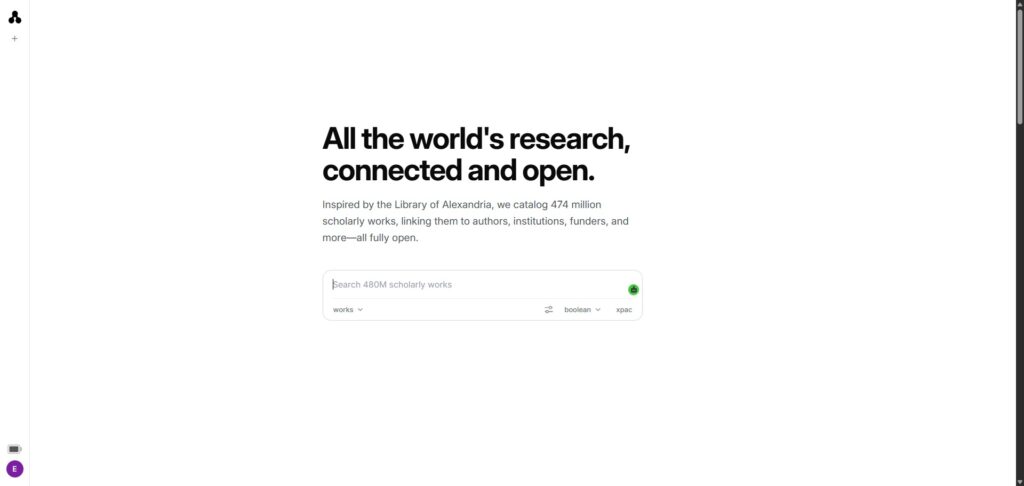
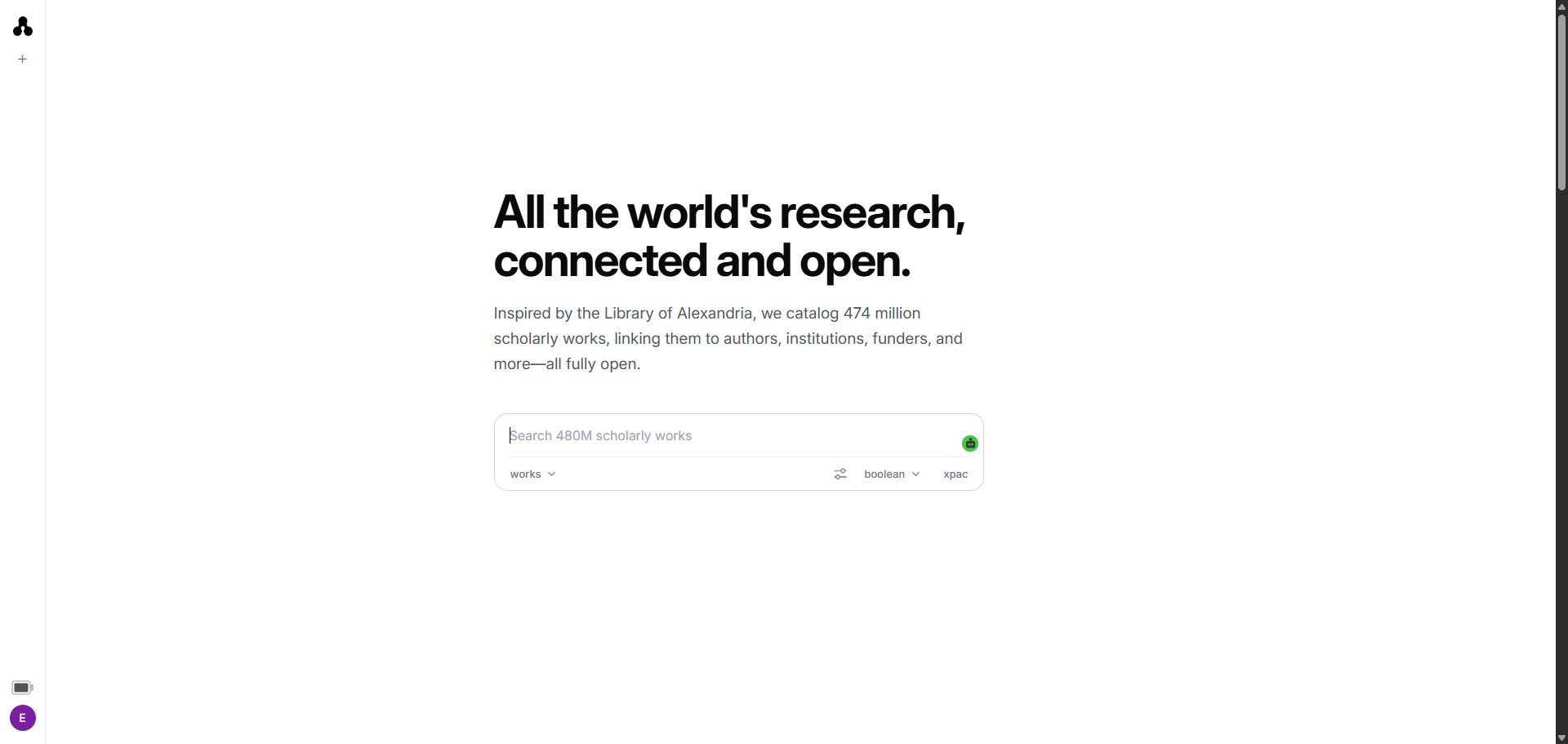
Go to the official OpenAlex website. Because the platform is built for open science, you can begin searching the database or browsing the documentation immediately without needing to create an account. - Use the Simple Search Interface
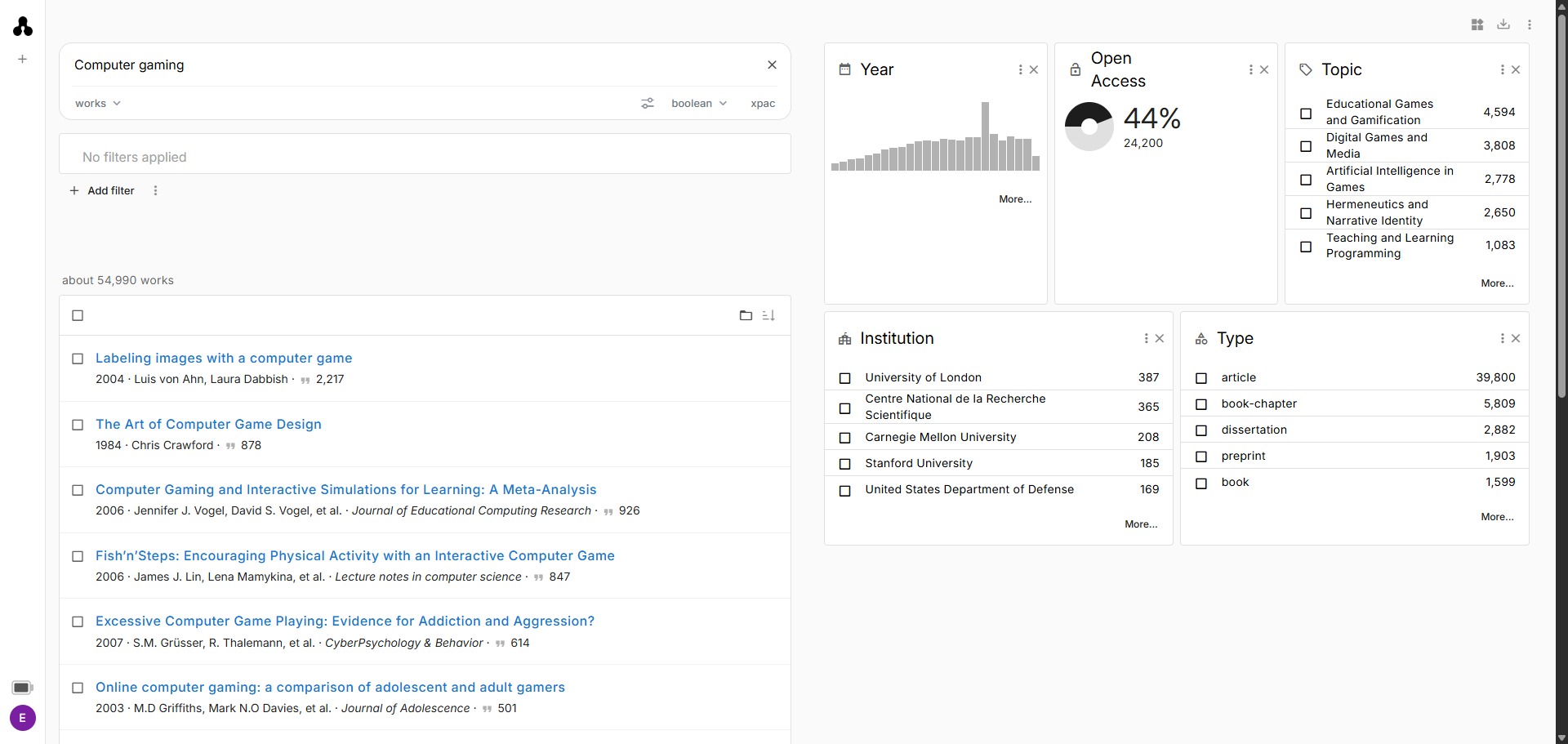
Navigate to the search bar on the homepage to find specific papers, authors, institutions, or topics. The search interface allows you to filter results by document type, publication year, and open-access status without any complex settings. - Explore Interconnected Entity Pages
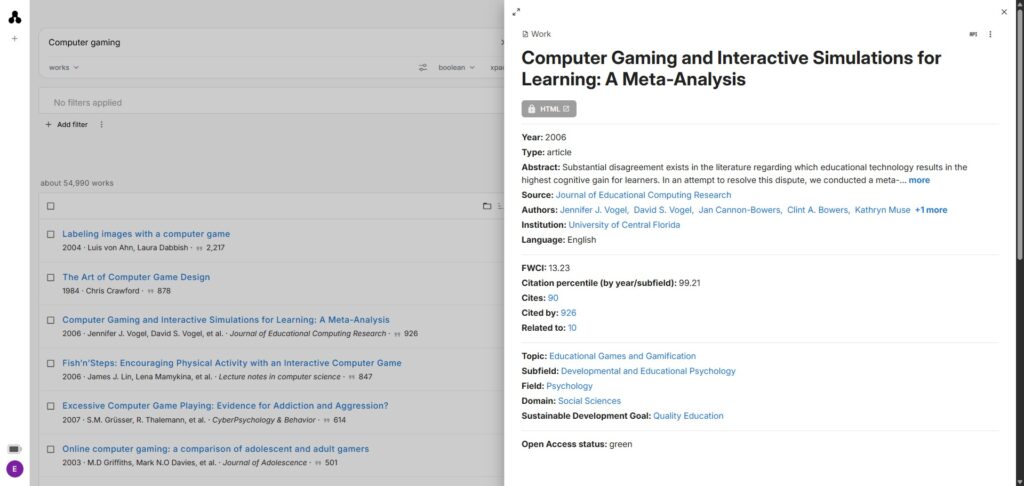
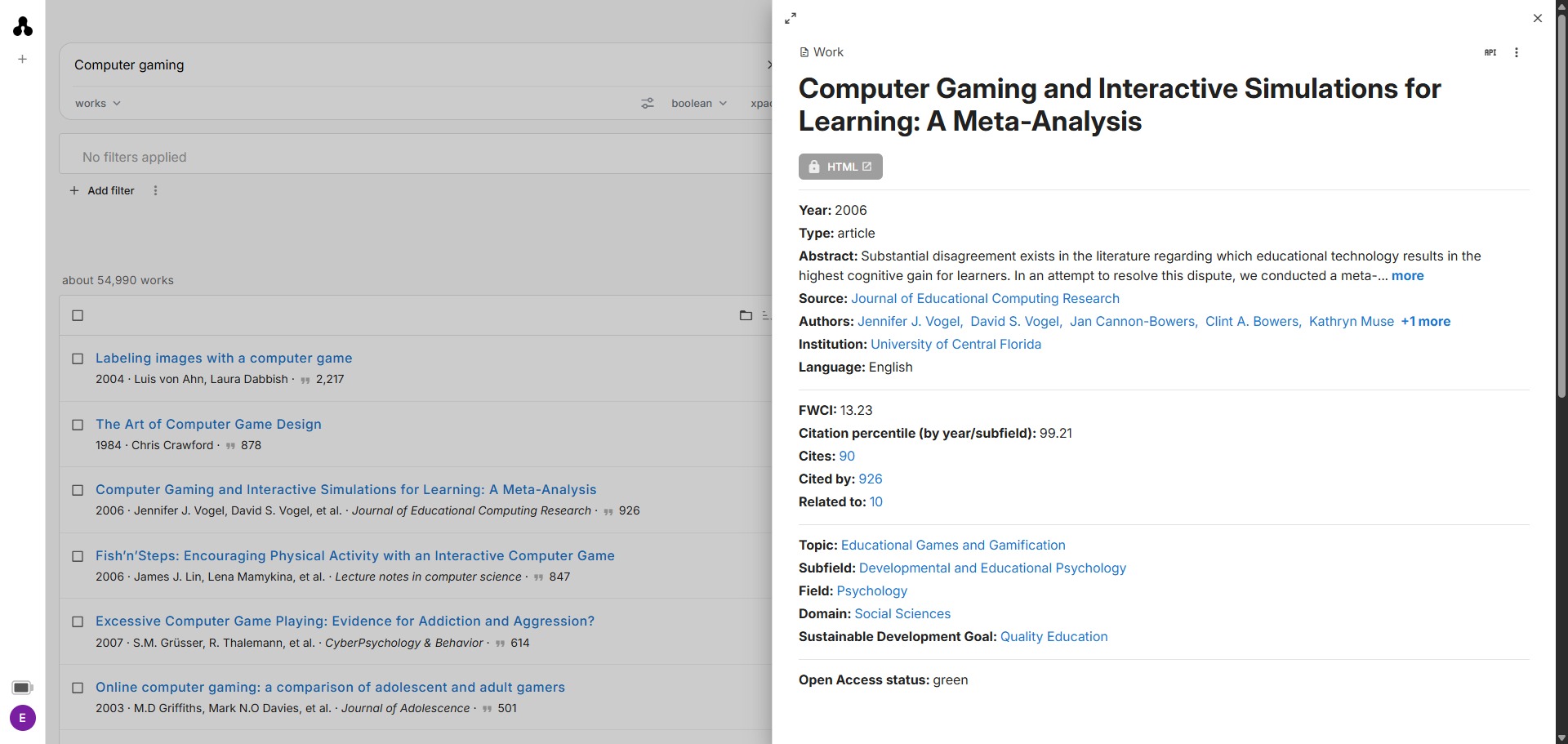
Click on any paper, author, or institutional result to open its dedicated entity page. This provides a comprehensive overview of the item, including its citation counts, research subfields, and direct links to affiliated research outputs. - Query Data via the API
If you are a developer or researcher building a custom tool, head to the documentation page to explore the RESTful API. Use the provided query builders to filter, sort, and gather metadata records programmatically for your own applications. - Register for an API Key
While you can query the API anonymously, register for a free account on the documentation platform to obtain an API key. Including this key in your requests places you in the “polite pool,” which guarantees consistent daily request rates and faster processing speeds. - Download Full Dataset Snapshots
Visit the downloads section if you need to run large-scale text mining or offline bibliometric analyses. You can grab the entire multi-terabyte database snapshot under a CC0 public domain license to host and query your own local instance.
Frequently Asked Questions
What is the connection between OpenAlex and Microsoft Academic Graph?
When Microsoft announced it was retiring its Academic Graph service at the end of 2021, the non-profit OurResearch stepped in to create OpenAlex. It used the final database dump from Microsoft as its starting foundation and has continued expanding the record set daily.
How do I get an API key for OpenAlex?
You can secure a free API key by registering an account on their main documentation platform. This key places you in the system’s “polite pool,” offering faster processing times and consistent daily request rates for your research tools.
Can I use OpenAlex data for commercial data analytics?
Yes. Because the full dataset snapshot is published under a CC0 public domain dedication, you can copy, alter, distribute, or perform commercial analysis on the data without asking for extra licenses or permissions.
How often does OpenAlex update its indexed research collection?
The core database index refreshes daily by harvesting new records from publishers, preprint servers, Crossref, and institutional libraries. Free public snapshot dumps are bundled together and made available for bulk download once a month.
Does OpenAlex include research coverage for datasets and grants?
Yes. Beyond standard journal articles and conference papers, the platform indexes over 11 million research grants alongside extensive collections of published datasets, mapping them straight back to their originating institutions.