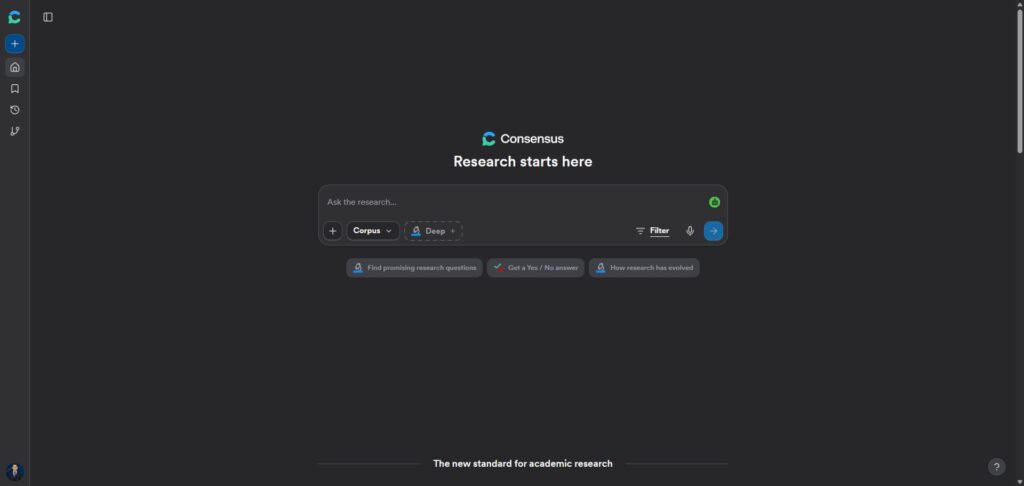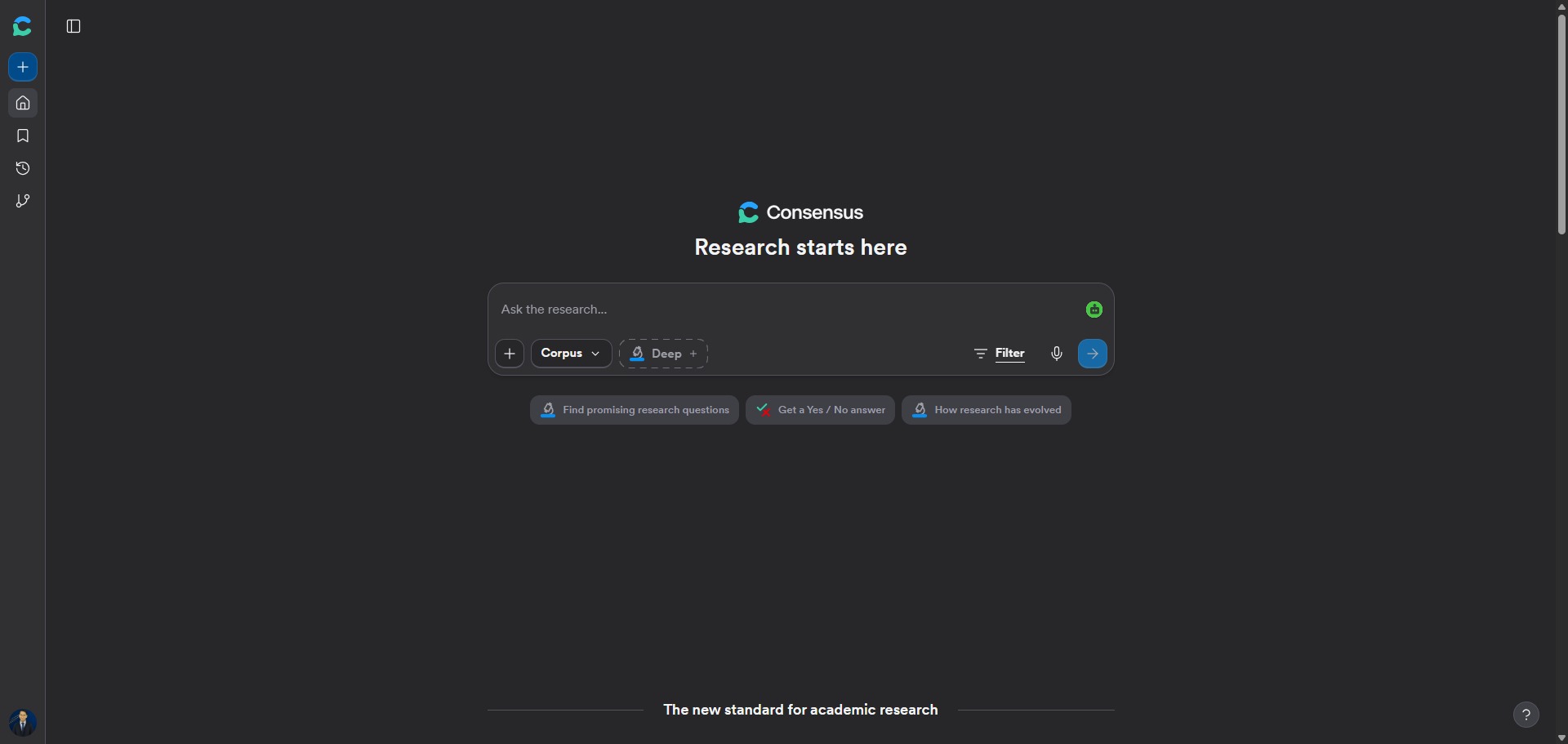

Consensus is a freemium, AI-powered academic search engine designed to extract and synthesise evidence-based answers directly from peer-reviewed scientific literature.
By indexing over 200 million academic papers, Consensus bypasses the traditional list of links and instead uses natural language processing models to read, analyze, and aggregate data. This lets you ask complex research questions and receive a synthesized summary of what the scientific community actually concludes.
Highly Recommended
What can you use Consensus for?
You can use it to instantly pull consensus data, extract core data points, and build out automated literature reports. When you input a direct yes-or-no question, the platform reads the top relevant abstracts and categorizes their findings to give you a clear look at where the scientific evidence stands.
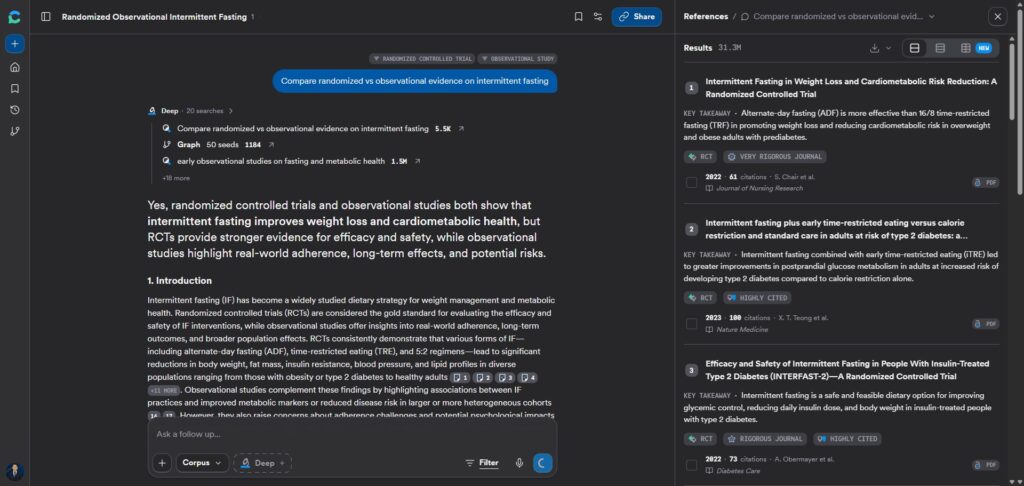
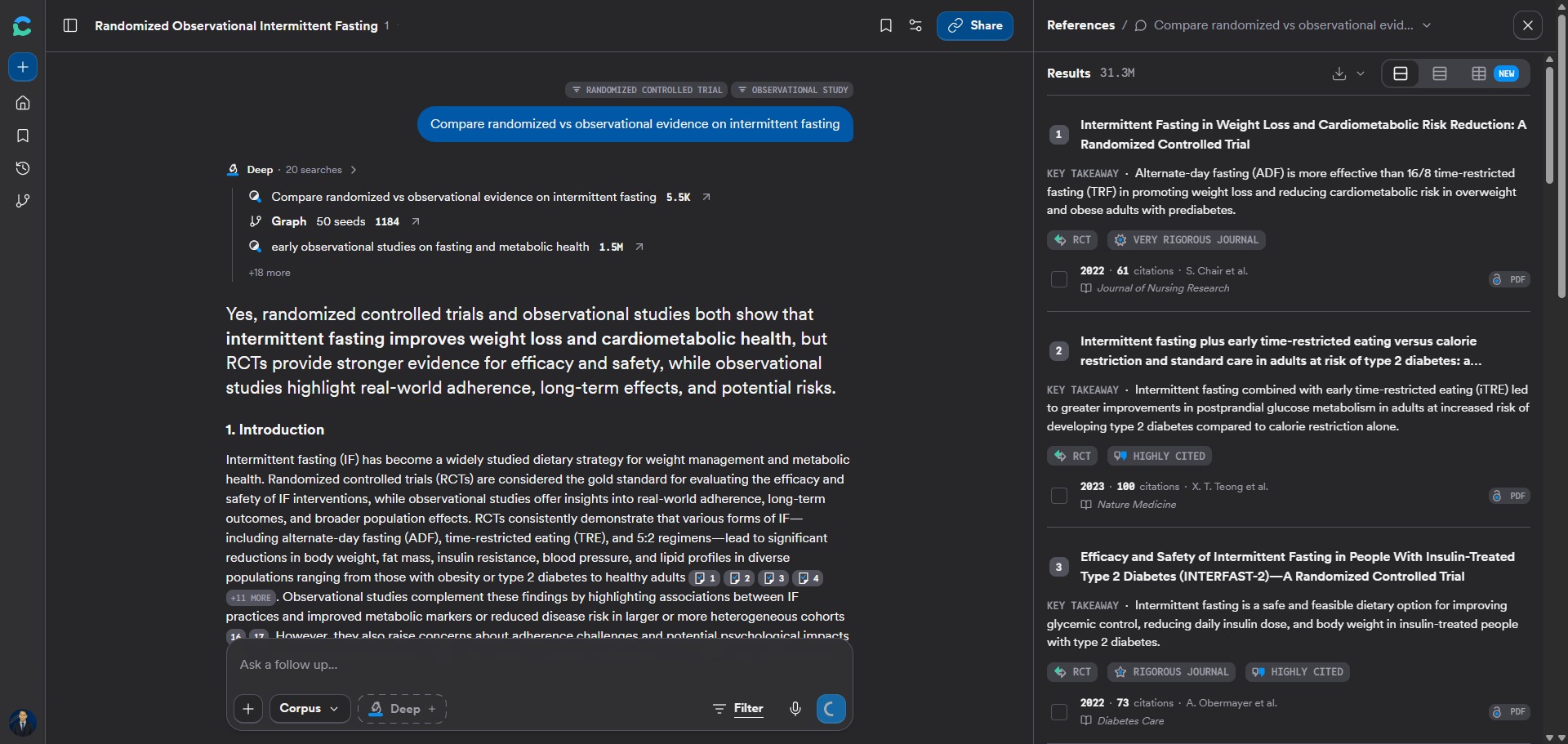
It also functions as an automated review assistant. By initiating a specialized deep search, it maps out conflicting arguments, builds out a step-by-step search methodology, and reviews the entire citation graph on your behalf to turn days of manual sourcing into minutes.
Who is Consensus best for?
It is ideal for university students, clinicians, and academic authors who need to ground their arguments in heavily cited, peer-reviewed data without spending hours parsing through individual papers.
It serves as a critical asset for researchers drafting systemic reviews or policy proposals that require immediate, empirical proof of scientific consensus.
Is Consensus genuinely free?
No. Consensus operates on a strict freemium model. While you can perform unlimited basic paper searches, key analytical tools such as advanced filters, Study Snapshots, and automated citation exports are heavily limited on the free account.
To access unlimited GPT-4 powered synthesis data, Copilot narrative breakdowns, and extensive deep searches, users must upgrade to a monthly or annual paid subscription tier.
Is Consensus Premium Worth It?
Yes, but primarily if you are performing rigorous literature reviews, systemic analyses, or high-volume academic research. While the free tier allows for unlimited basic searches, it significantly limits your access to the platform’s core analytical power. Upgrading is highly recommended for university postgraduates, clinical researchers, and thesis writers who rely on rapid data synthesis to meet strict deadlines.
When you should upgrade:
- You require deep narrative synthesis: The free tier limits your Copilot usage. Premium plans unlock extensive GPT-4 powered narrative breakdowns, which draft structured, multi-source summaries and literature reviews for you in seconds.
- You need deep research capabilities: Upgrading unlocks the Deep Search utility, an advanced research mode that automates the literature review process by tracing citation graphs and reconciling conflicting data across hundreds of papers.
- You export bibliographic data: Paid tiers enable seamless export pipelines, allowing you to move research metadata directly into reference managers like Zotero, Mendeley, and EndNote without manual re-entry.
If you only need a quick, evidence-based answer to a specific question or a brief overview of scientific opinion, the free tier is perfectly capable. However, for executing formal academic writing tasks or managing the heavy lifting of a systematic review, the premium subscription is an essential time-saving investment.
Should I use Consensus as an academic search engine?
Yes. It is an excellent, comprehensive tool for discovering scholarly literature, tracing citation networks, and finding accessible versions of research documents across almost every academic discipline.
Because it covers multiple areas of study in one central place, it makes the initial discovery process fast and straightforward. It serves as an essential starting point for any literary search before diving into niche database systems.
Key Features
- The Consensus Meter
Scans the top 20 most relevant papers and displays a visual percentage breakdown of how many studies support a “Yes”, “No”, or “Possibly” stance. - Copilot Narrative Synthesis
Utilizes advanced language models like GPT-4 to write an aggregated, structured summary of findings across multiple studies with in-line source attribution. - Automated Study Snapshots
Instantly extracts the exact population, sample size, methodology type, and specific outcome metrics from a paper without requiring you to open the full text. - Rigorous Quality Indicators
Automatically tags papers with essential verification badges like “RCT”, “Systematic Review”, “Highly Cited”, or “Top Journal” to help you prioritize reliable sources. - Natural Language Advanced Filtering
Allows you to apply intricate search criteria using plain text queries, such as filtering for human-only trials or isolating studies published before specific years.
Best for
- Quantifying scientific agreement
- Evidence-based answers
- Rapid data extraction
- Clinical and medical research queries
- Drafting systemic literature reviews
Pros and Cons
Here are the main advantages and limitations of using Consensus for academic research.
Pros
- ✓Consensus Meter provides an instant, data-driven look at scientific debate.
- ✓Every generated summary line is directly linked to a real, verifiable source.
- ✓Quality tags let you separate lightweight observations from rigorous randomized controlled trials at a glance.
Cons
- ✗The free tier heavily restricts the advanced AI capabilities and deep search features.
- ✗Requires precise, question-based prompts to trigger the consensus calculations effectively.
- ✗Can occasionally miss complex context, leading to a paper being misclassified in the meter.
How to Use Consensus
Follow this quick guide to run your evidence-based searches and synthesize findings from scientific literature.
- Visit the Website and Sign Up
Go to the official Consensus website. Create a free account profile to manage your search history and access your project dashboard, which helps you track and organize your research queries over time. - Construct a Direct Research Question
Enter a clear, objective question into the search bar. Consensus performs best when you ask about relationships, causes, or effects, such as “What is the effect of sleep deprivation on cognitive function?” rather than using broad keyword fragments. - Analyze the Consensus Meter
Examine the visual meter result displayed at the top of your search results. It provides an immediate, data-driven breakdown of the scientific community’s stance—categorized as “Yes,” “No,” or “Possibly”—based on the top 20 relevant studies. - Utilize Copilot for Narrative Summaries
Toggle the Copilot feature to generate a structured narrative report. The AI will synthesize findings from the top results into a cohesive summary, providing clear, in-line citations for every factual assertion made. - Extract Study Snapshots
Click on individual paper titles to view Study Snapshots. This feature instantly highlights critical metadata, including sample sizes, methodology types, and specific outcome metrics, so you do not have to parse the full-text PDF to understand the study design. - Export References to Your Manager
Once you identify high-quality sources, use the citation utility to export your metadata. Paid users can send these records directly into reference managers like Zotero or EndNote to build their bibliographies automatically.
Frequently Asked Questions
How does Consensus differ from standard AI tools like ChatGPT?
While ChatGPT generates answers based on internal memory patterns and can hallucinate fake information, Consensus strictly pulls information from a database of over 200 million peer-reviewed documents, ensuring every answer is factual and cited.
What kind of questions work best in the Consensus search bar?
Consensus performs best when given direct, objective questions about relationships or effects, such as “Does zinc shorten the duration of a cold?” or “What is the impact of remote learning on student socialization?”
Can I export bibliography data from Consensus?
Yes. Every paper result and synthesis profile includes a reference utility. Paid tier users can export metadata smoothly into standard academic formats, including BibTeX, EndNote, Zotero, and Mendeley.
What is the Deep Search function in Consensus?
Deep Search is an advanced research utility that runs an automated, multi-step literature review process. It expands your keywords, traces citation graphs, searches out conflicting data points, and builds a comprehensive narrative report.
Does Consensus offer a specialized layout for medical research?
Yes. The platform includes a specialized Medical Mode that isolates search data to roughly 50,000 clinical guidelines and over 8 million articles sourced strictly from the top 1,000 medical journals globally.