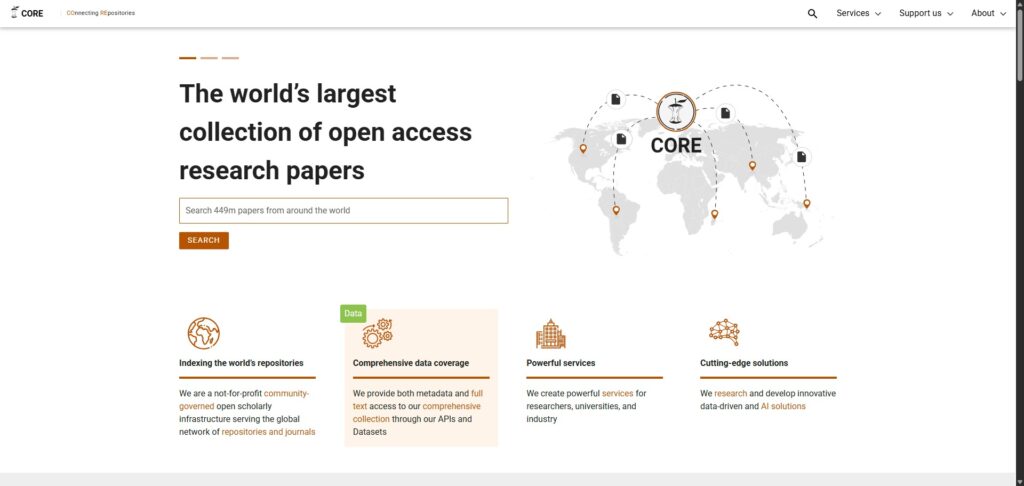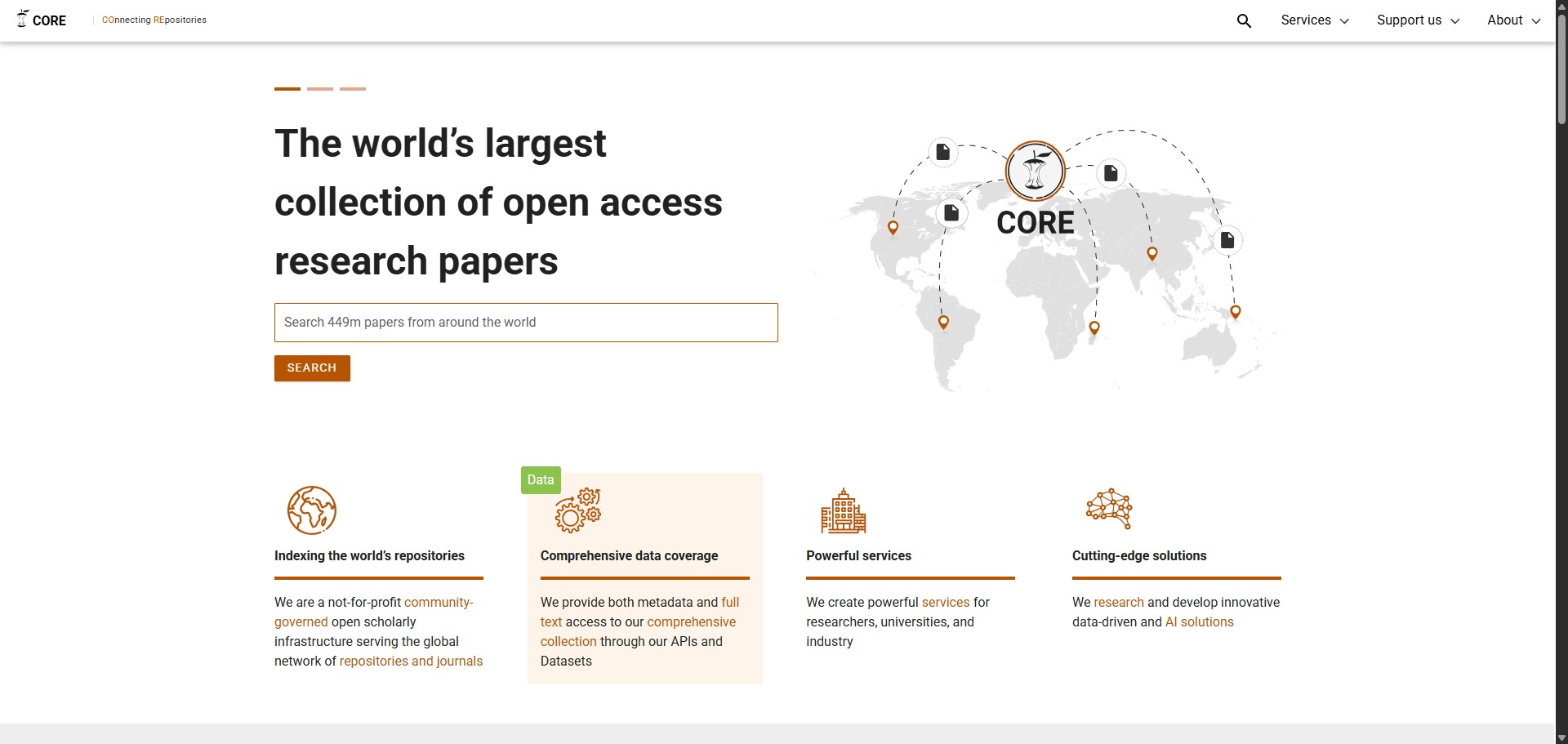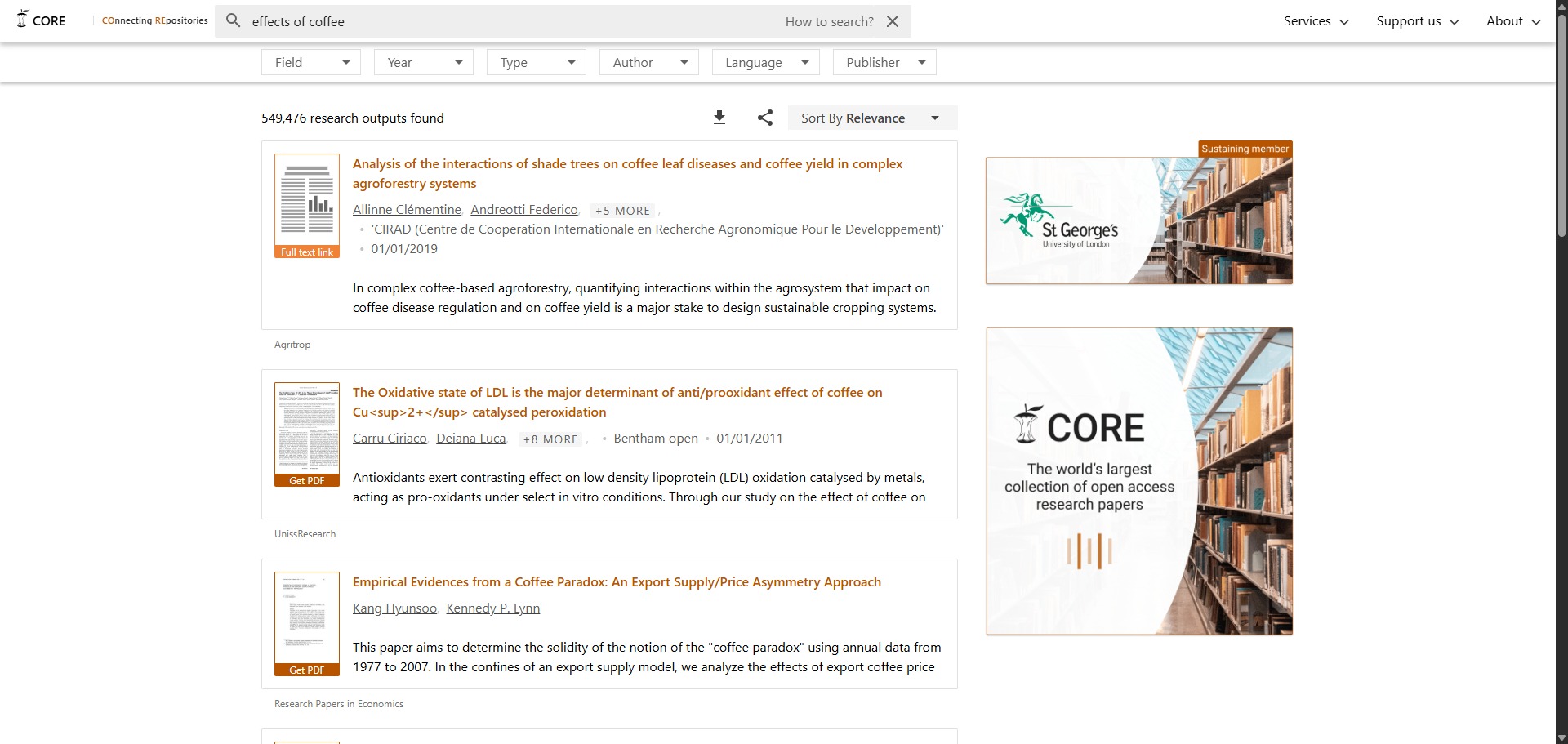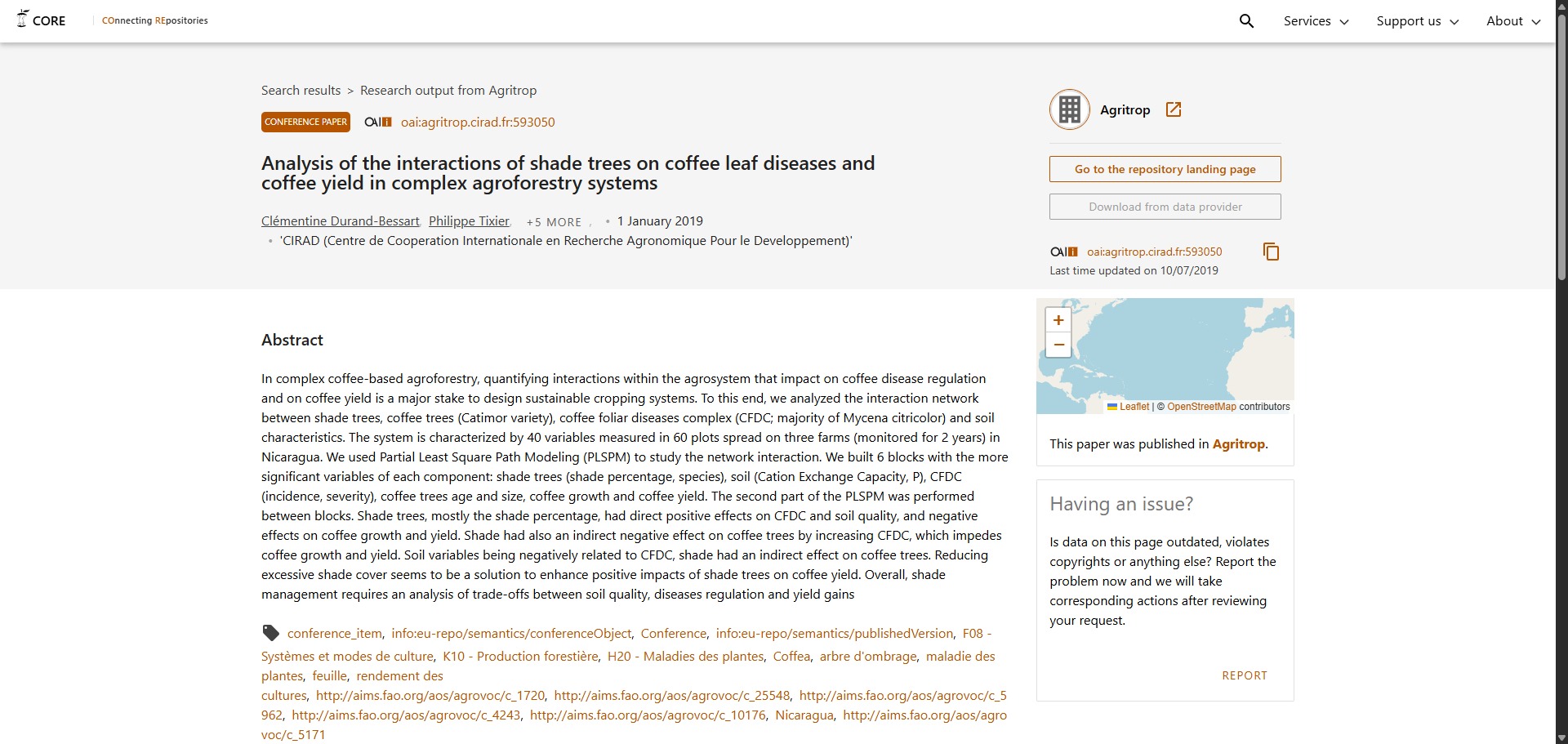

CORE (COnnecting REsearch) is a free, not-for-profit academic search engine designed to aggregate and deliver open-access scientific literature from across the globe.
Managed by The Open University and Jisc, CORE serves as a massive digital gateway, indexing over 400 million scholarly records. It collects metadata and full-text documents from thousands of institutional repositories, subject archives, and open journals to make research universally accessible without paywalls.
Highly Recommended
What can you use CORE for?
You can use it to search, discover, and download millions of verified open-access research papers, dissertations, and conference proceedings. Instead of routing you to paid publisher systems, the platform directly presents the downloadable, open-access PDF version of the text whenever it is available.
It also functions as a powerful text-mining engine. Advanced students, developers, and institutions utilize its framework to analyze bulk datasets, map global research trends, and run text-matching software across a unified digital library database.
Who is CORE best for?
It is ideal for independent researchers, journalists, and students who lack institutional access to expensive academic subscription services but still require validated scientific documentation.
It is also a vital tool for repository managers and university library teams aiming to monitor open-access policy compliance and increase the visibility of their institution’s own output.
Is CORE genuinely free?
Yes. CORE is completely free to access, search, and download articles for public users and researchers. There are no registration fees, personal subscription models, or hidden download restrictions built into the search platform.
The platform operates as a community-governed framework supported by Jisc, meaning it relies on voluntary institutional memberships rather than charging individual users for document access or basic search analytics.
Should I use CORE as an academic search engine?
Yes. It is an excellent, comprehensive tool for discovering scholarly literature, tracing citation networks, and finding accessible versions of research documents across almost every academic discipline.
Because it covers multiple areas of study in one central place, it makes the initial discovery process fast and straightforward. It serves as an essential starting point for any literary search before diving into niche database systems.
Key Features
- Unified global repository aggregation
Harvests metadata and full texts from thousands of institutional data systems across over 100 countries. - CORE Discovery extension
A specialized browser tool that automatically detects when you are viewing a paywalled paper elsewhere and redirects you to a free, legal version inside its network. - Smart content recommender
Utilizes deep algorithmic full-text analysis to suggest highly relevant semantic matches for whatever document you are currently viewing. - Faceted advanced search dashboard
Enables swift filtering across publishers, fields of study, language patterns, specific years, and hosting data locations. - Free Open API structure
Supplies programmable machine access to text blocks and citation frameworks for developer prototyping and academic metadata analysis.
Best for
- Sourcing free PDF downloads
- Bypassing journal paywalls legally
- Text and data mining projects
- Discovering grey literature and theses
- Independent scholarly research
Pros and Cons
Here are the main advantages and limitations of using CORE for academic research.
Pros
- ✓Provides direct access to millions of free, legal, full-text PDFs in one click.
- ✓The search interface is entirely ad-free and contains no commercial subscription popups.
- ✓Excellent coverage of institutional pre-prints, local university archives, and niche dissertations.
Cons
- ✗Excludes proprietary, closed-access journals that prohibit repository archiving.
- ✗Metadata consistency can vary depending on how cleanly the source university organized their archive.
- ✗Interface is highly functional and lacks modern AI-narrative summary tools found on newer systems.
How to Use CORE
Follow this quick guide to run your literature searches and access millions of free, full-text research papers.
-
Visit the Website
Go to the official CORE website. Because the platform is built for public-access research, you can begin searching the database immediately without needing to create an account or sign in. -
Perform Your Keyword Search
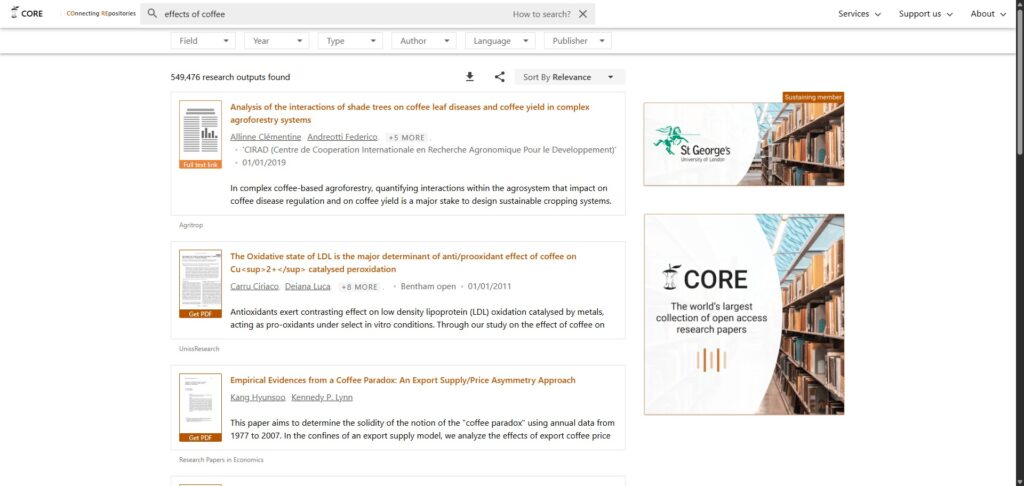
Type your research topic, author name, or paper title into the main search box. The engine scans its index of over 400 million records to find matching studies held within institutional repositories. -
Filter and Refine Your Results
Review the initial list of papers on the results page. Use the sidebar facets to narrow your selection by specific date ranges, language patterns, publishers, or repositories to target the most relevant literature. -
Download Full-Text PDFs
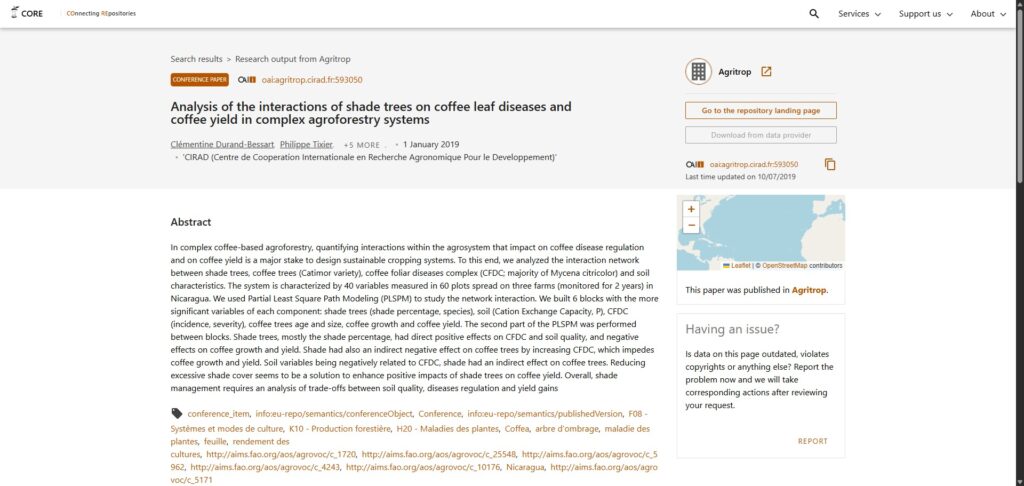
Click on any result title to expand its detail pane. Locate the “Download” or “Get Full Text” button to grab the open-access PDF file directly from the CORE cache or the linked institutional archive. -
Install the CORE Discovery Extension
If you frequently browse through paid journals, install the CORE Discovery browser tool. It automatically detects when you are visiting a paywalled paper and instantly redirects you to a free, legal open-access copy within the CORE network. -
Utilize the Recommendation Engine
When reading a paper on the site, look at the sidebar for context-aware suggestions. The system uses deep algorithmic analysis to offer matching papers from other repositories that align with your current research focus.
Frequently Asked Questions
What is the difference between CORE and Google Scholar?
Google Scholar indexes both open-access and proprietary, paywalled commercial documents indiscriminately. CORE focuses exclusively on open-access content, meaning every search result on the network is guaranteed to be completely free and legally downloadable in full.
Can I use CORE data for commercial applications?
Yes. CORE permits commercial use of its API data structures and text corpuses, though companies may need to secure a registered license tier depending on the volume of daily data processing requests required.
How does the CORE Content Recommender function?
The recommender is an integrated plugin used by major networks like arXiv. It reads the specific text structure of the paper you are exploring and immediately maps out matching concepts across other global institutional repositories to offer contextual reading suggestions.
Does CORE host the research papers directly on its own servers?
CORE caches millions of text documents directly within its own database to ensure long-term preservation and processing access. If a hosted document is unavailable, the system instantly routes you to the original institutional archive location.
What is an OAI identifier on the CORE search platform?
An Open Archives Initiative identifier is a unique, persistent digital label minted by repositories. CORE utilizes these cost-free identifiers to resolve metadata records, mapping publications back to their source homepages instead of relying strictly on publisher DOIs.